Cable Sophie, Baltazar Maria Teresa, Bunglawala Fazila, Carmichael Paul L, Contreas Leonardo, Dent Matthew Philip, Houghton Jade, Kukic Predrag, Malcomber Sophie, Nicol Beate, Przybylak Katarzyna R, Punt Ans, Reynolds Georgia, Reynolds Joe, Scott Sharon, Tang Dawei, Middleton Alistair M
Safety and Environmental Assurance Centre (SEAC), Unilever, Colworth Science Park, Sharnbrook MK44 1lQ, United Kingdom.
Toxicol Sci. 2025 Mar 1;204(1):79-95. doi: 10.1093/toxsci/kfae159.
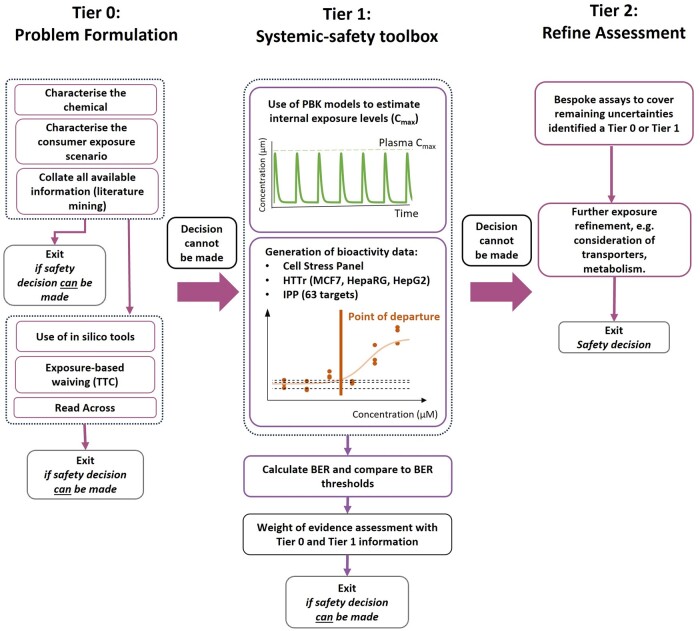
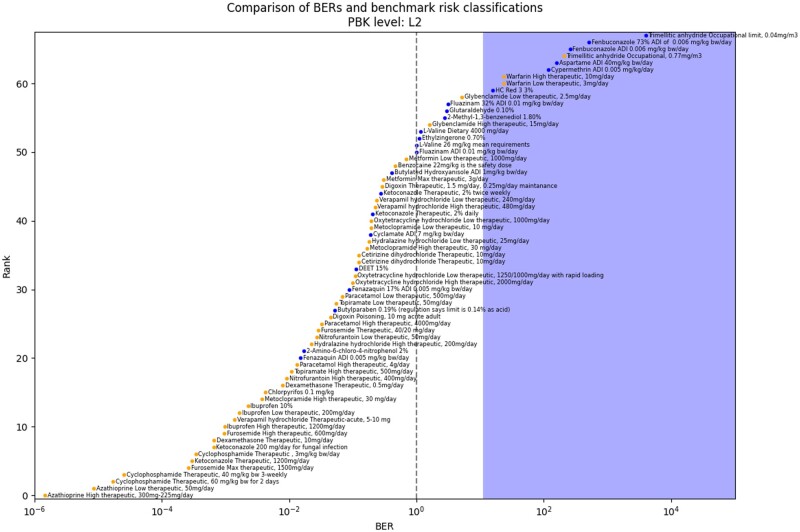
For many years, a method that allowed systemic toxicity safety assessments to be conducted without generating new animal test data, seemed out of reach. However, several different research groups and regulatory authorities are beginning to use a variety of in silico, in chemico, and in vitro techniques to inform safety decisions. To manage this transition to animal-free safety assessments responsibly, it is important to ensure that the level of protection offered by a safety assessment based on new approach methodologies (NAMs), is at least as high as that provided by a safety assessment based on traditional animal studies. To this end, we have developed an evaluation strategy to assess both the level of protection and the utility offered by a NAM-based systemic safety "toolbox." The toolbox comprises physiologically based kinetic models to predict internal exposures, and bioactivity NAMs designed to give broad coverage across many different toxicity modes of action. The output of the toolbox is the calculation of a bioactivity:exposure ratio (analogous to a margin of internal exposure), which can be used to inform decision-making. In this work, we have expanded upon an initial pilot study of 10 chemicals with an additional 38 chemicals and 70 consumer exposure scenarios. We found that, for the majority of these (>90%), the NAM-based workflow is protective of human health, enabling us to make animal-free safety decisions for systemic toxicity and preventing unnecessary animal use. We have also identified critical areas for improvement to further increase our confidence in the robustness of the approach.
多年来,一种无需生成新的动物试验数据就能进行全身毒性安全性评估的方法似乎遥不可及。然而,几个不同的研究小组和监管机构开始使用各种计算机模拟、化学分析和体外技术来为安全决策提供信息。为了负责任地管理向无动物安全性评估的转变,确保基于新方法学(NAMs)的安全性评估所提供的保护水平至少与基于传统动物研究的安全性评估所提供的保护水平一样高是很重要的。为此,我们制定了一种评估策略,以评估基于NAM的全身安全性“工具箱”所提供的保护水平和实用性。该工具箱包括用于预测体内暴露的基于生理学的动力学模型,以及旨在广泛涵盖许多不同毒性作用模式的生物活性NAMs。该工具箱的输出是生物活性与暴露比值的计算(类似于体内暴露余量),可用于为决策提供信息。在这项工作中,我们在对10种化学品的初步试点研究基础上,增加了38种化学品和70种消费者暴露场景。我们发现,对于这些化学品中的大多数(>90%),基于NAM的工作流程对人类健康具有保护作用,使我们能够就全身毒性做出无动物的安全决策,并避免不必要的动物使用。我们还确定了关键的改进领域,以进一步增强我们对该方法稳健性的信心。