Jagielska Natalia, Kaye Thomas G, Habib Michael B, Hirasawa Tatsuya, Pittman Michael
School of GeoSciences, University of Edinburgh, Edinburgh, United Kingdom.
Foundation for Scientific Advancement, Sierra Vista, United States.
Elife. 2024 Dec 18;13:RP100673. doi: 10.7554/eLife.100673.
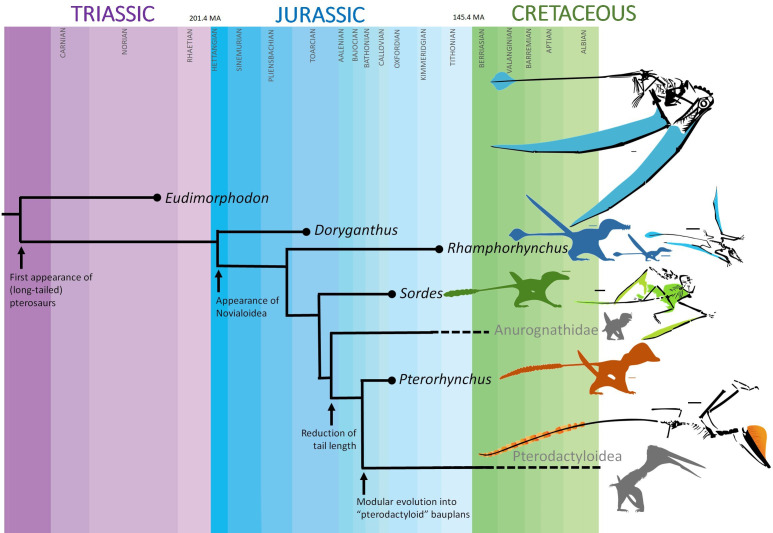
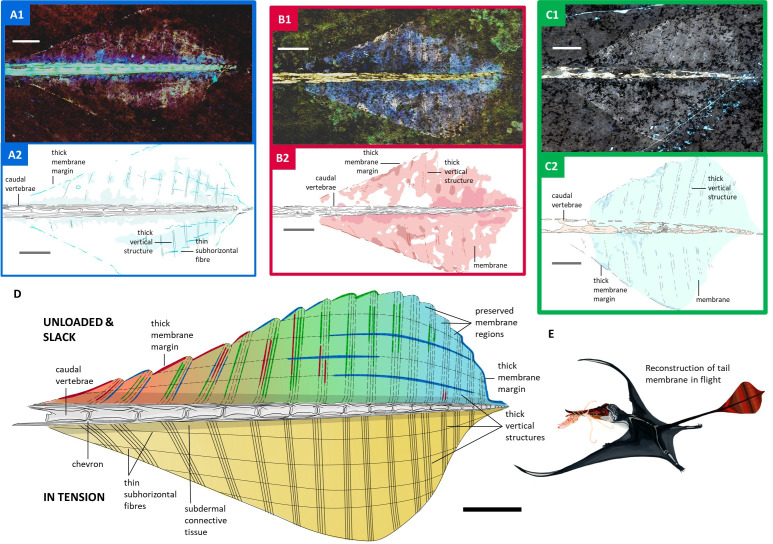
Pterosaurs were the first vertebrates to achieve powered flight. Early pterosaurs had long stiff tails with a mobile base that could shift their center of mass, potentially benefiting flight control. These tails ended in a tall, thin soft tissue vane that would compromise aerodynamic control and efficiency if it fluttered excessively during flight. Maintaining stiffness in the vane would have been crucial in early pterosaur flight, but how this was achieved has been unclear, especially since vanes were lost in later pterosaurs and are absent in birds and bats. Here, we use Laser-Stimulated Fluorescence imaging to reveal a cross-linking lattice within the tail vanes of early pterosaurs. The lattice supported a sophisticated dynamic tensioning system used to maintain vane stiffness, allowing the whole tail to augment flight control and the vane to function as a display structure.
翼龙是首批实现动力飞行的脊椎动物。早期翼龙有长长的硬尾巴,其基部可活动,能改变它们的重心,这可能有利于飞行控制。这些尾巴末端是一个又高又薄的软组织叶片,如果在飞行中过度摆动,会影响空气动力学控制和效率。在早期翼龙飞行中,保持叶片的刚度至关重要,但如何做到这一点尚不清楚,尤其是因为叶片在后来的翼龙中消失了,鸟类和蝙蝠也没有。在这里,我们使用激光激发荧光成像来揭示早期翼龙尾巴叶片内的交联晶格。这种晶格支撑着一个复杂的动态张紧系统,用于保持叶片的刚度,使整个尾巴增强飞行控制能力,并使叶片起到展示结构的作用。