Umeda Tatsuya, Yokoyama Osamu, Suzuki Michiaki, Kaneshige Miki, Isa Tadashi, Nishimura Yukio
Department of Developmental Physiology, National Institute for Physiological Sciences, National Institute of Natural Sciences, Okazaki, Aichi 4448585, Japan.
Department of Integrated Neuroanatomy and Neuroimaging, Graduate School of Medicine, Kyoto University, Kyoto 6068501, Japan.
Sci Adv. 2024 Dec 20;10(51):eadq4194. doi: 10.1126/sciadv.adq4194. Epub 2024 Dec 18.
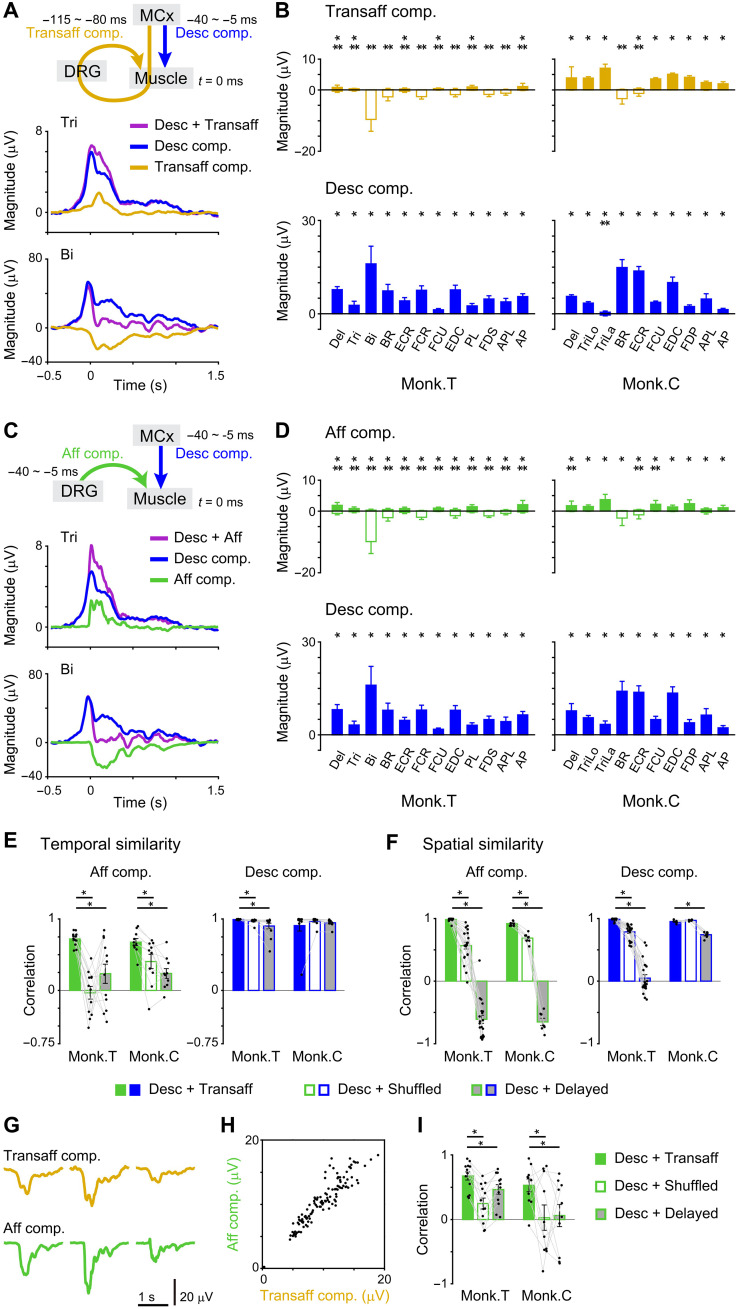
Mammals can execute intended limb movements despite the fact that spinal reflexes involuntarily modulate muscle activity. To generate appropriate muscle activity, the cortical descending motor output must coordinate with spinal reflexes, yet the underlying neural mechanism remains unclear. We simultaneously recorded activities in motor-related cortical areas, afferent neurons, and forelimb muscles of monkeys performing reaching movements. Motor-related cortical areas, predominantly primary motor cortex (M1), encode subsequent afferent activities attributed to forelimb movement. M1 also encodes a subcomponent of muscle activity evoked by these afferent activities, corresponding to spinal reflexes. Furthermore, selective disruption of the afferent pathway specifically reduced this subcomponent of muscle activity, suggesting that M1 output drives muscle activity not only through direct descending pathways but also through the "transafferent" pathway composed of descending plus subsequent spinal reflex pathways. Thus, M1 provides optimal motor output based on an internal forward model that prospectively computes future spinal reflexes.
尽管脊髓反射会不由自主地调节肌肉活动,但哺乳动物仍能执行预期的肢体运动。为了产生适当的肌肉活动,皮层下行运动输出必须与脊髓反射相协调,但其潜在的神经机制仍不清楚。我们同时记录了猴子进行伸手动作时运动相关皮层区域、传入神经元和前肢肌肉的活动。运动相关皮层区域,主要是初级运动皮层(M1),编码归因于前肢运动的后续传入活动。M1还编码由这些传入活动诱发的肌肉活动的一个子成分,对应于脊髓反射。此外,传入通路的选择性破坏特异性地减少了肌肉活动的这个子成分,这表明M1输出不仅通过直接下行通路驱动肌肉活动,还通过由下行加随后的脊髓反射通路组成的“跨传入”通路驱动。因此,M1基于一个前瞻性计算未来脊髓反射的内部前向模型提供最佳运动输出。