Kim Yujin, Kim Dong-Hee
College of Nursing, Pusan National University, Mulgeum-Eup, Yangsan-Si, Gyeongsangnam-Do, Korea.
College of NursingᆞResearch Institute of Nursing Science, Pusan National University, 49 Busandaehak-Ro, Mulgeum-Eup, Yangsan-Si, 50612, Gyeongsangnam-Do, Korea.
BMC Nurs. 2024 Dec 18;23(1):917. doi: 10.1186/s12912-024-02538-z.
Integrating family members into the care of hospitalized end-of-life patients enhances patient-family-centered care and significantly influences the experiences of patients and their families. This study used the integrative review methodology to assess the scope and effectiveness of interventions designed to facilitate family involvement in end-of-life care. It identified gaps and consolidated existing knowledge to improve nursing practices.
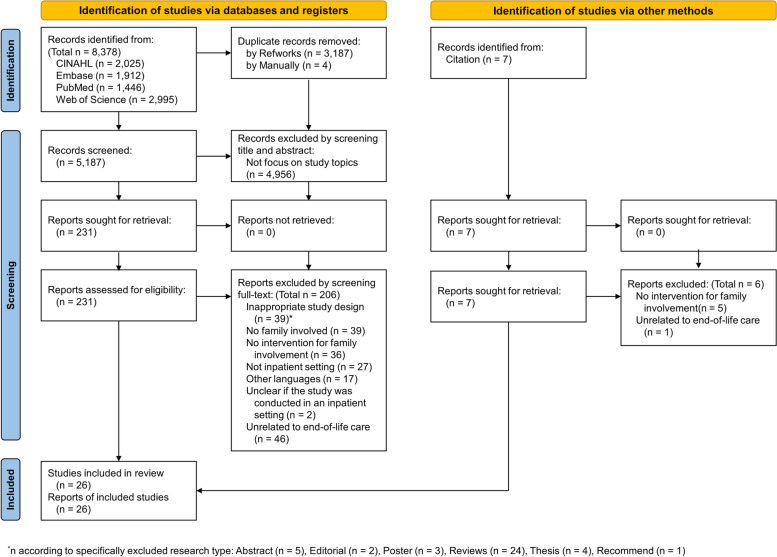
This integrative review encompasses both experimental and non-experimental studies. The process included problem identification, literature search, data evaluation, analysis, and integration. The literature search targeted studies describing interventions for family involvement in EOLC using databases such as PubMed, CINAHL, Embase, and Web of Science. Data evaluation was conducted by assessing the quality of the studies using the Mixed Methods Appraisal Tool. Data analysis and integration were conducted by synthesizing the results of the selected studies and identifying the elements of family involvement using the 'Components of Family Involvement' framework.
Of the 8,378 identified studies, 26 were eligible for inclusion. Interventions involving the families of patients with terminal illness varied, including programs to enhance communication among patients, families, and healthcare providers; family meetings; decision-making support; and digital visits and rounds. The findings show that these interventions improve patients' psychological and physical comfort, family satisfaction, and communication. However, some families reported increased distress. The most frequently addressed elements of family involvement were communication and receiving information, followed by decision-making and meeting care needs. Family presence and contribution to care were the least addressed elements in the interventions.
This integrative review highlights the effectiveness of interventions to increase family involvement in end-of-life care, demonstrating positive impacts on patient comfort, family satisfaction, and communication. Despite progress in incorporating families into communication and decision-making, further efforts are needed to ensure their presence and direct care involvement. Future research should focus on improving these interventions to enhance scalability and support comprehensive family involvement, including digital tools for participation.
让家庭成员参与住院临终患者的护理可加强以患者和家庭为中心的护理,并对患者及其家庭的体验产生重大影响。本研究采用综合评价方法,评估旨在促进家庭参与临终护理的干预措施的范围和效果。它找出了差距并整合了现有知识,以改进护理实践。
本综合评价涵盖实验性和非实验性研究。该过程包括问题识别、文献检索、数据评估、分析和整合。文献检索针对使用PubMed、CINAHL、Embase和Web of Science等数据库描述家庭参与临终护理干预措施的研究。通过使用混合方法评估工具评估研究质量来进行数据评估。通过综合所选研究的结果并使用“家庭参与要素”框架确定家庭参与的要素来进行数据分析和整合。
在识别出的8378项研究中,26项符合纳入条件。涉及晚期疾病患者家庭的干预措施各不相同,包括加强患者、家庭和医疗保健提供者之间沟通的项目;家庭会议;决策支持;以及数字探视和查房。研究结果表明,这些干预措施可改善患者的心理和身体舒适度、家庭满意度以及沟通。然而,一些家庭报告痛苦增加。家庭参与最常涉及的要素是沟通和接收信息,其次是决策和满足护理需求。家庭在场和对护理的贡献是干预措施中最少涉及的要素。
本综合评价突出了增加家庭参与临终护理干预措施的有效性,表明对患者舒适度、家庭满意度和沟通有积极影响。尽管在让家庭参与沟通和决策方面取得了进展,但仍需要进一步努力确保他们在场并直接参与护理。未来的研究应侧重于改进这些干预措施,以提高可扩展性并支持全面的家庭参与,包括用于参与的数字工具。