
政策改革对居家医院服务的影响:上海市的中断时间序列分析
Impact of policy reforms on hospital-at-home services: an interrupted time series analysis of Shanghai.
作者信息
Du Sixian, Luo Fei
机构信息
School of Medicine and Health Management, Tongji Medical College, Huazhong University of Science and Technology, Wuhan, Hubei, 430030, China.
Department of Scientific Research, Union Hospital, Tongji Medical College, Huazhong University of Science and Technology, Wuhan, Hubei, 43002, China.
出版信息
BMC Health Serv Res. 2024 Dec 18;24(1):1615. doi: 10.1186/s12913-024-12105-6.
BACKGROUND
The global rise in elderly populations and chronic disease patients has increased the demand for hospital-at-home (HaH) services, which could help reduce hospitalization costs.
OBJECTIVE
To assess the impact of two policies on the implementation of HaH services in Shanghai.
METHODS
A two-stage interrupted time series (ITS) analysis with a control group was conducted to examine changes in three areas-institutional capacity, home-based medical services, and HaH beds-using 11 indicators from 2007 to -2022 across all community health service centres and hospitals providing HaH services.
RESULTS
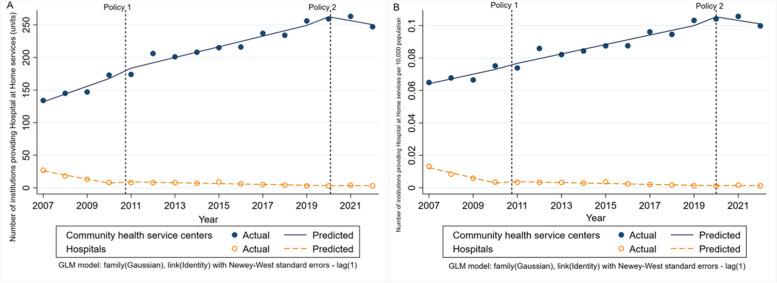
After the first policy was implemented, the number of institutions providing HaH services significantly increased + + =8.200, <0.001). HaH beds in hospitals increased after the first policy was implemented = 247.717 < 0.01) but decreased after the second policy was implemented ( + = -76.500, < 0.01). In community health service centres (stations), the number of active HaH beds per 10,000 population at year-end (beds/10,000 people) increased significantly after the first policy implementation ( + + = 0.406 < 0.001), with a significant increase in the slope difference compared with hospitals ( + =0.429 < 0.001).
CONCLUSION
These policies may increase the number of HaH institutions and beds but decrease home-based medical visits, likely due to the risks of home care and a shortage of health care personnel. Further policy support is needed to meet the growing demand for home-based services in China.
背景
全球老年人口和慢性病患者数量的增加,使得对居家医院(HaH)服务的需求上升,这有助于降低住院成本。
目的
评估两项政策对上海居家医院服务实施的影响。
方法
采用带有对照组的两阶段中断时间序列(ITS)分析,使用2007年至2022年期间所有提供居家医院服务的社区卫生服务中心和医院的11项指标,考察机构能力、居家医疗服务和居家医院床位三个领域的变化。
结果
第一项政策实施后,提供居家医院服务的机构数量显著增加(β = 8.200,P < 0.001)。第一项政策实施后,医院的居家医院床位增加(β = 247.717,P < 0.01),但第二项政策实施后减少(β + γ = -76.500,P < 0.01)。在社区卫生服务中心(站),年末每万人口活跃居家医院床位数(床/万人)在第一项政策实施后显著增加(β + β = 0.406,P < 0.001),与医院相比,斜率差异显著增加(β + γ = 0.429,P < 0.001)。
结论
这些政策可能会增加居家医院机构和床位的数量,但会减少居家医疗就诊次数,这可能是由于居家护理风险和医护人员短缺所致。需要进一步的政策支持,以满足中国对居家服务日益增长的需求。



 Zotero 插件