Genova Elena, Rispoli Paola, Fengming Yue, Kohei Johkura, Bramuzzo Matteo, Bulla Roberta, Lucafò Marianna, Ferraro Rosalba Monica, Decorti Giuliana, Stocco Gabriele
Institute for Maternal and Child Health - IRCCS Burlo Garofolo, Trieste, Italy.
Department of Medicine, Surgery and Health Sciences, University of Trieste, Trieste, Italy.
Stem Cell Res Ther. 2024 Dec 18;15(1):483. doi: 10.1186/s13287-024-04068-6.
Differentiation of patient-specific induced pluripotent stem cells (iPS) helps researchers to study the individual sensibility to drugs. However, differentiation protocols are time-consuming, and not all tissues have been studied. Few works are available regarding pancreatic exocrine differentiation of iPS cells, and little is known on culturing and cryopreserving these cells.
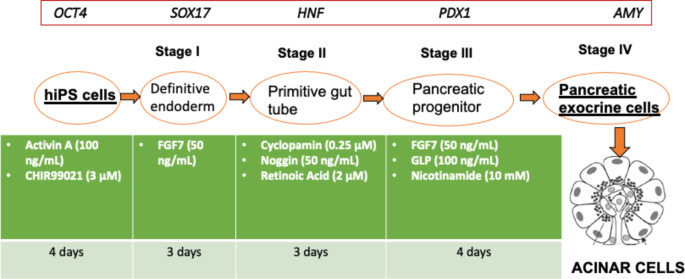
We differentiated the iPS cells of two pediatric Crohn's disease patients into pancreatic progenitors and exocrine cells, adapting and shortening a protocol for differentiating embryonic stem cells. We analyzed the expression of key genes and proteins of the differentiation process by qPCR and immunofluorescence, respectively. We explored the possibility of keeping differentiated cells in culture and freezing and thawing them to shorten the time needed for the differentiation. We analyzed the cell cycle of undifferentiated and differentiated cells by flow cytometry.
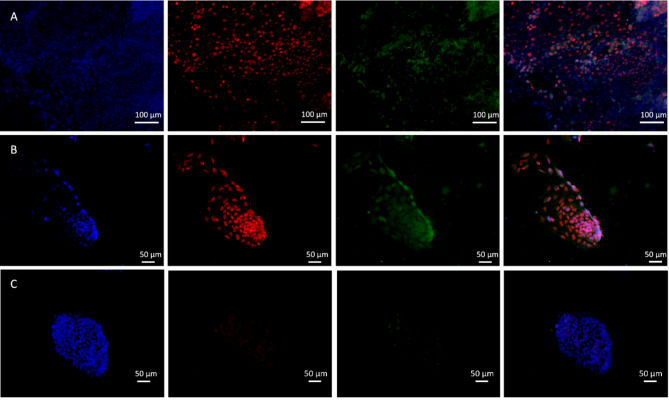
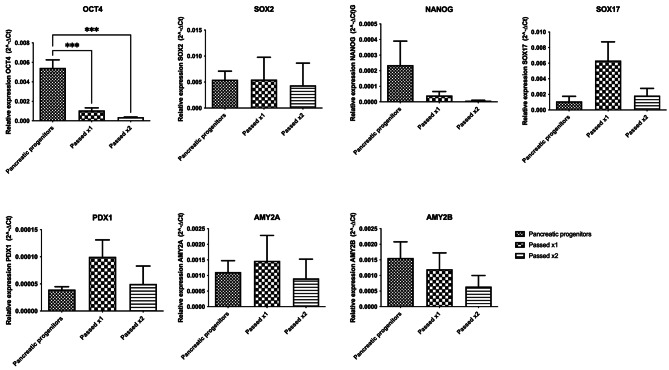
The analysis of mRNA levels of key pancreatic differentiation genes PDX1 and pancreatic amylase indicate that iPS cells were successfully differentiated into pancreatic exocrine cells with expression of PDX1 (one way ANOVA p < 0.0001), and the two isoforms of amylase (one way ANOVA p < 0.05) significantly higher in exocrine cells in comparison to iPS cells. Differentiation efficiency was also confirmed by immunofluorescence analysis of PDX1 and amylase. We confirmed the possibility of shortening the time necessary for obtaining pancreatic cells without losing differentiation efficiency. Pancreatic progenitors and exocrine cells were maintained in culture and cryopreserved. Interestingly, the stemness marker OCT4 resulted significantly lower after subculturing (OCT4 p < 0.001; one-way ANOVA) and after freezing and thawing procedures (p < 0.05, one-way ANOVA) suggesting a reduction of undifferentiated stem cells leading to a purer population of pancreatic progenitor cells. Also, the stemness marker NANOG resulted lower after passaging, corroborating this result.
In this work, we optimized the generation of patient-specific pancreatic differentiated cells and laid the foundation for creating a bank of patient-specific pancreatic lines exploitable for tailored pharmacological assays.
The study was approved by the Ethical Committee of the Institute of Maternal and Child Health IRCCS Burlo Garofolo, with approval number 1556 (internal ID RC 44/22).
患者特异性诱导多能干细胞(iPS)的分化有助于研究人员了解个体对药物的敏感性。然而,分化方案耗时较长,且并非所有组织都已得到研究。关于iPS细胞胰腺外分泌分化的研究较少,对这些细胞的培养和冷冻保存了解也不多。
我们将两名儿童克罗恩病患者的iPS细胞分化为胰腺祖细胞和外分泌细胞,对分化胚胎干细胞的方案进行了调整和缩短。我们分别通过定量聚合酶链反应(qPCR)和免疫荧光分析分化过程中关键基因和蛋白质的表达。我们探索了在培养中保存分化细胞以及对其进行冻融以缩短分化所需时间的可能性。我们通过流式细胞术分析未分化和分化细胞的细胞周期。
对关键胰腺分化基因PDX1和胰腺淀粉酶mRNA水平的分析表明,iPS细胞成功分化为胰腺外分泌细胞,外分泌细胞中PDX1的表达(单因素方差分析p < 0.0001)以及淀粉酶的两种同工型(单因素方差分析p < 0.05)均显著高于iPS细胞。PDX1和淀粉酶的免疫荧光分析也证实了分化效率。我们证实了在不损失分化效率的情况下缩短获得胰腺细胞所需时间的可能性。胰腺祖细胞和外分泌细胞得以在培养中维持并冻存。有趣的是,干性标志物OCT4在传代培养后(OCT4 p < 0.001;单因素方差分析)以及冻融处理后(p < 0.05,单因素方差分析)显著降低,这表明未分化干细胞减少,从而得到了更纯的胰腺祖细胞群体。同样,干性标志物NANOG在传代后也降低,证实了这一结果。
在本研究中,我们优化了患者特异性胰腺分化细胞的生成,为建立可用于定制药理分析的患者特异性胰腺细胞系库奠定了基础。
本研究已获得IRCCS Burlo Garofolo母婴健康研究所伦理委员会批准,批准号为1556(内部识别号RC 44/22)。