Akorli Esinam A, Andoh Nana Efua, Egyirifa Richardson K, Dorcoo Christopher, Otoo Sampson, Tetteh Seraphim N A, Pul Reuben Mwimson, Sackitey Derrick B, Oware Stephen K D, Dadzie Samuel K, Akorli Jewelna
Department of Parasitology, Noguchi Memorial Institute for Medical Research, University of Ghana, Legon, P.O. Box LG 581, Accra, Ghana.
Department of Pathology, University of Cambridge, 10 Tennis Ct Rd, Cambridge, CB2 1QP, UK.
Parasit Vectors. 2024 Dec 18;17(1):509. doi: 10.1186/s13071-024-06596-9.
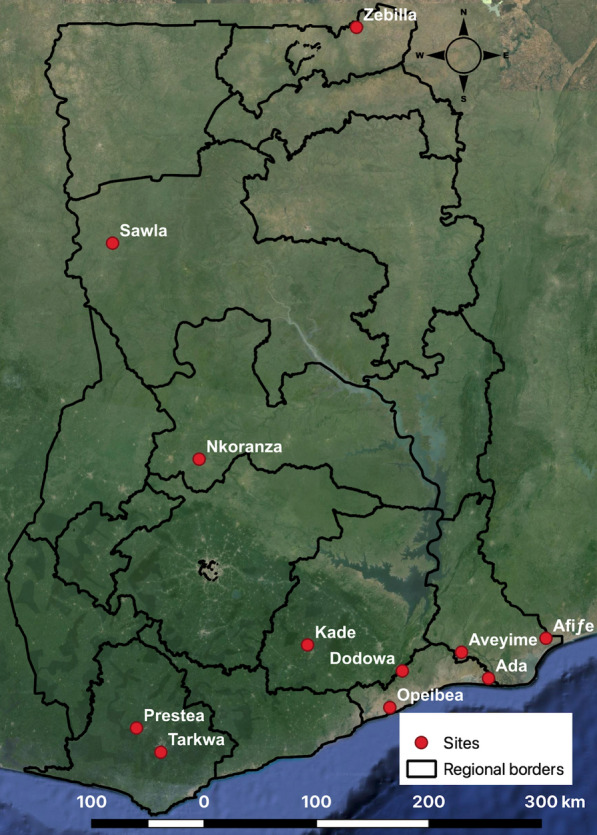
Microsporidia MB disrupts Plasmodium development in Anopheles mosquitoes, making it a possible biocontrol tool for malaria. As a tool for vector/disease control, its ecological distribution and the factors that determine their occurrence must be defined. We investigated the frequency of Microsporidia MB in Anopheles mosquitoes across selected sites in northern and southern Ghana, as well as the physicochemical parameters of mosquito breeding water that are associated with the occurrence of the fungus, by fitting regression models.
A non-column extraction method was used to extract DNA from the abdomens of 4255 adult Anopheles mosquitoes that emerged from larvae and pupae collected between August and October of 2021 and 2022. Detection of Microsporidia MB was achieved using quantitative PCR (qPCR), while mosquito species were molecularly identified using short interspersed nuclear elements (SINE), restriction fragment length polymorphism (RFLP) methods, and the ANOSPP algorithm.
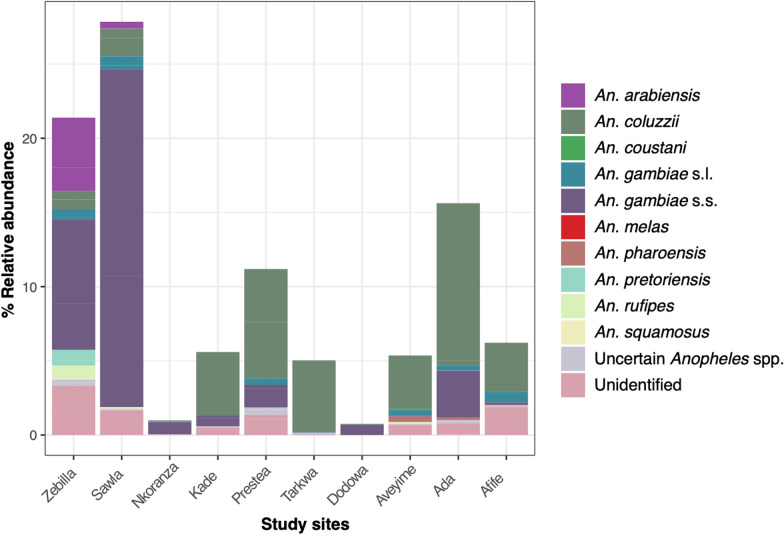
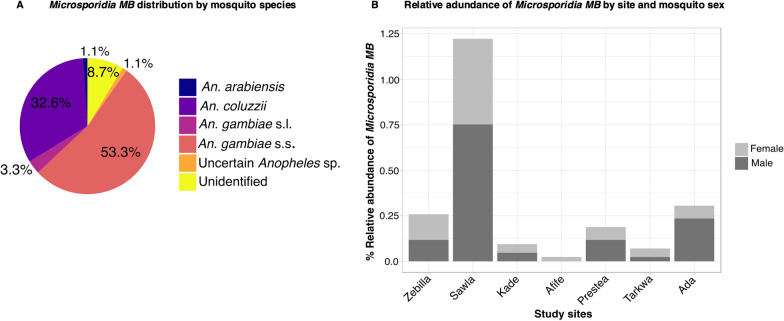
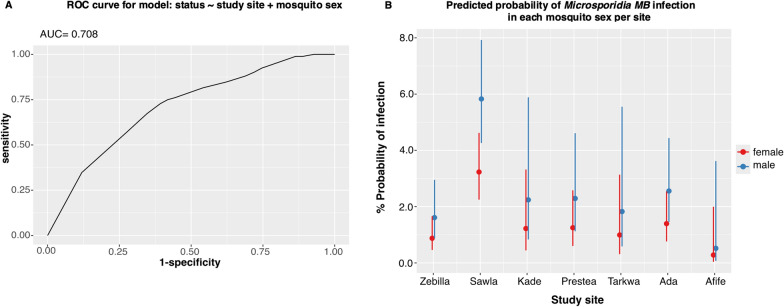
Overall Microsporidia MB distribution was 2.2% (92/4255). Male mosquitoes exhibited a higher frequency of infections and had a predicted probability of infection that was 85% higher than that of females. Sites in Ghana's Savannah zone had the highest Microsporidia MB distribution (68.5%). Biochemical oxygen demand in mosquito breeding water was estimated to be positively associated with and significantly predicts Microsporidia MB in mosquitoes with an accuracy of 94%. Increasing ammonium ion concentrations reduced the chances of finding Microsporidia MB-positive mosquitoes. According to our data, all Anopheles mosquitoes, including minor species such as An. squamosus, An. pretoriensis and An. rufipes, had equal probability of Microsporidia MB infection.
These results provide preliminary information on micro-ecological factors that potentially support the sustainability of Microsporidia MB infection in mosquitoes during their aquatic life stages. It will be important, therefore, to explore the impact of strategies for larval source management on these factors to ensure that the symbiont's persistence during the host's aquatic stages may not be adversely affected should it be used as an integrated approach for mosquito/disease control.
微孢子虫MB可破坏疟原虫在按蚊体内的发育,使其成为一种潜在的疟疾生物防治工具。作为一种病媒/疾病控制工具,必须明确其生态分布以及决定其出现的因素。我们通过拟合回归模型,调查了加纳北部和南部选定地点按蚊体内微孢子虫MB的感染频率,以及与该真菌出现相关的蚊虫孳生水的理化参数。
采用非柱提取法从2021年8月至10月以及2022年8月至10月收集的幼虫和蛹羽化出的4255只成年按蚊腹部提取DNA。使用定量PCR(qPCR)检测微孢子虫MB,同时利用短散在核元件(SINE)、限制性片段长度多态性(RFLP)方法和ANOSPP算法对蚊虫种类进行分子鉴定。
微孢子虫MB的总体分布率为2.2%(92/4255)。雄蚊的感染频率更高,其预测感染概率比雌蚊高85%。加纳萨凡纳地区的地点微孢子虫MB分布率最高(68.5%)。据估计,蚊虫孳生水的生化需氧量与按蚊体内的微孢子虫MB呈正相关,且能显著预测,准确率达94%。铵离子浓度增加会降低发现微孢子虫MB阳性按蚊的几率。根据我们的数据,所有按蚊,包括小种类如鳞斑按蚊、普氏按蚊和红足按蚊,感染微孢子虫MB的概率相同。
这些结果提供了有关微生态因素的初步信息,这些因素可能支持微孢子虫MB在蚊虫水生生活阶段感染的可持续性。因此,探索幼虫源管理策略对这些因素的影响很重要,以确保在将其用作蚊虫/疾病控制的综合方法时,共生体在宿主水生阶段的持久性不会受到不利影响。