Kendrew Rachael, Ajraoui Salma, Beaudet Amélie, Kelly Kimberly, Kiely David G, Rothman Alexander, Varian Frances, Davis Stacy, Pillai Nadia
IQVIA Patient Centered Solutions, London, UK.
Actelion Pharmaceuticals Ltd, Allschwil, Switzerland.
BMC Pulm Med. 2024 Dec 18;24(1):608. doi: 10.1186/s12890-024-03442-7.
Pulmonary arterial hypertension (PAH) and chronic thromboembolic pulmonary hypertension (CTEPH) are severe, progressive diseases characterized by key symptoms such as dyspnea and fatigue. These symptoms impair physical functioning, with patients struggling to perform their daily activities. One traditional measure of physical functioning and exercise capacity is the 6-minute walk test (6MWT). Actigraphy represents a promising tool to complement the 6MWT and provide a holistic picture of physical performance in patients with PAH or CTEPH. However, the current literature holds limited evidence on content validity of actigraphy in these populations, as reported by patients themselves. The primary objective of this study was to understand which physical functioning concepts are most meaningful to patients with PAH or CTEPH and identify relevant actigraphy variables and appropriate timeframes for their measurement.
This was a cross-sectional, qualitative study in adults with a confirmed diagnosis of PAH or CTEPH. Participants from the UK and USA were interviewed one-on-one via a web-based platform, with interviewers using a semi-structured discussion guide that included concept elicitation and cognitive debriefing sections. Data within the anonymized interview transcripts were coded and thematically analyzed.
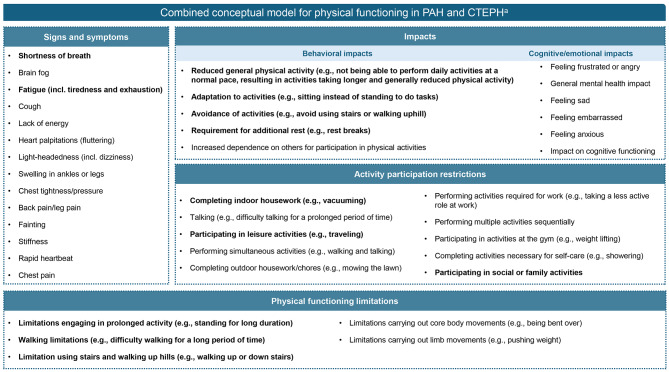
Concept elicitation identified the physical functioning concepts most meaningful to patients with PAH or CTEPH and generated a combined conceptual model of physical functioning, which strongly aligned with previous literature. During cognitive debriefing, of the four actigraphy variables debriefed in relation to these physical functioning concepts, study participants highly valued time spent in non-sedentary physical activity and time spent in moderate to vigorous activity, while step count and walking speed emerged as less relevant. Participants indicated four alternative variables as relevant: walking distance, walking up hills or inclines, duration of continuous walking bouts, and time spent walking. Regardless of the variable, participants suggested a timeframe of approximately 10 or 12 h/day over a minimum of 14 days for measuring physical functioning.
By demonstrating the content validity of actigraphy measures of physical functioning, this qualitative study begins to address the evidence gaps identified by the regulatory requirements for using actigraphy endpoints in future PAH and CTEPH clinical trials.
肺动脉高压(PAH)和慢性血栓栓塞性肺动脉高压(CTEPH)是严重的进行性疾病,其特征为呼吸困难和疲劳等关键症状。这些症状会损害身体机能,患者难以进行日常活动。身体机能和运动能力的一项传统衡量指标是6分钟步行试验(6MWT)。活动记录仪是一种很有前景的工具,可补充6MWT,并全面呈现PAH或CTEPH患者的身体表现。然而,正如患者自己所报告的那样,目前的文献中关于活动记录仪在这些人群中的内容效度的证据有限。本研究的主要目的是了解哪些身体机能概念对PAH或CTEPH患者最有意义,并确定相关的活动记录仪变量及其测量的合适时间范围。
这是一项针对确诊为PAH或CTEPH的成年人的横断面定性研究。来自英国和美国的参与者通过基于网络的平台进行一对一访谈,访谈者使用半结构化讨论指南,其中包括概念引出和认知反馈部分。对匿名访谈记录中的数据进行编码并进行主题分析。
概念引出确定了对PAH或CTEPH患者最有意义的身体机能概念,并生成了一个身体机能综合概念模型,该模型与先前的文献高度一致。在认知反馈过程中,在与这些身体机能概念相关的四个活动记录仪变量中,研究参与者高度重视非久坐身体活动时间和中度至剧烈活动时间,而步数和步行速度的相关性较低。参与者指出另外四个相关变量:步行距离、爬坡或上坡、连续步行时间和步行时间。无论变量如何,参与者建议在至少14天的时间内,每天测量身体机能的时间范围约为10或12小时。
通过证明活动记录仪身体机能测量的内容效度,这项定性研究开始填补未来PAH和CTEPH临床试验中使用活动记录仪终点的监管要求所确定的证据空白。