
肥胖和高脂血症与膝关节骨关节炎更严重的滑膜炎、结构异常以及较差的功能结局相关:一项回顾性比较研究。
Obesity and hyperlipidemia were associated with more severe synovitis and structural abnormalities as well as inferior functional outcomes in knee osteoarthritis: a retrospective comparative study.
作者信息
Hao Kuo, Wang Juncai, Niu Yingzhen, Wang Fei
机构信息
Department of Orthopaedic Surgery, Hebei Medical University Third Hospital, Shijiazhuang, Hebei, 050051, China.
出版信息
J Orthop Surg Res. 2024 Dec 19;19(1):845. doi: 10.1186/s13018-024-05326-2.
BACKGROUND
Considering that the respective effects of obesity and hyperlipidemia on knee osteoarthritis (OA) have not been fully investigated, the purpose of this study was to determine the relationship of obesity or hyperlipidemia with the synovitis and structural abnormalities of knee OA, and the effect of obesity and hyperlipidemia on functional outcomes of total knee arthroplasty.
METHODS
There were 99 OA patients without obesity and hyperlipidemia in Group 1, 100 OA patients only with obesity in Group 2, 98 OA patients only with hyperlipidemia in Group 3, and 97 OA patients with both obesity and hyperlipidemia in Group 4. Semi-quantitative synovial inflammatory markers were measured including effusion-synovitis, size and intensity of infrapatellar fat pad abnormality, and synovial proliferation score. The structural abnormalities of knee OA were evaluated using Whole-Organ Magnetic Resonance Imaging Score (WORMS). Functional outcomes were evaluated before surgery and at 2 years follow-up.
RESULTS
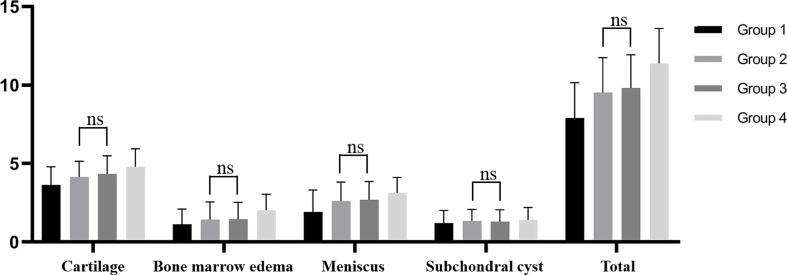
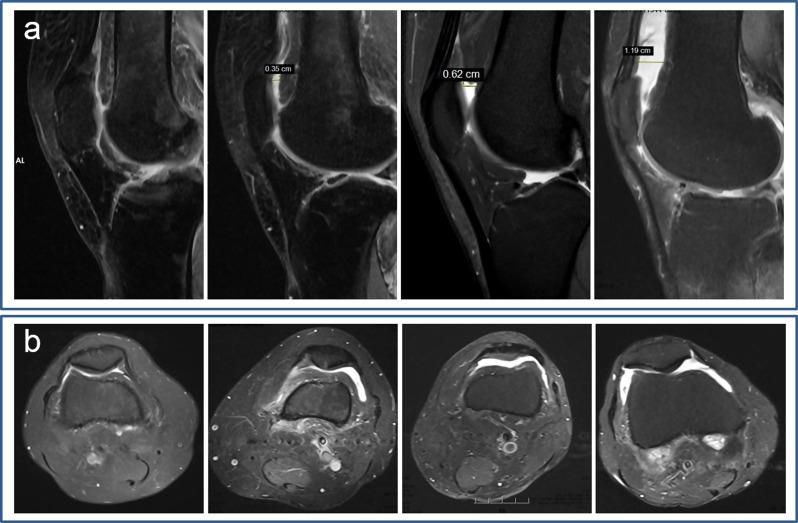
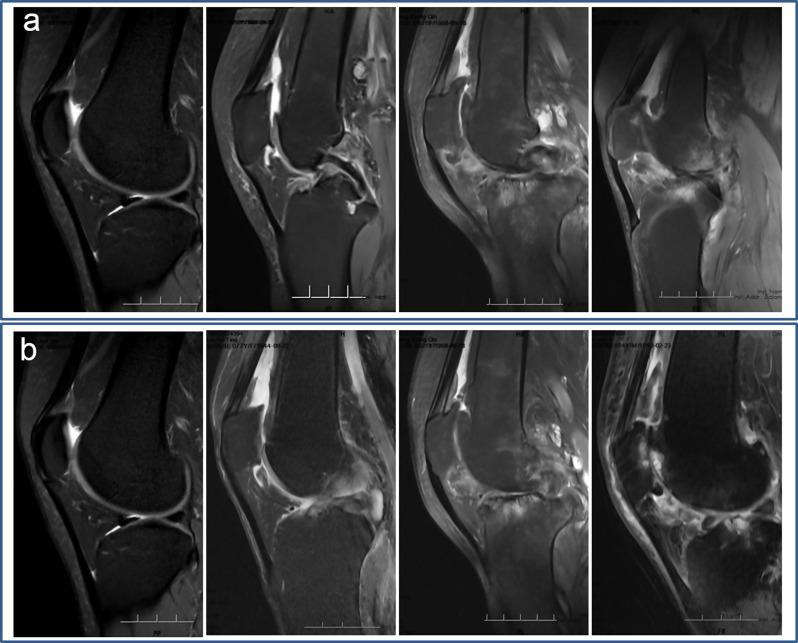
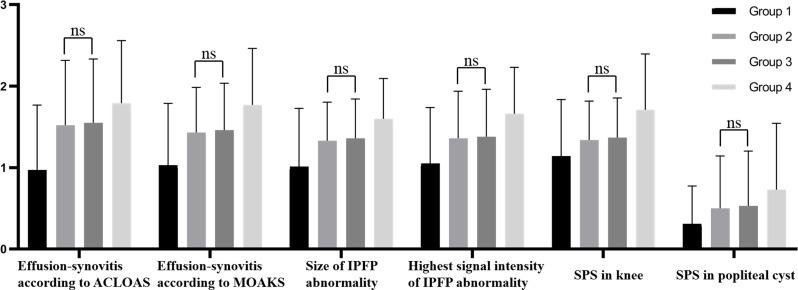
There were significantly higher effusion-synovitis, size and intensity of infrapatellar fat pad abnormality, and synovial proliferation score, as well as higher cartilage, bone marrow edema, meniscus, and total WORMS scores in Group 2, Group 3, and Group 4 (P < 0.05), but with no significant difference between Group 2 and Group 3 (P > 0.05). Group 2, Group 3, Group 4 had significantly worse Western Ontario and McMaster Universities Osteoarthritis Index, Forgotten Joint Score, Oxford Knee Score, Knee Society Score at baseline and 2 years follow-up (P < 0.05), but with no significant difference between Group 2 and Group 3 (P > 0.05). There were significant associations of obesity or hyperlipidemia with all synovial inflammatory markers and cartilage, bone marrow edema, meniscus, and total WORMS scores as well as functional outcomes (P < 0.05).
CONCLUSIONS
Obesity and hyperlipidemia were associated with more severe synovitis and structural abnormalities of knee OA, as well as inferior preoperative and postoperative functional outcomes. The negative effects of obesity and hyperlipidemia on knee OA could be mutually enhanced. The findings emphasized the negative effects of obesity and hyperlipidemia on the symptoms and outcomes of knee OA, and highlighted the association of obesity and hyperlipidemia with synovitis.
背景
鉴于肥胖和高脂血症对膝关节骨关节炎(OA)的各自影响尚未得到充分研究,本研究的目的是确定肥胖或高脂血症与膝关节OA滑膜炎和结构异常的关系,以及肥胖和高脂血症对全膝关节置换术功能结局的影响。
方法
第1组有99例无肥胖和高脂血症的OA患者,第2组有100例仅患有肥胖症的OA患者,第3组有98例仅患有高脂血症的OA患者,第4组有97例同时患有肥胖症和高脂血症的OA患者。测量半定量滑膜炎症标志物,包括积液性滑膜炎、髌下脂肪垫异常的大小和强度以及滑膜增殖评分。使用全器官磁共振成像评分(WORMS)评估膝关节OA的结构异常。在手术前和随访2年时评估功能结局。
结果
第2组、第3组和第4组的积液性滑膜炎、髌下脂肪垫异常的大小和强度、滑膜增殖评分以及软骨、骨髓水肿、半月板和WORMS总分显著更高(P<0.05),但第2组和第3组之间无显著差异(P>0.05)。第2组、第3组、第4组在基线和随访2年时的西安大略和麦克马斯特大学骨关节炎指数、遗忘关节评分、牛津膝关节评分、膝关节协会评分明显更差(P<0.05),但第2组和第3组之间无显著差异(P>0.05)。肥胖或高脂血症与所有滑膜炎症标志物、软骨、骨髓水肿、半月板和WORMS总分以及功能结局均存在显著关联(P<0.05)。
结论
肥胖和高脂血症与膝关节OA更严重的滑膜炎和结构异常以及术前和术后较差的功能结局相关。肥胖和高脂血症对膝关节OA的负面影响可能相互增强。这些发现强调了肥胖和高脂血症对膝关节OA症状和结局的负面影响,并突出了肥胖和高脂血症与滑膜炎的关联。


 Zotero 插件