
血糖、血脂及炎症标志物与中老年人群新发关节炎之间的非线性关联——一项欧洲队列研究
Non-linear associations between blood glucose, blood lipids and inflammatory markers and new-onset arthritis in the middle-aged and older population - a cohort study in Europe.
作者信息
Qiu Fanji, Li Jinfeng, Legerlotz Kirsten
机构信息
Movement Biomechanics, Institute of Sport Sciences, Humboldt-Universität zu Berlin, Unter den Linden 6, 10099, Berlin, Germany.
Department of Kinesiology, Iowa State University, Ames, IA, 50011, USA.
出版信息
Lipids Health Dis. 2025 Mar 1;24(1):79. doi: 10.1186/s12944-025-02495-9.
OBJECTIVE
The arthritis burden increases with aging, while blood glucose, lipid profiles and inflammatory markers may affect the development of arthritis. This study aims to determine the associations between blood markers and rheumatoid arthritis (RA) and osteoarthritis (OA) for better arthritis management.
METHOD
Data from the 6th and 9th wave of the Survey of Health, Ageing, and Retirement in Europe (SHARE) were used. Logistic regression and Cox proportional hazards regression models were used to examine the associations between blood markers and arthritis. Generalized additive models and restricted cubic splines (RCS) were employed to assess non-linear associations.
RESULTS
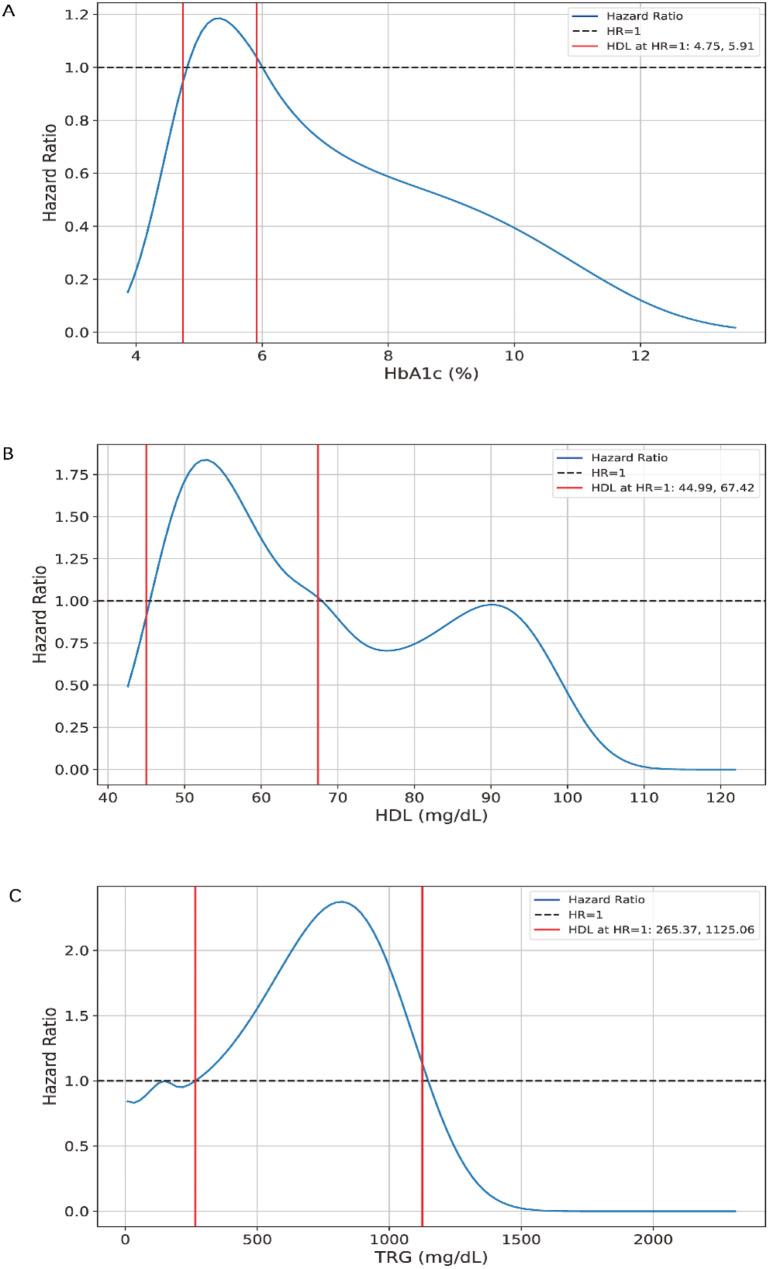
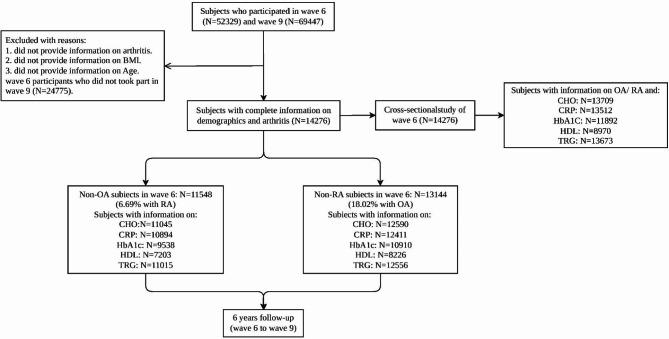
This study included a total of 14,276 participants. The incidence was 5.80% for OA, and 13.92% for RA. The participants with new-onset OA and RA were more likely to be older, female, and with higher body mass index. The generalized additive model detected nonlinear associations between the incidence of OA and glycated hemoglobin A (HbA1c), and between the incidence of RA and high-density lipoprotein (HDL) and triglycerides (TRG). RCS curves (P-nonlinear < 0.05) showed an increased risk of new-onset OA for HbA1c levels between 4.75% and 5.91% in individuals aged ≤ 65. For those aged>65, HDL levels between 44.99 and 67.42 mg/dL and TRG levels between 265.37 and 1125.06 mg/dL were associated with an increased risks of new-onset RA. Furthermore, total cholesterol, HbA1c, HDL and TRG were associated with the prevalence of arthritis.
CONCLUSION
Monitoring lipid profiles and HbA1c levels in middle-aged and older adults may help to manage arthritis.
目的
关节炎负担随年龄增长而增加,而血糖、血脂谱和炎症标志物可能影响关节炎的发展。本研究旨在确定血液标志物与类风湿性关节炎(RA)和骨关节炎(OA)之间的关联,以更好地管理关节炎。
方法
使用来自欧洲健康、老龄化和退休调查(SHARE)第6波和第9波的数据。采用逻辑回归和Cox比例风险回归模型来检验血液标志物与关节炎之间的关联。使用广义相加模型和受限立方样条(RCS)来评估非线性关联。
结果
本研究共纳入14276名参与者。OA的发病率为5.80%,RA的发病率为13.92%。新发OA和RA的参与者更可能年龄较大、为女性且体重指数较高。广义相加模型检测到OA发病率与糖化血红蛋白A(HbA1c)之间以及RA发病率与高密度脂蛋白(HDL)和甘油三酯(TRG)之间存在非线性关联。RCS曲线(P-非线性<0.05)显示,年龄≤65岁的个体,HbA1c水平在4.75%至5.91%之间时新发OA风险增加。对于年龄>65岁的个体,HDL水平在44.99至67.42mg/dL之间以及TRG水平在265.37至1125.06mg/dL之间与新发RA风险增加相关。此外,总胆固醇、HbA1c、HDL和TRG与关节炎患病率相关。
结论
监测中老年人的血脂谱和HbA1c水平可能有助于管理关节炎。
 Zotero 插件