Lim Jun-Sik, Vergne Timothée, Kim Eutteum, Guinat Claire, Dellicour Simon, Andraud Mathieu
IHAP, Université de Toulouse, INRAE, ENVT, Toulouse, France.
Department of Companion Animal Industry, Daegu University, Gyeongsan-si, Republic of Korea.
Vet Res. 2024 Dec 18;55(1):163. doi: 10.1186/s13567-024-01422-7.
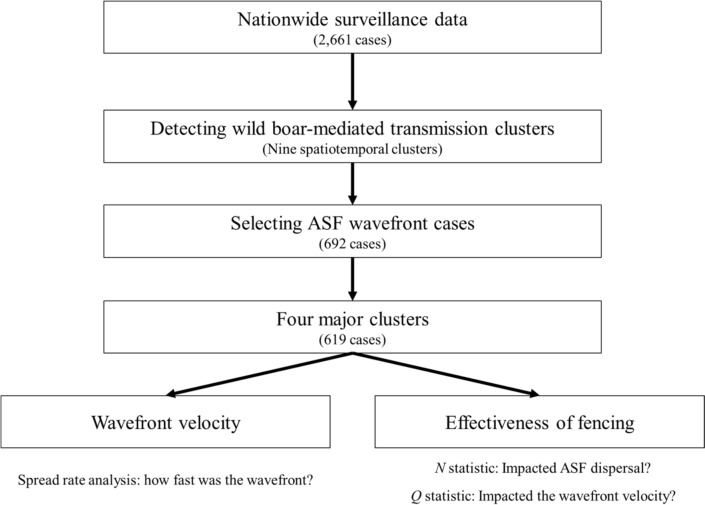
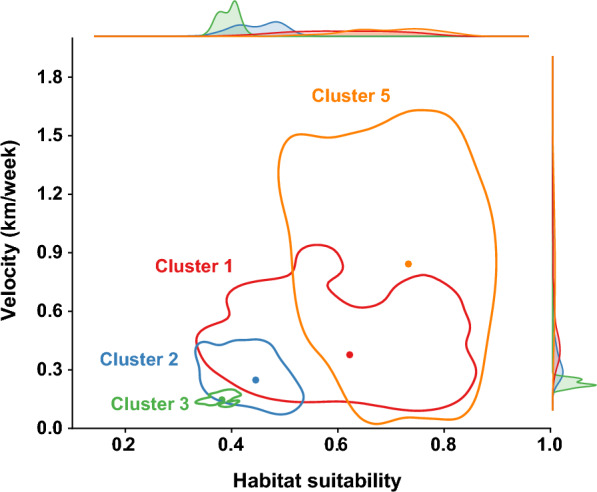
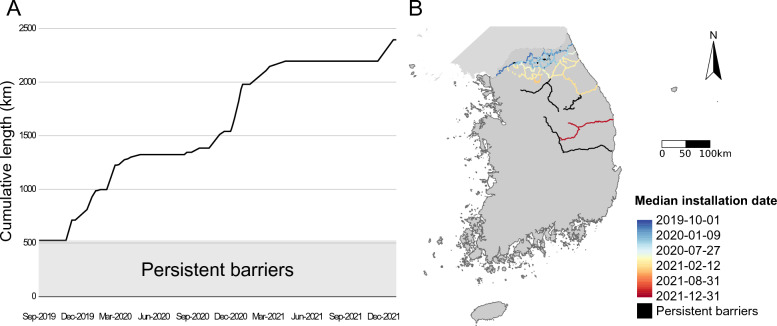
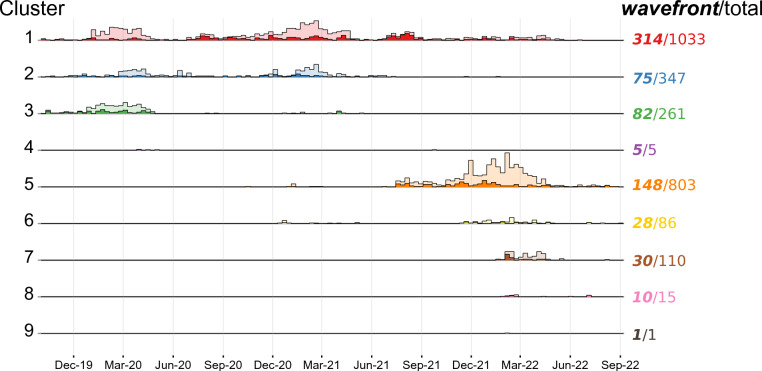
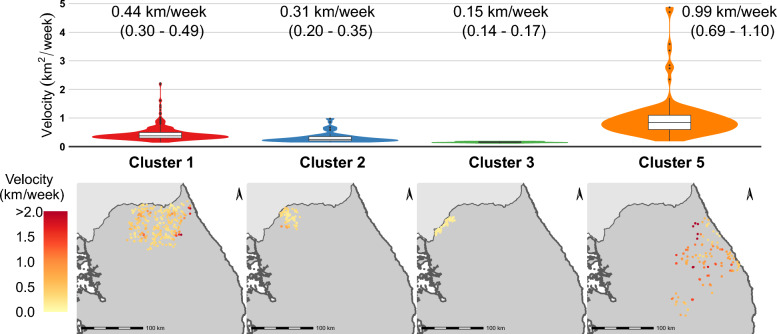
In October 2019, South Korea's first case of African swine fever (ASF) was reported in wild boar in the north of the country. Despite the implementation of a 2300 km-long fencing strategy, the ASF wavefront continued to invade southward. Our study aimed to investigate the ASF wavefront dynamics in different regions of South Korea, as well as to assess the effectiveness of the fencing measures on ASF dispersal and wavefront velocity. From the nationwide wild boar surveillance system, we extracted 2661 cases, starting from 2 October 2019 (first detection) to 15 September 2022. The cases were categorised into four main spatiotemporal clusters. The average wavefront velocity over the four clusters was estimated at 0.52 km/week, with the cluster in the eastern part of the Korean peninsula exhibiting the fastest velocity (0.99 km/week) compared to the other clusters (0.44, 0.31, and 0.15 km/week). We hypothesise that these differences are related to different wild boar densities due to heterogeneous habitat suitability. We also found that fencing significantly impacted ASF dispersal in only two of the four main clusters, with no evidence that fencing slowed down the spread of the wavefront in any of the clusters. We argue that this heterogeneity might result from fencing locations being misaligned with the true (and unobserved) wavefront.
2019年10月,韩国首例非洲猪瘟(ASF)在该国北部的野猪身上被发现。尽管实施了长达2300公里的围栏策略,但非洲猪瘟的传播前沿仍继续向南蔓延。我们的研究旨在调查韩国不同地区非洲猪瘟传播前沿的动态,以及评估围栏措施对非洲猪瘟传播和传播前沿速度的有效性。从全国野猪监测系统中,我们提取了2661个案例,时间从2019年10月2日(首次发现)到2022年9月15日。这些案例被分为四个主要的时空集群。四个集群的平均传播前沿速度估计为每周0.52公里,与其他集群(每周0.44公里、0.31公里和0.15公里)相比,朝鲜半岛东部的集群速度最快(每周0.99公里)。我们推测,这些差异与栖息地适宜性不同导致的野猪密度差异有关。我们还发现,围栏仅在四个主要集群中的两个集群中对非洲猪瘟的传播产生了显著影响,没有证据表明围栏减缓了任何一个集群中传播前沿的扩散。我们认为,这种异质性可能是由于围栏位置与真实(且未观察到的)传播前沿不一致造成的。