Jianchun Yu
School of Economics and Management, Weifang University of Science and Technology, Shandong, 262700, China.
BMC Psychol. 2024 Dec 18;12(1):744. doi: 10.1186/s40359-024-02269-5.
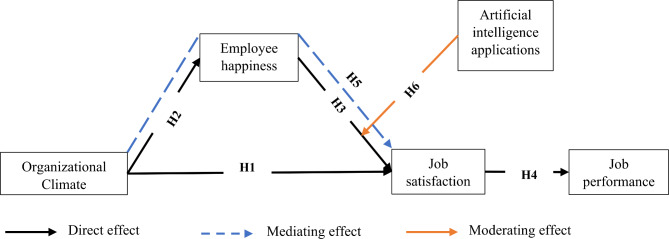
The Chinese educational sector is dynamic; hence, there is a need to anchor the factors that influence faculty job satisfaction and performance. These are channeled through organizational climate (OrgC) and employee happiness (EmH). The growing integration of artificial intelligence applications (AIAs)-like ChatGPT-into the learning environment raises questions about AIAs' moderating role in the relationship between EmH at work and EJoS.
This research empirically examines the influence of OrgC on EmH, the direct and mediated impacts of EmH on EJoS, and the moderating effect of AIAs on the influence of EmH on EJoS.
DESIGN/METHODOLOGY: Data was collected from faculty members of various Chinese universities. Using SmartPLS version 4.1, I have analyzed six hypotheses and the corresponding research questions.
The outcomes include favorable effects of OrgC on EmH and EJoS. EmH significantly correlates with EJoS, partially mediating the relationship between OrgC and EJoS. Interestingly, the research did not find evidence that AIAs moderated the relationship (ChatGPT) between EmH and EJoS. The predictors (OrgC and EmH) and moderation of AIAs explained a 51.9% change in EJoS, and EJoS explained a 13.3% variance in employee job performance.
This study's findings support a supportive OrgC as the key instrument for improving employees' happiness and job satisfaction. AI assistants, such as ChatGPT, provide relative efficiency and support but do not significantly affect how EmH at work relates to job satisfaction.
中国教育领域充满活力;因此,有必要确定影响教师工作满意度和绩效的因素。这些因素通过组织氛围(OrgC)和员工幸福感(EmH)来体现。人工智能应用(AIA)如ChatGPT越来越多地融入学习环境,引发了关于AIA在工作中的员工幸福感与员工工作满意度(EJoS)关系中调节作用的问题。
本研究实证检验组织氛围对员工幸福感的影响、员工幸福感对员工工作满意度的直接和中介影响,以及人工智能应用对员工幸福感与员工工作满意度关系的调节作用。
设计/方法:从中国各所大学的教师中收集数据。使用SmartPLS 4.1版本,我分析了六个假设及相应的研究问题。
结果包括组织氛围对员工幸福感和员工工作满意度有积极影响。员工幸福感与员工工作满意度显著相关,部分中介了组织氛围与员工工作满意度之间的关系。有趣的是,研究未发现证据表明人工智能应用(ChatGPT)调节了员工幸福感与员工工作满意度之间的关系。预测因素(组织氛围和员工幸福感)及人工智能应用的调节作用解释了员工工作满意度51.9%的变化,员工工作满意度解释了员工工作绩效13.3%的方差。
本研究结果支持一个支持性的组织氛围作为提高员工幸福感和工作满意度的关键手段。像ChatGPT这样的人工智能助手提供了相对的效率和支持,但对工作中的员工幸福感与工作满意度之间的关系没有显著影响。