Ragni Enrico, Perucca Orfei Carlotta, Papait Andrea, de Girolamo Laura
IRCCS Istituto Ortopedico Galeazzi, Laboratorio di Biotecnologie Applicate all' Ortopedia, Milan I-20161, Italy.
Centro di Ricerca E. Menni, Fondazione Poliambulanza Istituto Ospedaliero, Brescia I-25124, Italy.
Extracell Vesicles Circ Nucl Acids. 2021 Aug 3;2(3):202-221. doi: 10.20517/evcna.2021.11. eCollection 2021.
Mesenchymal stromal cells (MSCs) emerged as a promising therapeutic option for osteoarthritis (OA) management, in particular those isolated from adipose tissue (hASCs) and amniotic membrane (hAMSCs). The cartilage protective and immunomodulatory features of hASCs and hAMSCs are ascribed to secreted factors, including extracellular vesicles (EVs) and embedded miRNAs. The purpose of this study was to compare EVs and shuttled miRNAs from both MSC types and discuss them in the frame of OA pathological tissues.
Human hASCs and hAMSCs were analyzed by flow cytometry. EVs were analyzed by flow cytometry, nanoparticle tracking analysis, and electron microscopy. High-throughput qRT-PCR miRNA data available in the literature were compared. Abundant miRNAs and their experimentally validated targets were associated with those reported to drive OA pathology at cartilage, synovia, and macrophage levels. Four tools (Genorm, Normfinder, BestKeeper, and Delta Ct) were used to identify EVs stable reference genes.
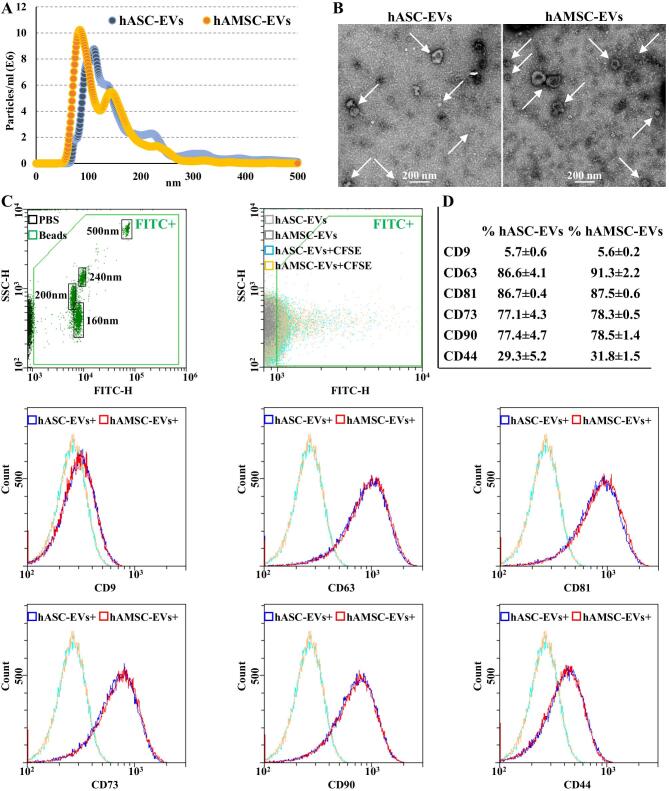
EVs did not show phenotypical or dimensional differences between the two sources, with hAMSCs releasing more particles. In total, 307 EV miRNAs were identified, with 306 shared. Several of the most abundant miRNAs target OA-driving factors and are involved in cartilage and synovia protective mechanisms, with hAMSC-EVs' preponderance for M2 anti-inflammatory macrophage commitment. miR-34a-5p emerged as the most stable reference gene.
Both hASCs and hAMSCs release EVs enriched in joint-protective and anti-inflammatory miRNAs, supporting their use for treatment of joint diseases. Future comparative clinical studies would be needed to test whether hAMSCs' higher EV secretion and enhanced M2 macrophage polarizing miRNA cargo allow for potentially increased OA therapeutic features.
间充质基质细胞(MSCs)成为骨关节炎(OA)治疗的一种有前景的选择,特别是那些从脂肪组织(hASCs)和羊膜(hAMSCs)中分离出来的细胞。hASCs和hAMSCs的软骨保护和免疫调节特性归因于分泌因子,包括细胞外囊泡(EVs)和包埋的微小RNA(miRNAs)。本研究的目的是比较两种间充质干细胞类型的细胞外囊泡和穿梭的微小RNA,并在OA病理组织的框架内进行讨论。
通过流式细胞术分析人hASCs和hAMSCs。通过流式细胞术、纳米颗粒跟踪分析和电子显微镜分析细胞外囊泡。比较文献中可用的高通量qRT-PCR微小RNA数据。丰富的微小RNA及其经实验验证的靶标与那些据报道在软骨、滑膜和巨噬细胞水平驱动OA病理的因素相关。使用四种工具(Genorm、Normfinder、BestKeeper和Delta Ct)来鉴定细胞外囊泡稳定的参考基因。
两种来源的细胞外囊泡在表型或尺寸上没有差异,hAMSCs释放的颗粒更多。总共鉴定出307种细胞外囊泡微小RNA,其中306种是共有的。几种最丰富的微小RNA靶向OA驱动因子,并参与软骨和滑膜保护机制,hAMSC-EVs在M2抗炎巨噬细胞定向方面占优势。miR-34a-5p成为最稳定的参考基因。
hASCs和hAMSCs都释放富含关节保护和抗炎微小RNA的细胞外囊泡,支持它们用于治疗关节疾病。未来需要进行比较临床研究,以测试hAMSCs更高的细胞外囊泡分泌和增强的M2巨噬细胞极化微小RNA负载是否可能增加OA治疗特性。