Schmidt Moritz C, Alvarez Agustin O, de Boer Jeroen J, van de Ven Larissa J M, Ehrler Bruno
AMOLF, Science Park 104, 1098 XG Amsterdam, The Netherlands.
University of Groningen, Nijenborgh 3, 9747 AG Groningen, The Netherlands.
ACS Energy Lett. 2024 Nov 12;9(12):5850-5858. doi: 10.1021/acsenergylett.4c02446. eCollection 2024 Dec 13.
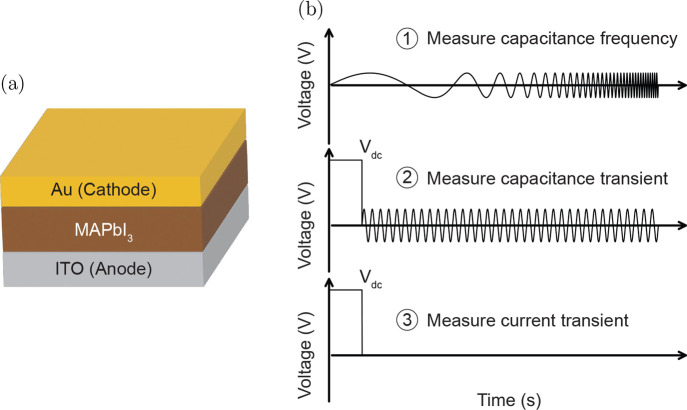
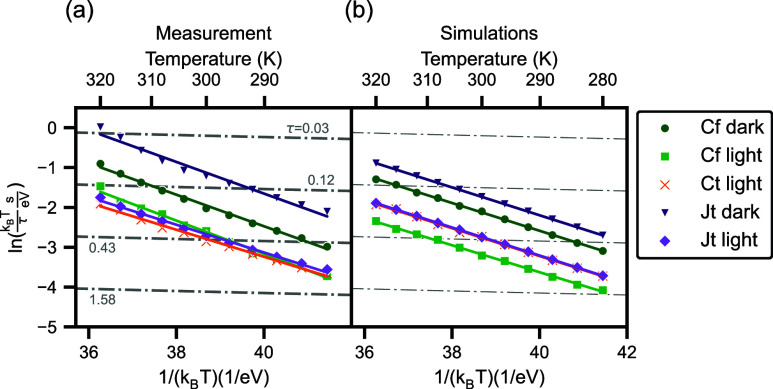
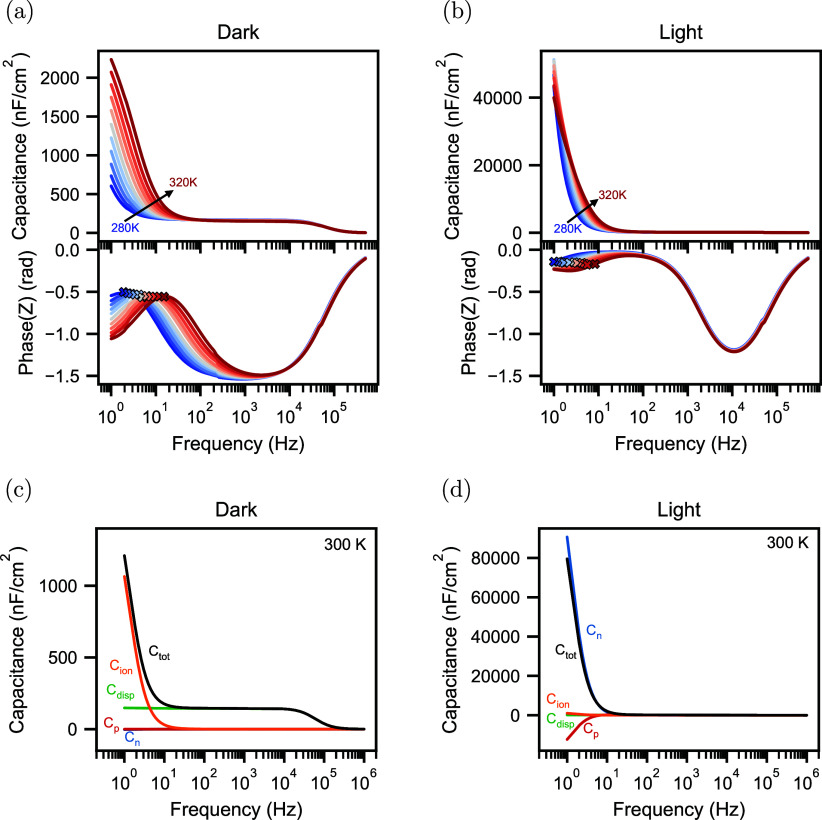
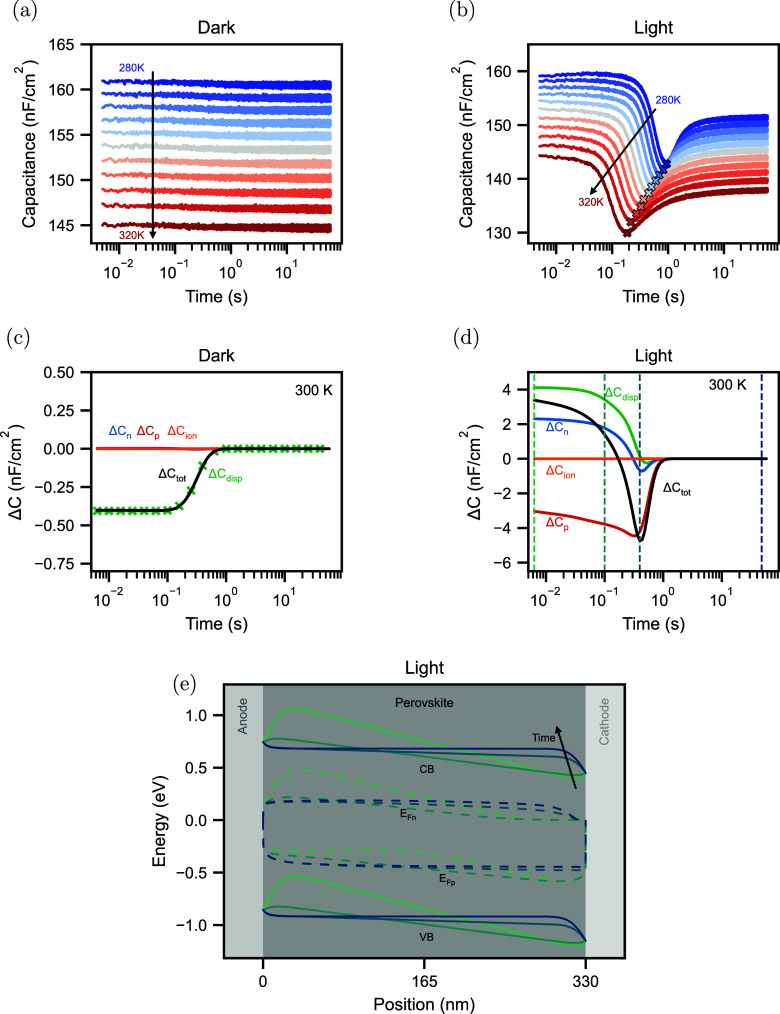
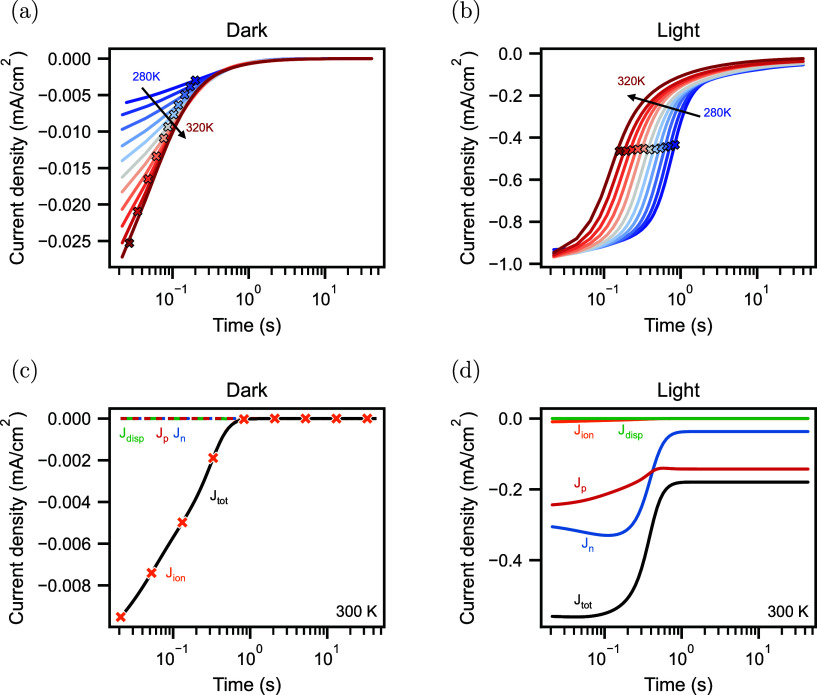
The migration of mobile ions through the metal halide perovskite layer is still one of the main reasons for the poor stability of perovskite solar cells, LEDs, and photodetectors. To characterize mobile ions in the perovskite layer, time- and frequency-based electrical measurements are promising techniques. However, the presence of transport layers complicates their interpretation, limiting the information about mobile ions that can be extracted, and it is not clear how different features in frequency- and time-domain measurements relate to mobile ions. Here, we characterize a transport-layer-free device with capacitance frequency, capacitance transient, and current transient measurements in the dark, under illumination, and at different temperatures. We extract characteristic ionic signatures from the measurements, which we reproduce with drift-diffusion simulations for each technique. This allows us to explain the origins of the different ionic signatures, advancing our understanding of how electronic characterization techniques can be used to study the properties of mobile ions.
移动离子在金属卤化物钙钛矿层中的迁移仍然是钙钛矿太阳能电池、发光二极管和光电探测器稳定性较差的主要原因之一。为了表征钙钛矿层中的移动离子,基于时间和频率的电学测量是很有前景的技术。然而,传输层的存在使测量结果的解读变得复杂,限制了可提取的关于移动离子的信息,而且尚不清楚频域和时域测量中的不同特征与移动离子之间的关系。在此,我们通过在黑暗、光照及不同温度条件下进行电容频率、电容瞬态和电流瞬态测量,对一种无传输层的器件进行了表征。我们从测量中提取了特征离子信号,并通过每种技术的漂移 - 扩散模拟对其进行了重现。这使我们能够解释不同离子信号的来源,加深了我们对如何利用电子表征技术研究移动离子特性的理解。