Reichert Sebastian, An Qingzhi, Woo Young-Won, Walsh Aron, Vaynzof Yana, Deibel Carsten
Institut für Physik, Technische Universität Chemnitz, 09126, Chemnitz, Germany.
Kirchhoff-Institut für Physik and Centre for Advanced Materials, Ruprecht-Karls-Universität Heidelberg, Im Neuenheimer Feld 227, 69120, Heidelberg, Germany.
Nat Commun. 2020 Nov 30;11(1):6098. doi: 10.1038/s41467-020-19769-8.
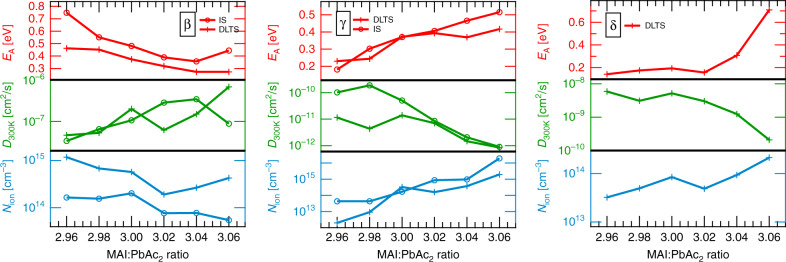
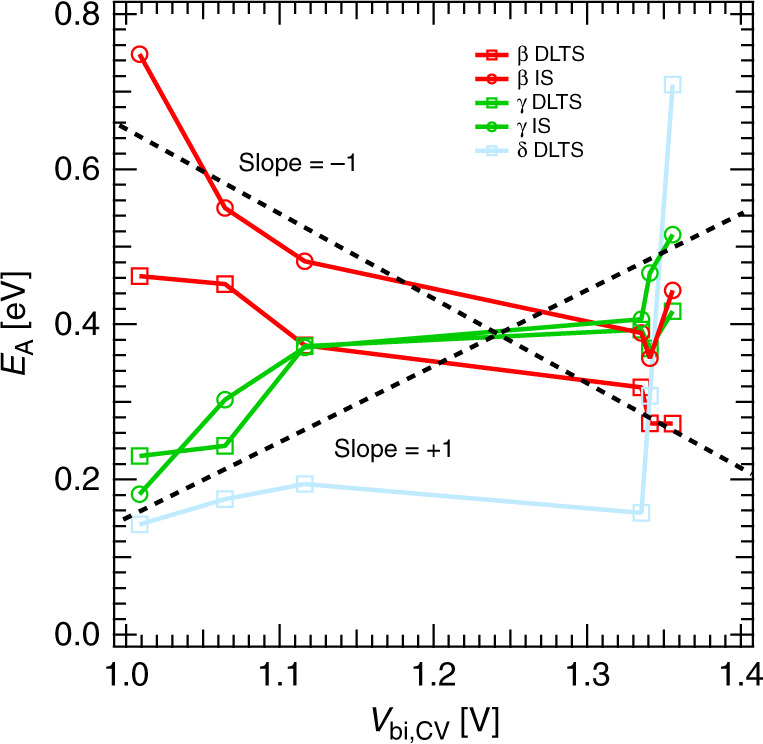
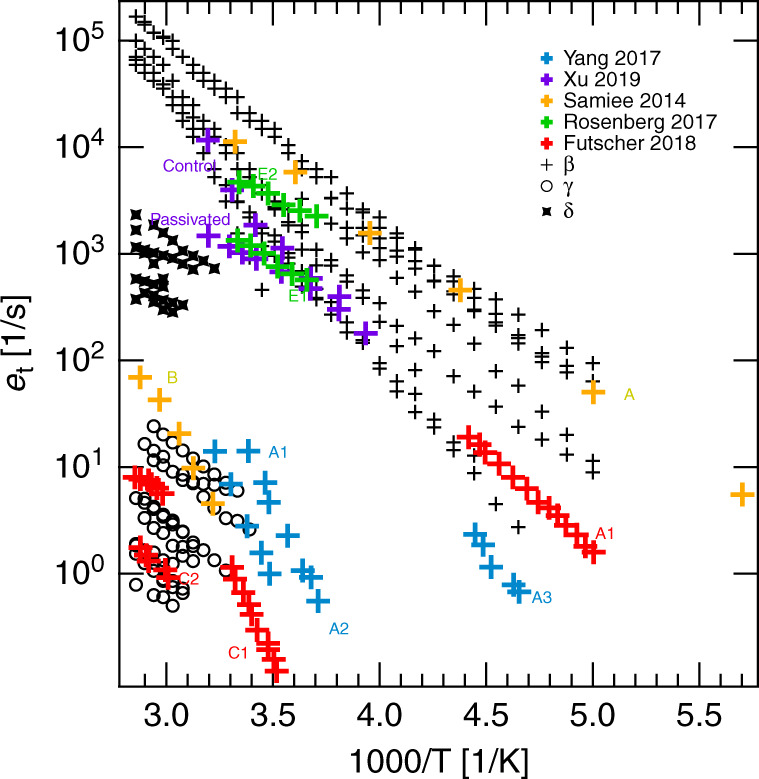
Point defects in metal halide perovskites play a critical role in determining their properties and optoelectronic performance; however, many open questions remain unanswered. In this work, we apply impedance spectroscopy and deep-level transient spectroscopy to characterize the ionic defect landscape in methylammonium lead triiodide (MAPbI) perovskites in which defects were purposely introduced by fractionally changing the precursor stoichiometry. Our results highlight the profound influence of defects on the electronic landscape, exemplified by their impact on the device built-in potential, and consequently, the open-circuit voltage. Even low ion densities can have an impact on the electronic landscape when both cations and anions are considered as mobile. Moreover, we find that all measured ionic defects fulfil the Meyer-Neldel rule with a characteristic energy connected to the underlying ion hopping process. These findings support a general categorization of defects in halide perovskite compounds.
金属卤化物钙钛矿中的点缺陷在决定其性质和光电性能方面起着关键作用;然而,许多悬而未决的问题仍未得到解答。在这项工作中,我们应用阻抗谱和深能级瞬态谱来表征碘化甲脒铅(MAPbI)钙钛矿中的离子缺陷情况,其中通过部分改变前驱体化学计量比有意引入了缺陷。我们的结果突出了缺陷对电子态势的深远影响,以其对器件内建电势的影响为例,进而影响开路电压。当阳离子和阴离子都被视为可移动时,即使是低离子密度也会对电子态势产生影响。此外,我们发现所有测量到的离子缺陷都符合迈耶 - 内德尔规则,其特征能量与潜在的离子跳跃过程相关。这些发现支持了卤化物钙钛矿化合物中缺陷的一般分类。