Chalyan Tatevik, Feizpour Mehdi, Liu Qing, Vanmol Koen, Solerdelcoll Núria, Takebe Gen, Thienpont Hugo, Ottevaere Heidi
Brussels Photonics (B-PHOT), Department of Applied Physics and Photonics, Vrije Universiteit Brussel and Flanders Make Pleinlaan 2 B-1050 Brussels Belgium
Central Research Laboratory, Hamamatsu Photonics K.K. 5000, Hirakuchi, Hamana-ku Hamamatsu Shizuoka Japan.
Nanoscale Adv. 2024 Dec 17;7(3):840-849. doi: 10.1039/d4na00742e. eCollection 2025 Jan 28.
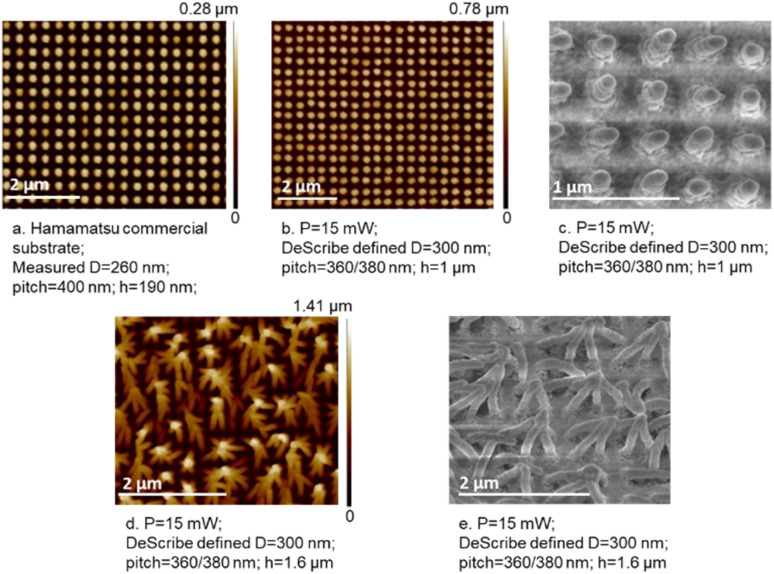
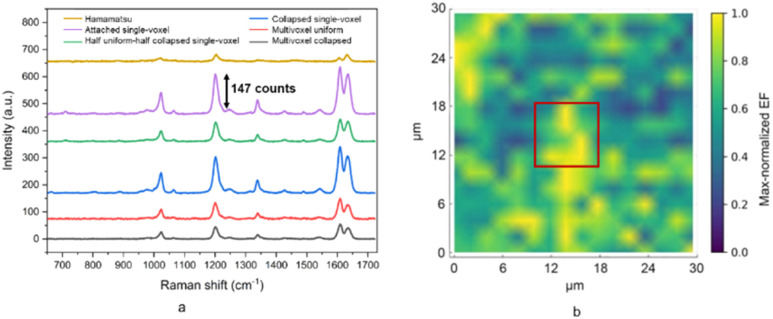
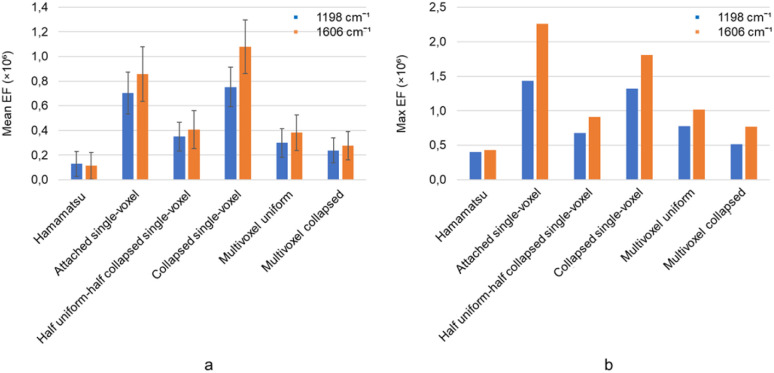
Surface-enhanced Raman spectroscopy (SERS) has shown its ability to characterize biological substances down to a single-molecule level without a specific biorecognition mechanism. Various nanofabrication technologies enable SERS substrate prototyping and mass manufacturing. This study reports a complete cycle of design, fabrication, prototyping, and metrology of SERS substrates based on two-photon polymerization (2PP). Highly controllable direct laser writing allows the fabrication of individual nanopillars with up to an aspect ratio of 4. The developed SERS substrates show up to 10 Raman signal enhancement, comparable to commercial substrates. Moreover, the rapid prototyping of the 2PP-printed SERS substrates takes from a minute to less than 2 hours, depending upon the nano-printing approach and aspect ratio requirements. The process is well-controlled and reproducible for achieving a uniform distribution of nanostructure arrays, allowing the SERS substrates to be used for a broad range of applications and the characterization of different molecules.
表面增强拉曼光谱(SERS)已展现出在无需特定生物识别机制的情况下,将生物物质表征至单分子水平的能力。各种纳米制造技术推动了SERS基底的原型制作和大规模生产。本研究报告了基于双光子聚合(2PP)的SERS基底从设计、制造、原型制作到计量的完整流程。高度可控的直接激光写入能够制造出纵横比高达4的单个纳米柱。所开发的SERS基底展现出高达10倍的拉曼信号增强,与商业基底相当。此外,根据纳米打印方法和纵横比要求,2PP打印的SERS基底的快速原型制作耗时从1分钟到不到2小时不等。该过程控制良好且可重复,以实现纳米结构阵列的均匀分布,使得SERS基底可用于广泛的应用以及不同分子的表征。