Rodriguez-Martinez Ana Catalina, Tailor-Hamblin Vijay K, Crossland Michael D, Higgins Bethany E, Blindow Enzo, Dekker Tessa M, Greenwood John A, Henderson Robert H, Jones Pete R, Moosajee Mariya
UCL Institute of Ophthalmology, London, UK.
Moorfields Eye Hospital NHS Foundation Trust, London, UK.
Transl Vis Sci Technol. 2024 Dec 2;13(12):33. doi: 10.1167/tvst.13.12.33.
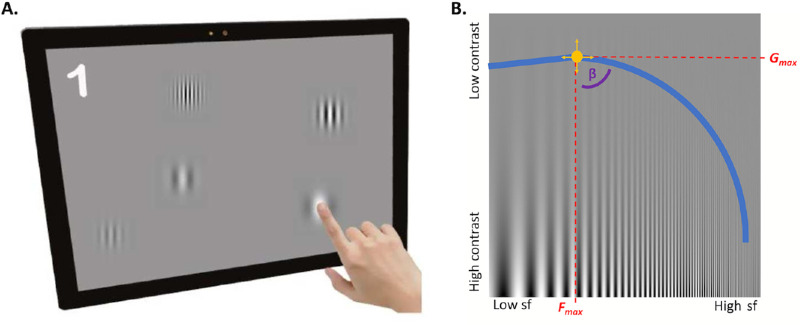
Mutations affecting the CRB1 gene can result in a range of retinal phenotypes, including early onset severe retinal dystrophy/Leber congenital amaurosis (EOSRD/LCA), retinitis pigmentosa, cone-rod dystrophy (CORD), and macular dystrophy (MD). As research into treatment strategies advances towards clinical translation, there is a need to establish reliable outcome metrics. This study explores the contrast sensitivity function (CSF) across different spatial frequencies in individuals with CRB1-retinopathies using the child-friendly PopCSF test, an iPad-based "gamified" assessment.
Prospective cross-sectional study of 20 patients with molecularly confirmed biallelic CRB1 pathogenic variants from Moorfields Eye Hospital, London, UK, was conducted. Best-corrected visual acuity (BCVA), contrast sensitivity using the Pelli-Robson chart, and the PopCSF test were performed.
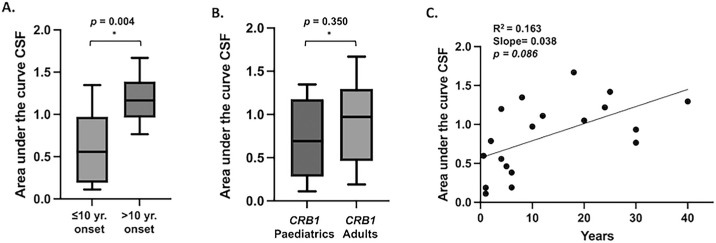
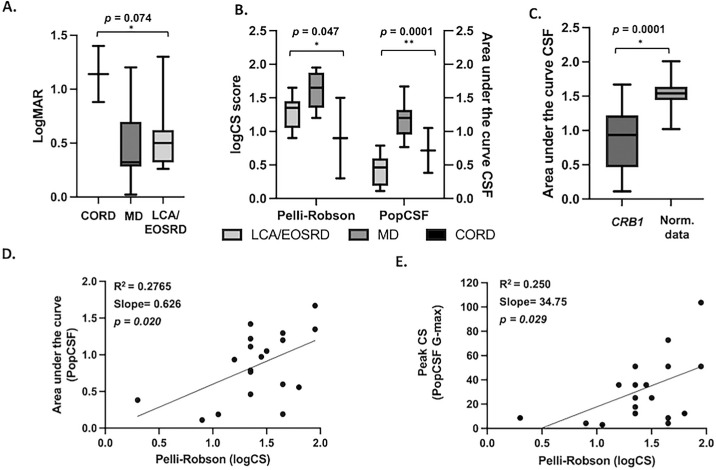
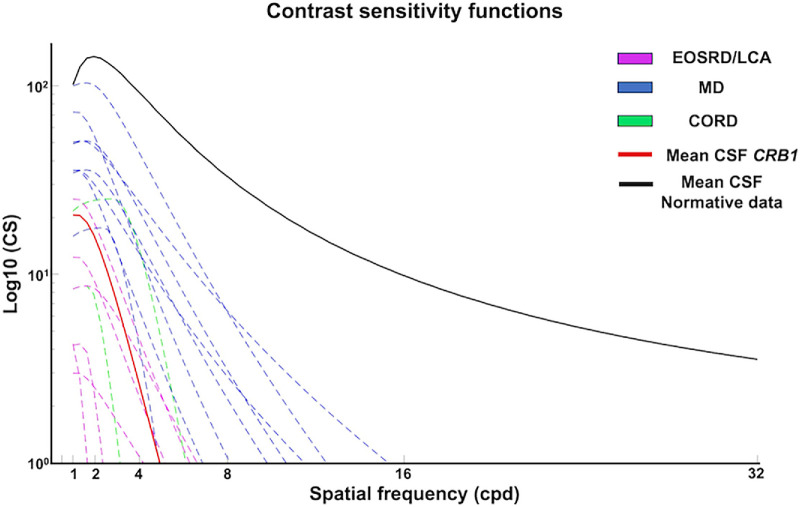
Of the 20 CRB1 patients, seven had EOSRD/LCA, three had CORD, and 10 had MD. There was no statistically significant difference between the mean BCVA between phenotypes (P = 0.066). However, a significant difference was found between groups in the mean letter log contrast sensitivity (logCS) and area under the contrast sensitivity function (AUCSF) with P = 0.047 and P < 0.001, respectively. A moderate positive correlation was observed between Pelli-Robson and PopCSF (r = 0.53, P = 0.020). The CRB1 cohort had significantly lower CSF at both low and high spatial frequencies compared to controls. Among the CRB1 phenotypes, patients with EOSRD/LCA, exhibited the lowest CSF.
This study is the first to examine CSF across spatial frequencies in patients with CRB1-retinopathies using the novel PopCSF test.
The CSF holds promise as a potential functional vision trial endpoint.
影响CRB1基因的突变可导致一系列视网膜表型,包括早发性严重视网膜营养不良/莱伯先天性黑蒙(EOSRD/LCA)、色素性视网膜炎、锥杆营养不良(CORD)和黄斑营养不良(MD)。随着治疗策略的研究朝着临床转化方向推进,需要建立可靠的结果指标。本研究使用儿童友好型PopCSF测试(一种基于iPad的“游戏化”评估),探索CRB1视网膜病变患者在不同空间频率下的对比敏感度函数(CSF)。
对来自英国伦敦摩尔菲尔德眼科医院的20例经分子确诊为双等位基因CRB1致病变异的患者进行前瞻性横断面研究。进行了最佳矫正视力(BCVA)、使用佩利-罗布森图表的对比敏感度以及PopCSF测试。
在20例CRB1患者中,7例患有EOSRD/LCA,3例患有CORD,10例患有MD。各表型之间的平均BCVA无统计学显著差异(P = 0.066)。然而,在平均字母对数对比敏感度(logCS)和对比敏感度函数下的面积(AUCSF)方面,组间存在显著差异,P值分别为0.047和P < 0.001。佩利-罗布森和PopCSF之间观察到中度正相关(r = 0.53,P = 0.020)。与对照组相比,CRB1队列在低空间频率和高空间频率下的CSF均显著降低。在CRB1表型中,EOSRD/LCA患者的CSF最低。
本研究首次使用新型PopCSF测试检查CRB1视网膜病变患者在不同空间频率下的CSF。
CSF有望作为潜在的功能性视力试验终点。