Filteau Suzanne, Chisenga Molly, Namunkonda Cassandra, Mukwasi-Kahari Cynthia, Kasonka Lackson, Simms Victoria, Gregson Celia L, Wells Jonathan C
Faculty of Epidemiology and Population Health, London School of Hygiene and Tropical Medicine, London, United Kingdom.
University Teaching Hospital, Lusaka, Zambia.
PLOS Glob Public Health. 2024 Dec 19;4(12):e0003200. doi: 10.1371/journal.pgph.0003200. eCollection 2024.
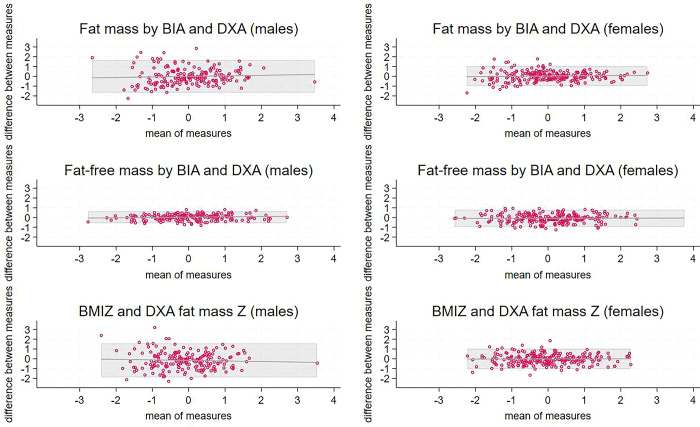
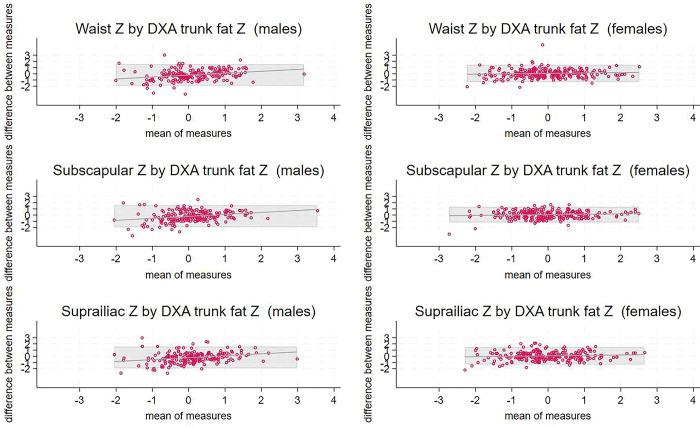
Assessment of body composition can be useful in managing many clinical or public health conditions, including HIV. Most people living with HIV infection are in Africa where clinics may lack equipment, utilities or staff time for optimal body composition assessment. Thus, it is important to determine whether less expensive and more available and scalable methods can provide adequate information. We estimated body composition of 420 perinatally HIV-infected Zambian adolescents, aged 11-19 years, using dual-energy X-ray absorptiometry (DXA), bioelectrical impedance (BIA) and anthropometry: body mass index (BMI), waist circumference, and subscapular and suprailiac skinfolds. Data were converted to internal population Z-scores in order to compare measures. BIA and DXA were compared for total fat and fat-free mass, BMI was compared to DXA fat mass, and waist circumference and skinfolds were compared to DXA trunk (central) fat. Neither anthropometry nor BIA adequately reflected total fat or trunk fat as measured by DXA. Although mean bias was generally small, especially for females, the limits of agreement were wide for all comparisons. In addition, for central fat in males, the bias was larger at higher mean Z-score values. BMI had similar agreement with DXA fat mass, as did BIA in females, though not males. We conclude that, because of wide limits of agreement and bias in some measures, none of the simpler methods examined are adequate for assessing longitudinal changes in body composition in order to monitor children's health. However, where BIA is available and DXA is not, BIA may still be able to describe broad trends in body composition of African adolescents living with HIV.
身体成分评估对于管理包括艾滋病病毒(HIV)在内的许多临床或公共卫生状况可能是有用的。大多数感染HIV的人生活在非洲,那里的诊所可能缺乏进行最佳身体成分评估所需的设备、公用设施或工作人员时间。因此,确定成本较低、更易获得且可扩展的方法是否能提供足够的信息很重要。我们使用双能X线吸收法(DXA)、生物电阻抗法(BIA)和人体测量学方法(体重指数(BMI)、腰围以及肩胛下和髂上皮肤褶厚度)对420名11至19岁的赞比亚围产期感染HIV的青少年的身体成分进行了评估。为了比较各项测量指标,数据被转换为内部人群Z分数。比较了BIA和DXA的总脂肪量和去脂体重,将BMI与DXA脂肪量进行了比较,并将腰围和皮肤褶厚度与DXA躯干(中心)脂肪进行了比较。无论是人体测量学方法还是BIA都不能充分反映DXA所测量的总脂肪或躯干脂肪。尽管平均偏差通常较小,尤其是对女性而言,但所有比较的一致性界限都很宽。此外,对于男性的中心脂肪,在较高的平均Z分数值时偏差更大。BMI与DXA脂肪量的一致性类似,女性的BIA也是如此,但男性并非如此。我们得出结论,由于某些测量方法的一致性界限宽且存在偏差,所研究的更简单方法中没有一种足以评估身体成分的纵向变化以监测儿童健康。然而,在有BIA而没有DXA的情况下,BIA仍可能能够描述感染HIV的非洲青少年身体成分的大致趋势。