Zhu Junping, Lin Ye, Li Gejing, He Yini, Su Zhaoli, Tang Yuanyuan, Zhang Ye, Xu Qian, Yao Zhongliu, Zhou Hua, Liu Bin, Cai Xiong
Institute of Innovation and Applied Research in Chinese Medicine; Department of Rheumatology of First Hospital, Hunan University of Chinese Medicine, Changsha, 410208, China.
College of Biology, Hunan University, Changsha, 410082, China.
J Pharm Anal. 2024 Nov;14(11):100981. doi: 10.1016/j.jpha.2024.100981. Epub 2024 Apr 22.
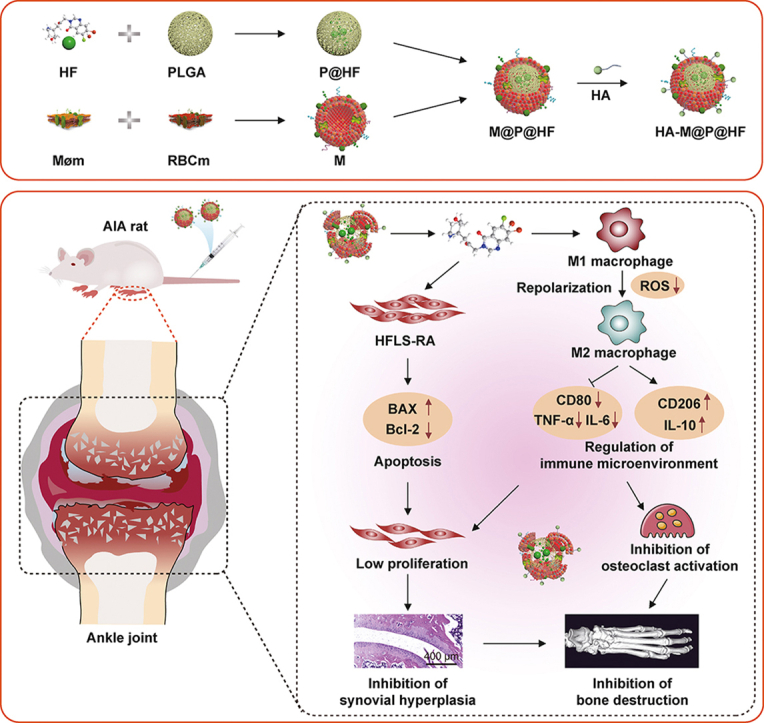
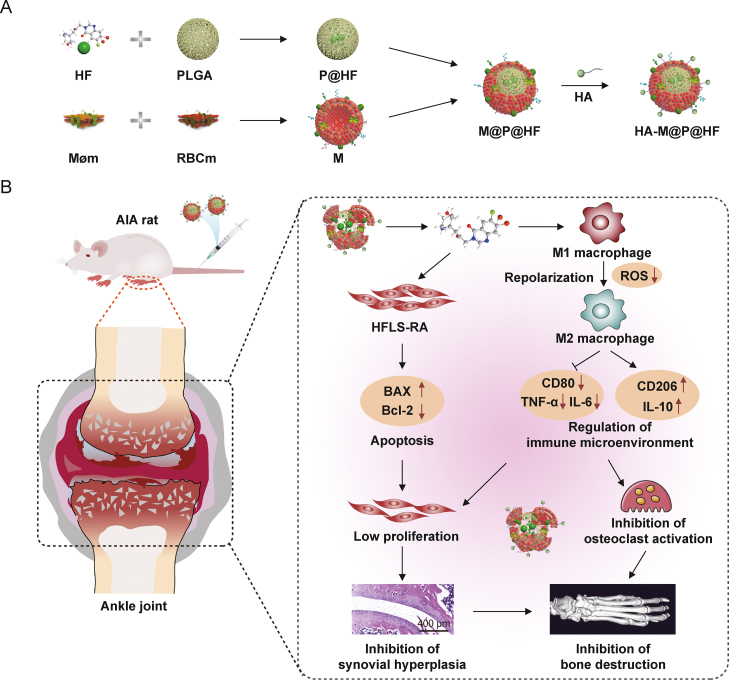
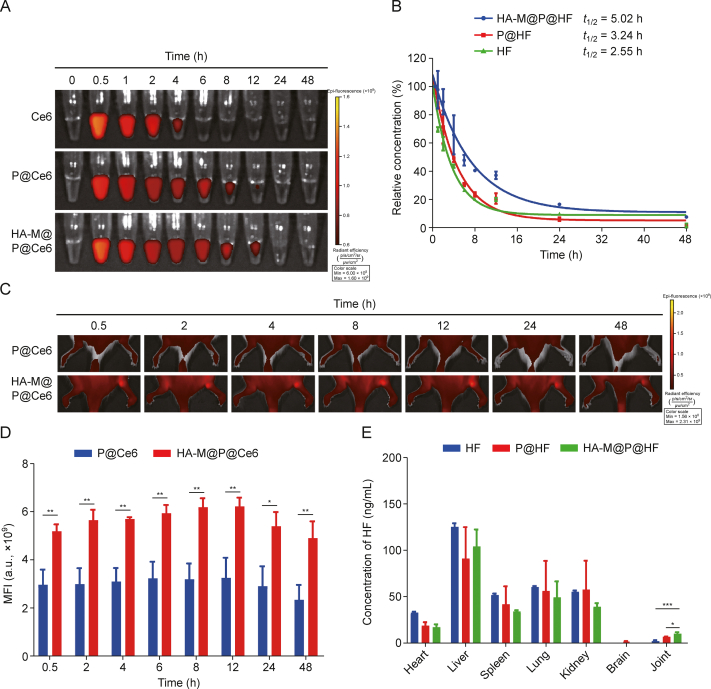
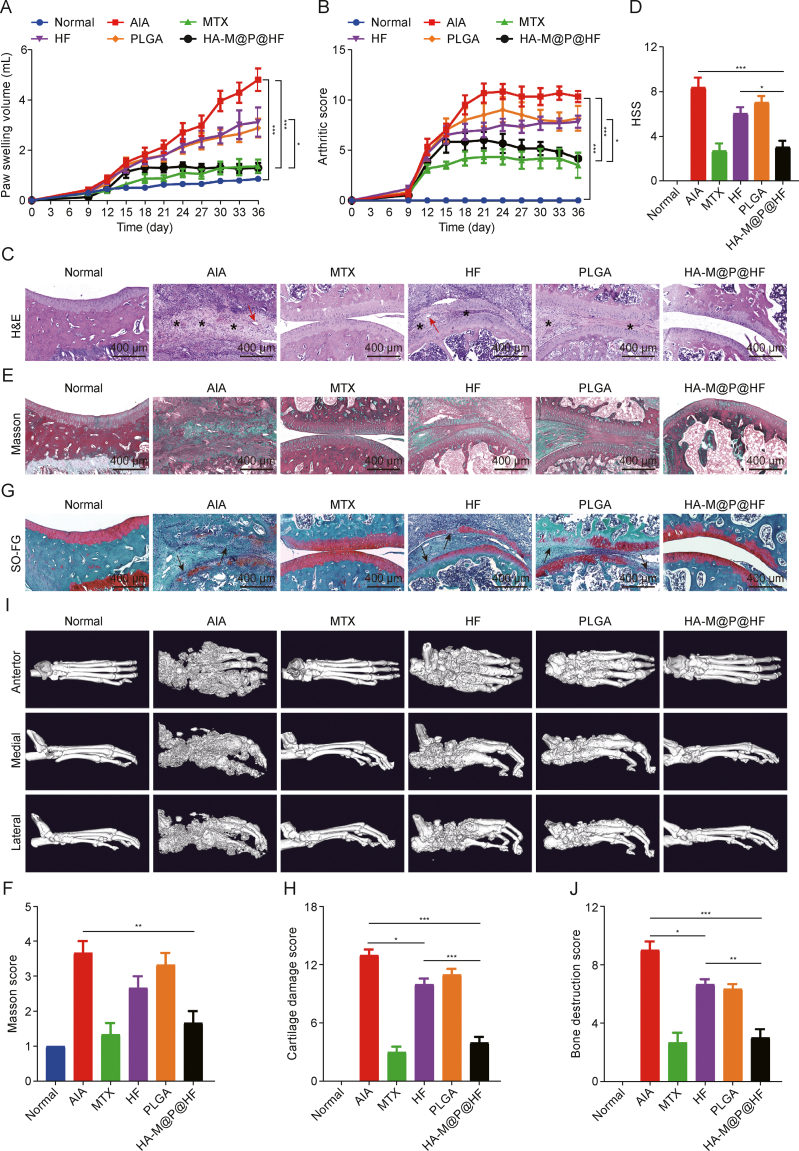
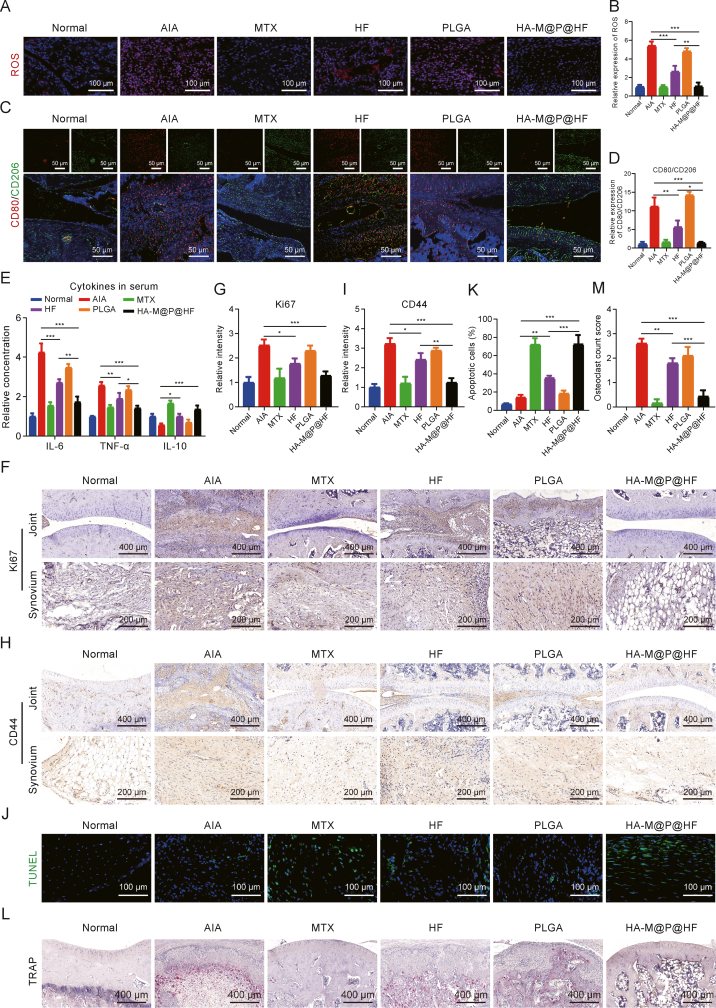
Rheumatoid arthritis (RA) is a prevalent autoimmune disease characterized by chronic inflammation and excessive proliferation of the synovium. Currently, treatment options focus on either reducing inflammation or inhibiting synovial hyperplasia. However, these modalities are unsatisfactory in achieving the desired therapeutic outcomes. Halofuginone hydrobromide (HF), an herbal active ingredient, has demonstrated pharmacological effects of both anti-inflammation and inhibition of synovial hyperplasia proliferation. However, HF's medical efficacy is limited due to its poor water solubility, short half-life ( ), and non-target toxicity. In the current study, by using the advantages of nanotechnology, we presented a novel dual-targeted nanocomplex, termed HA-M@P@HF NPs, which consisted of a hyaluronic acid (HA)-modified hybrid membrane (M)-camouflaged poly lactic--glycolic acid (PLGA) nanosystem for HF delivery. These nanocomplexes not only overcame the limitations of HF but also achieved simultaneous targeting of inflammatory macrophages and human fibroblast-like synoviocytes-RA (HFLS-RA). experiments demonstrated that these nanocomplexes effectively suppressed immune-mediated inflammation and synovial hyperplasia, safeguarding against bone destruction in rats with adjuvant-induced arthritis (AIA). Remarkable anti-arthritic effects of these nanocomplexes were accomplished through promoting repolarization of M1-to-M2 macrophages and apoptosis of HFLS-RA, thereby offering a promising therapeutic strategy for RA.
类风湿性关节炎(RA)是一种常见的自身免疫性疾病,其特征为慢性炎症和滑膜过度增殖。目前,治疗方案主要集中在减轻炎症或抑制滑膜增生。然而,这些方法在实现预期治疗效果方面并不理想。氢溴酸常山酮(HF)是一种草药活性成分,已显示出抗炎和抑制滑膜增生的药理作用。然而,由于其水溶性差、半衰期短以及非靶向毒性,HF的医学疗效有限。在本研究中,我们利用纳米技术的优势,提出了一种新型双靶向纳米复合物,称为HA-M@P@HF NPs,它由透明质酸(HA)修饰的混合膜(M)伪装的聚乳酸-乙醇酸(PLGA)纳米系统组成,用于递送HF。这些纳米复合物不仅克服了HF的局限性,还实现了对炎性巨噬细胞和人成纤维细胞样滑膜细胞-RA(HFLS-RA)的同时靶向。实验表明,这些纳米复合物有效地抑制了免疫介导的炎症和滑膜增生,预防了佐剂性关节炎(AIA)大鼠的骨破坏。这些纳米复合物通过促进MⅠ型向MⅡ型巨噬细胞的重极化和HFLS-RA的凋亡,实现了显著的抗关节炎作用,从而为RA提供了一种有前景的治疗策略。