McEwan Kathryn, Atkinson Joanne, Clarke Amanda, Bate Angela, Jeffery Caroline, Dalkin Sonia
University of Northumbria at Newcastle, Newcastle Upon Tyne, England.
BMC Palliat Care. 2024 Dec 21;23(1):287. doi: 10.1186/s12904-024-01610-4.
For many patients and caregivers, attending to dying and death at home will be a new and fearful experience. This research brings new evidence on the central support of the Rapid Response Service (RRS), provided to those who chose to die at home. RRS's are variable, although all seek to avoid unwanted hospital admissions and to respond flexibly to suit individual preferences for support. Staffed by specialist palliative and end-of-life care nurses, the RRS works alongside primary and acute care, but little is known on their impact.
Realist evaluation is a theory driven approach which identifies patterns of generative causation; this approach ascertains what works, for who, why, and in what circumstances. In this study, initial theories were developed by the research team and subsequently tested through semi-structured realist interviews with patients, caregivers, RRS staff, and other health practitioners. Iterative rounds of data analysis were undertaken to tease out contexts, mechanisms and outcomes, testing and revising the theories, including the application of substantive theory. Finally, we produced refined programme theories (PTs) which provide the basis for wider application of findings.
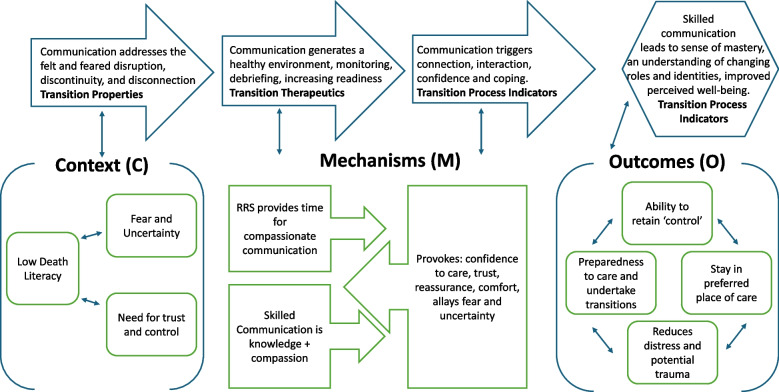
Overall, 36 participants contributed, and six areas of inquiry were developed. This paper sets out the data from one area, PT Skilled Communication. Several benefits arose from RRS staff having the time to talk to and with patients and caregivers: specifically, that this communication improved knowledge in a tailored and compassionate manner. These exchanges allayed fears and reduced uncertainty, improving confidence to care. This was particularly embedded in one RRS because of their holistic approach.
Supporting death and dying at home is a novel and difficult experience for many; skilled communication, provided by specialist palliative care staff, can make a positive difference. Through their provision of compassionate support, RRS staff can help caregivers to recognise and respond to different symptoms and situations, reducing fear. By responding rapidly, only on request, they also meet individual preferences for contact. Together, this improves the opportunity for the last days and hours of life to be experienced, at home, in as affirmative a manner as possible.
对于许多患者及其照护者而言,在家中面对临终和死亡将是一种全新且令人恐惧的经历。本研究为快速反应服务(RRS)向选择在家中离世者提供的核心支持带来了新证据。尽管所有快速反应服务都旨在避免不必要的住院治疗,并灵活响应以满足个人对支持的偏好,但它们各有不同。快速反应服务由专业姑息治疗和临终关怀护士提供人员配备,与初级和急性护理协同工作,但其影响鲜为人知。
现实主义评价是一种理论驱动的方法,可识别生成性因果关系模式;该方法确定什么有效、对谁有效、为何有效以及在何种情况下有效。在本研究中,初始理论由研究团队制定,随后通过与患者、照护者、快速反应服务人员及其他医疗从业者进行的半结构化现实主义访谈进行检验。进行了多轮迭代数据分析,以梳理背景、机制和结果,检验并修订理论,包括应用实质性理论。最后,我们生成了完善的项目理论(PTs),为更广泛地应用研究结果奠定了基础。
总体而言,36名参与者提供了信息,并形成了六个探究领域。本文阐述了来自一个领域——项目理论“专业沟通”的数据。快速反应服务人员有时间与患者及照护者交谈带来了诸多益处:具体而言,这种沟通以量身定制且充满关怀的方式增进了知识。这些交流减轻了恐惧,减少了不确定性,增强了照护信心。由于其整体方法,这一点在一项快速反应服务中尤为突出。
对许多人来说,在家中支持临终和死亡是一种全新且困难的经历;专业姑息治疗人员提供的专业沟通能产生积极影响。通过提供富有同情心的支持,快速反应服务人员可帮助照护者识别并应对不同症状和情况,减轻恐惧。通过仅应要求迅速做出回应,他们还满足了个人对联系的偏好。综合起来,这增加了在家中以尽可能积极的方式度过生命最后时光的机会。