Yusoff Hanizah Mohd, Mohamed Norfariha Che, Yew Sheng Qian, Nawi Azmawati Mohammed, Rashidah Ismail Ohnmar Htwe, Tohit Noorlaili Mohd, Mohamed Zuraida, Noordin Muhamad Ariff Muhamad, Mohd Fazlin Hazirah, Shariff Mohammad Izzat Akmal, Shaharum Muaz Haqim, Rahman Anita Abd, Dapari Rahmat
Department of Public Health Medicine, Faculty of Medicine, Universiti Kebangsaan Malaysia, Jalan Yaacob Latif, Bandar Tun Razak, Cheras, Kuala Lumpur, 56000, Malaysia.
Ministry of Health, Complex E, Federal Government Administrative Centre, Putrajaya, 62590, Malaysia.
J Health Popul Nutr. 2024 Nov 25;43(1):194. doi: 10.1186/s41043-024-00696-z.
The manufacturing sector in Malaysia has been severely impacted by the COVID-19 pandemic. This is further exacerbated by Long COVID-19 symptoms among the manufacturing workers, which are proven to influence work performance and quality of life. Of note, there is currently a lack of knowledge regarding the burden of Long COVID-19 in the Malaysian manufacturing sector. As such, our study aims to investigate the prevalence and risk factors of Long COVID-19 symptoms among the manufacturing workers, and subsequently assess the prevalence and risk factors of adverse work outcomes among the workers with Long Covid-19 symptoms.
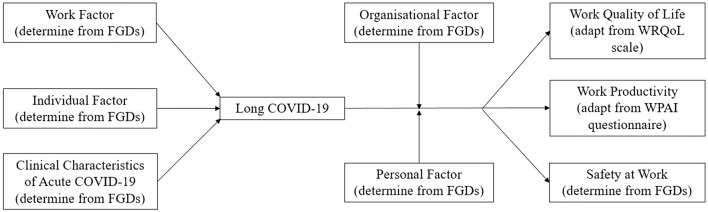
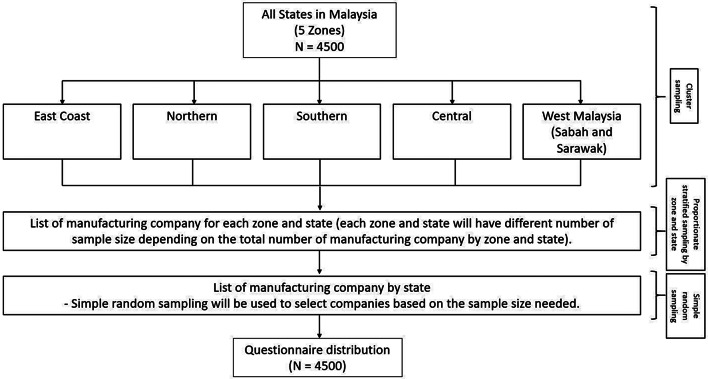
This is an exploratory mixed-methods study. In phase 1 (qualitative phase), three groups of participants (i.e., clinicians, employers, and workers) will be invited to participate to focus group discussions (FGDs) until thematic saturation. The aim of the FGDs is to explore the understanding, experience, and potential risk factors of Long Covid-19 among manufacturing workers. Findings from the FGDs will be analysed thematically. Themes generated from the FGDs will be used to generate items in a new questionnaire. The newly developed questionnaire will be validated using a fuzzy Delphi study, which will also be conducted among clinicians, employers, and workers. Phase 2 is a cross-sectional study that will be conducted among manufacturing workers across all states in Malaysia to identify the prevalence and risk factors of Long COVID-19, as well as the prevalence and risk factors of adverse work outcomes among workers with Long COVID-19. A multistage cluster sampling will be used to collect data from 4500 manufacturing workers in Malaysia. Logistic regression will be performed to determine the association between risk factors with both Long COVID-19 and adverse work outcomes.
Once the prevalence and risk factors of Long COVID and its associated adverse work outcome are identified, timely support and effective interventions could be provided to manufacturing workers to maintain their health and productivity.
Ethical approval has been granted by the Research Ethics Committee of the National University of Malaysia (JEP-2023-607) and the Medical Research and Ethics Committee (MREC) Malaysia (NMRR ID-23-03310-H3E).
马来西亚制造业受到新冠疫情的严重冲击。制造业工人的新冠长期症状进一步加剧了这种影响,事实证明这些症状会影响工作表现和生活质量。值得注意的是,目前对于马来西亚制造业中新冠长期症状的负担缺乏了解。因此,我们的研究旨在调查制造业工人中新冠长期症状的患病率和风险因素,随后评估有新冠长期症状的工人中不良工作结果的患病率和风险因素。
这是一项探索性混合方法研究。在第一阶段(定性阶段),将邀请三组参与者(即临床医生、雇主和工人)参加焦点小组讨论(FGD),直至达到主题饱和。FGD的目的是探索制造业工人对新冠长期症状的理解、经历和潜在风险因素。将对FGD的结果进行主题分析。从FGD中产生的主题将用于生成一份新问卷中的项目。新开发的问卷将通过模糊德尔菲研究进行验证,该研究也将在临床医生、雇主和工人中进行。第二阶段是一项横断面研究,将在马来西亚所有州的制造业工人中进行,以确定新冠长期症状的患病率和风险因素,以及有新冠长期症状的工人中不良工作结果的患病率和风险因素。将采用多阶段整群抽样从马来西亚4500名制造业工人中收集数据。将进行逻辑回归以确定风险因素与新冠长期症状和不良工作结果之间的关联。
一旦确定了新冠长期症状及其相关不良工作结果的患病率和风险因素,就可以为制造业工人提供及时的支持和有效的干预措施,以维持他们的健康和生产力。
马来西亚国立大学研究伦理委员会(JEP - 2023 - 607)和马来西亚医学研究与伦理委员会(MREC)(NMRR ID - 23 - 03310 - H3E)已批准伦理许可。