Cai Jing, Shen Ling, Kang Hunseung, Xu Tao
Jiangsu International Joint Center of Genomics, Jiangsu Key Laboratory of Comparative Genomics, School of Life Sciences, Jiangsu Normal University, Xuzhou, Jiangsu Province 221116, China.
Jiangsu International Joint Center of Genomics, Jiangsu Key Laboratory of Comparative Genomics, School of Life Sciences, Jiangsu Normal University, Xuzhou, Jiangsu Province 221116, China; Department of Applied Biology, College of Agriculture and Life Sciences, Chonnam National University, Gwangju 61186, South Korea.
Plant Commun. 2025 Feb 10;6(2):101229. doi: 10.1016/j.xplc.2024.101229. Epub 2024 Dec 21.
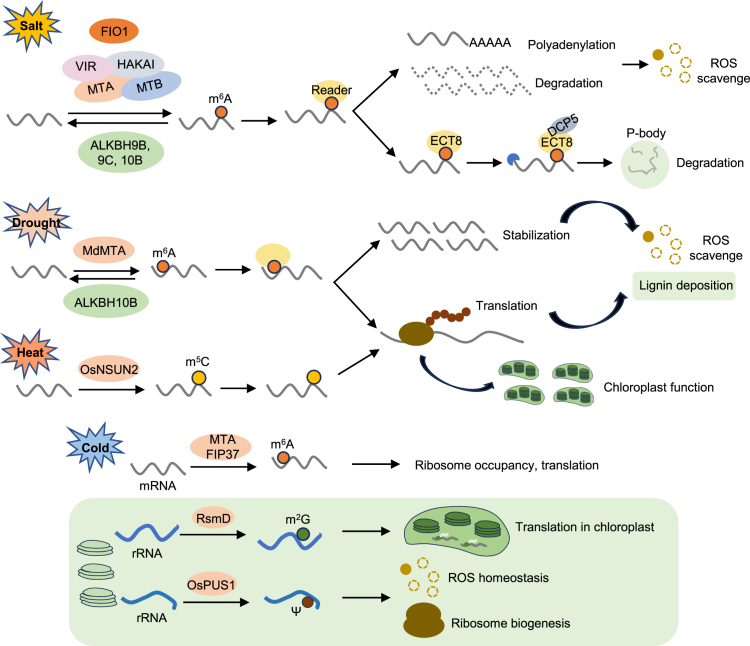
Epitranscriptomic chemical modifications of RNAs have emerged as potent regulatory mechanisms in the process of plant stress adaptation. Currently, over 170 distinct chemical modifications have been identified in mRNAs, tRNAs, rRNAs, microRNAs (miRNAs), and long noncoding RNAs (lncRNAs). Genetic and molecular studies have identified the genes responsible for addition and removal of chemical modifications from RNA molecules, which are known as "writers" and "erasers," respectively. N-methyladenosine (mA) is the most prevalent chemical modification identified in eukaryotic mRNAs. Recent studies have identified mA writers and erasers across different plant species, including Arabidopsis (Arabidopsis thaliana), rice (Oryza sativa), cotton (Gossypium hirsutum), and tomato (Solanum lycopersicum). Accumulating discoveries have improved our understanding of the functions of RNA modifications in plant stress responses. This review highlights the latest research on RNA modification, emphasizing the biological and cellular roles of diverse chemical modifications of mRNAs, tRNAs, rRNAs, miRNAs, and lncRNAs in plant responses to environmental and hormonal signals. We also propose and discuss critical questions and future challenges for enhancing our understanding of the cellular and mechanistic roles of RNA modifications in plant stress responses. Integrating molecular insights into the regulatory roles of RNA modifications in stress responses with novel genome- and RNA-editing technologies will facilitate the breeding of stress-tolerant crops through precise engineering of RNA modifications.
RNA的表观转录组化学修饰已成为植物应激适应过程中强大的调控机制。目前,已在信使核糖核酸(mRNA)、转运核糖核酸(tRNA)、核糖体核糖核酸(rRNA)、微小核糖核酸(miRNA)和长链非编码核糖核酸(lncRNA)中鉴定出170多种不同的化学修饰。遗传和分子研究已确定了负责从RNA分子上添加和去除化学修饰的基因,分别称为“书写器”和“擦除器”。N6-甲基腺苷(m6A)是真核生物mRNA中鉴定出的最普遍的化学修饰。最近的研究已在不同植物物种中鉴定出m6A书写器和擦除器,包括拟南芥(Arabidopsis thaliana)、水稻(Oryza sativa)、棉花(Gossypium hirsutum)和番茄(Solanum lycopersicum)。越来越多的发现增进了我们对RNA修饰在植物应激反应中功能的理解。本综述重点介绍了RNA修饰的最新研究,强调了mRNA、tRNA、rRNA、miRNA和lncRNA的各种化学修饰在植物对环境和激素信号反应中的生物学和细胞作用。我们还提出并讨论了关键问题和未来挑战,以加强我们对RNA修饰在植物应激反应中的细胞和机制作用的理解。将分子见解与新颖的基因组和RNA编辑技术整合到RNA修饰在应激反应中的调控作用中,将有助于通过精确工程改造RNA修饰培育耐逆作物。