Spinal Cord Damage Research Center, James J. Peters Veterans Affairs (VA) Medical Center, Bronx, New York.
Departments of Rehabilitation and Human Performance and Medicine, Icahn School of Medicine at Mount Sinai, New York, New York.
JAMA Netw Open. 2024 Sep 3;7(9):e2431501. doi: 10.1001/jamanetworkopen.2024.31501.
Robotic exoskeletons leverage technology that assists people with spinal cord injury (SCI) to walk. The efficacy of home and community exoskeletal use has not been studied in a randomized clinical trial (RCT).
To examine whether use of a wheelchair plus an exoskeleton compared with use of only a wheelchair led to clinically meaningful net improvements in patient-reported outcomes for mental and physical health.
DESIGN, SETTING, AND PARTICIPANTS: This RCT of veterans with SCI was conducted at 15 Veterans Affairs medical centers in the US from September 6, 2016, to September 27, 2021. Data analysis was performed from March 10, 2022, to June 20, 2024.
Participants were randomized (1:1) to standard of care (SOC) wheelchair use or SOC plus at-will use of a US Food and Drug Administration (FDA)-cleared exoskeletal-assisted walking (EAW) device for 4 months in the home and community.
Two primary outcomes were studied: 4.0-point or greater improvement in the mental component summary score on the Veterans RAND 36-Item Health Survey (MCS/VR-36) and 10% improvement in the total T score of the Spinal Cord Injury-Quality of Life (SCI-QOL) physical and medical health domain and reported as the proportion who achieved clinically meaningful changes. The primary outcomes were measured at baseline, post randomization after advanced EAW training sessions, and at 2 months and 4 months (primary end point) in the intervention period. Device usage, reasons for not using, and adverse events were collected.
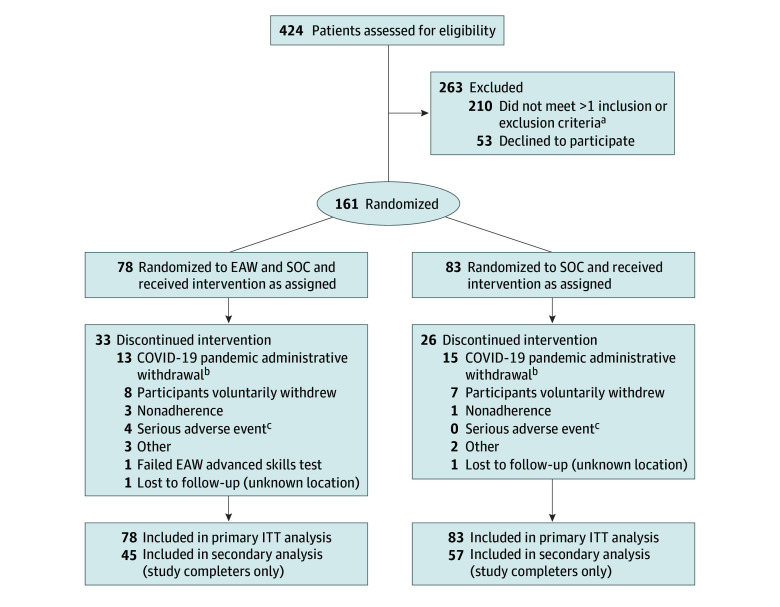
A total of 161 veterans with SCI were randomized to the EAW (n = 78) or SOC (n = 83) group; 151 (94%) were male, the median age was 47 (IQR, 35-56) years, and median time since SCI was 7.3 (IQR, 0.5 to 46.5) years. The difference in proportion of successes between the EAW and SOC groups on the MCS/VR-36 (12 of 78 [15.4%] vs 14 of 83 [16.9%]; relative risk, 0.91; 95% CI, 0.45-1.85) and SCI-QOL physical and medical health domain (10 of 78 [12.8%] vs 11 of 83 [13.3%]; relative risk, 0.97; 95% CI, 0.44-2.15) was not statistically different. Device use was lower than expected (mean [SD] distance, 1.53 [0.02] miles per month), primarily due to the FDA-mandated companion being unavailable 43.9% of the time (177 of 403 instances). Two EAW-related foot fractures and 9 unrelated fractures (mostly during wheelchair transfers) were reported.
In this RCT of veterans with SCI, the lack of improved outcomes with EAW device use may have been related to the relatively low device usage. Solutions for companion requirements and user-friendly technological adaptations should be considered for improved personal use of these devices.
ClinicalTrials.gov Identifier: NCT02658656.
重要性:机器人外骨骼利用辅助脊髓损伤(SCI)患者行走的技术。在家中和社区使用外骨骼的功效尚未在随机临床试验(RCT)中进行研究。
目的:研究与仅使用轮椅相比,使用轮椅加外骨骼是否会导致患者报告的心理健康和身体健康的主要结局有临床意义的净改善。
设计、地点和参与者:这项在美国 15 个退伍军人事务医疗中心进行的 RCT 纳入了 SCI 退伍军人,于 2016 年 9 月 6 日至 2021 年 9 月 27 日进行,数据分析于 2022 年 3 月 10 日至 2024 年 6 月 20 日进行。
干预措施:参与者被随机(1:1)分配至标准护理(SOC)轮椅使用或 SOC 加美国食品和药物管理局(FDA)批准的外骨骼辅助行走(EAW)设备在家中和社区中的自由使用,为期 4 个月。
主要结局和测量:研究了两个主要结局:退伍军人 RAND 36 项健康调查(MCS/VR-36)的心理成分综合评分提高 4.0 分或更多,以及脊髓损伤生活质量(SCI-QOL)身体和医疗健康领域的总 T 评分提高 10%,并报告实现临床意义变化的比例。主要结局在基线、随机分组后的高级 EAW 训练后以及干预期间的 2 个月和 4 个月(主要终点)进行测量。收集了设备使用情况、未使用的原因和不良事件。
结果:共有 161 名 SCI 退伍军人被随机分配至 EAW(n=78)或 SOC(n=83)组;151 名(94%)为男性,中位年龄为 47(IQR,35-56)岁,中位 SCI 时间为 7.3(IQR,0.5-46.5)年。在 MCS/VR-36(78 名中的 12 名[15.4%]与 83 名中的 14 名[16.9%];相对风险,0.91;95%CI,0.45-1.85)和 SCI-QOL 身体和医疗健康领域(78 名中的 10 名[12.8%]与 83 名中的 11 名[13.3%];相对风险,0.97;95%CI,0.44-2.15),EAW 组和 SOC 组的成功率差异无统计学意义。设备使用率低于预期(平均[SD]距离,每月 1.53[0.02]英里),主要原因是 FDA 要求的伴侣可用性为 43.9%(403 次中有 177 次)。报告了 2 例 EAW 相关足部骨折和 9 例无关骨折(主要发生在轮椅转移期间)。
结论和相关性:在这项 SCI 退伍军人的 RCT 中,使用 EAW 设备改善结果的可能性不大,这可能与设备使用率相对较低有关。应考虑伴侣需求和用户友好的技术适应方面的解决方案,以提高这些设备的个人使用。
试验注册:ClinicalTrials.gov 标识符:NCT02658656。