Fang Liguang, Gao Dandan, Wang Tong, Zhao Haijun, Zhang Yanan, Wang Shijun
College of Traditional Chinese Medicine, Shandong University of Traditional Chinese Medicine, Jinan, Shandong, China.
The First Clinical Medical College, Shandong University of Traditional Chinese Medicine, Jinan, Shandong, China.
Front Immunol. 2024 Dec 6;15:1483459. doi: 10.3389/fimmu.2024.1483459. eCollection 2024.
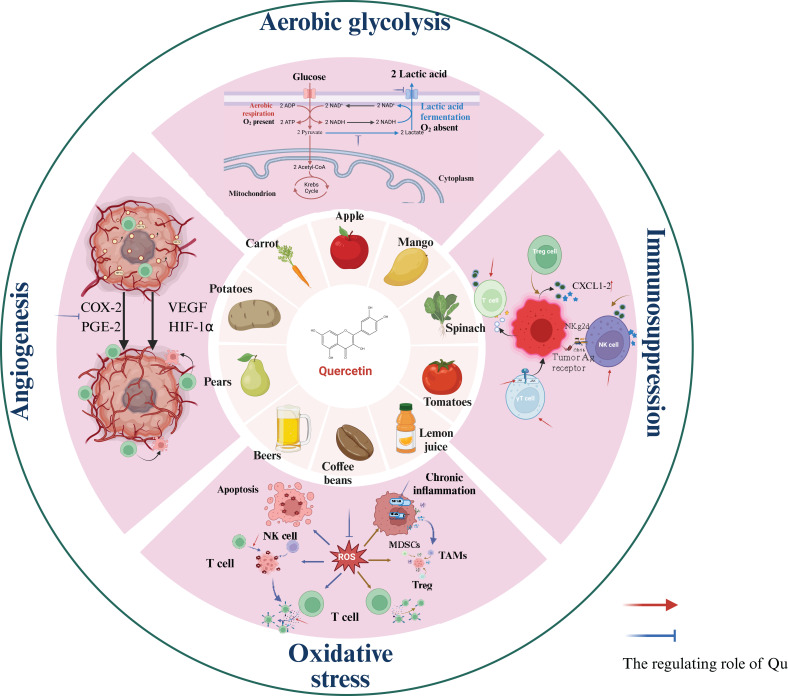
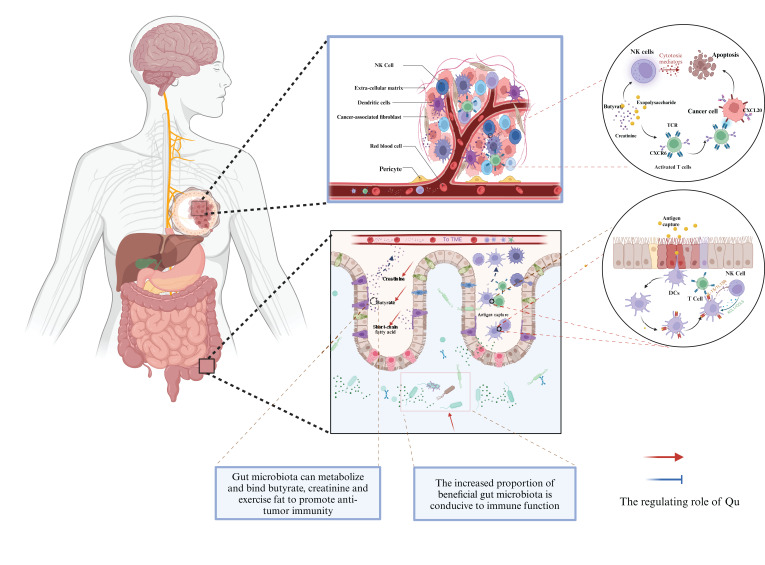
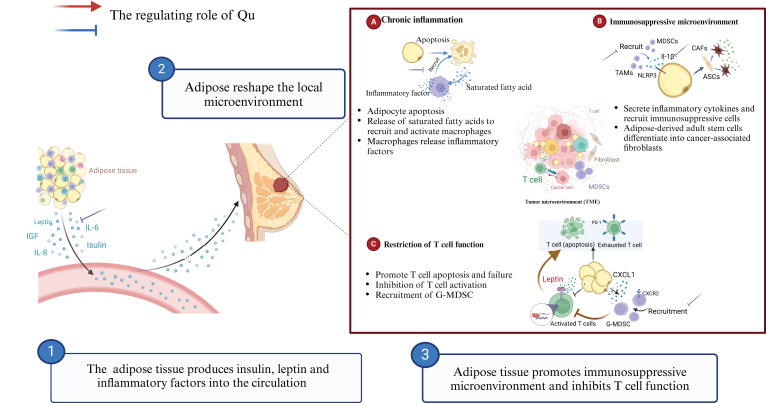
Immunotherapy has brought hope to many breast cancer patients, but not all patients benefit from it. Quercetin (Qu), a natural product found in various sources, has anti-inflammatory and anti-tumor properties. We conducted a review of the pharmacological research of Qu in regulating anti-tumor immunity and . Qu can directly regulate the local tumor microenvironment (TME) by enhancing the activity of immune cells which includes promoting the infiltration of T cells and natural killer (NK) cells, inhibiting the recruitment of myeloid-derived suppressor cells and tumor-associated macrophages. Additionally, Qu inhibits anaerobic glycolysis in tumor cells, thereby reducing the production and transport of lactic acid. It also suppresses tumor angiogenesis by targeting the vascular endothelial growth factor (VEGF) pathway and the vitamin D pathway. Furthermore, Qu can enhance the efficacy of immunotherapy for breast cancer by modulating the systemic microenvironment. This includes inhibiting obesity-related chronic inflammation to decrease the production of inflammatory factors, regulating the composition of intestinal microbiota, and intervening in the metabolism of intestinal flora. At the same time, we also address challenges in the clinical application of Qu, such as low absorption rates and unknown effective doses. In conclusion, we highlight Qu as a natural immunomodulator that enhances immune cell activity and has the potential to be developed as an adjunct for breast cancer.
免疫疗法给许多乳腺癌患者带来了希望,但并非所有患者都能从中受益。槲皮素(Qu)是一种存在于多种来源的天然产物,具有抗炎和抗肿瘤特性。我们对Qu在调节抗肿瘤免疫方面的药理学研究进行了综述。Qu可通过增强免疫细胞活性直接调节局部肿瘤微环境(TME),这包括促进T细胞和自然杀伤(NK)细胞的浸润,抑制髓源性抑制细胞和肿瘤相关巨噬细胞的募集。此外,Qu抑制肿瘤细胞中的无氧糖酵解,从而减少乳酸的产生和转运。它还通过靶向血管内皮生长因子(VEGF)途径和维生素D途径抑制肿瘤血管生成。此外,Qu可通过调节全身微环境增强乳腺癌免疫疗法的疗效。这包括抑制与肥胖相关的慢性炎症以减少炎症因子的产生,调节肠道微生物群的组成,以及干预肠道菌群的代谢。同时,我们也讨论了Qu在临床应用中的挑战,如吸收率低和有效剂量未知。总之,我们强调Qu作为一种天然免疫调节剂,可增强免疫细胞活性,有潜力被开发为乳腺癌的辅助治疗药物。