Cheng Shilei, Li Yufei, Sun Xiaoliang, Liu Zhirui, Guo Liang, Wu Jueheng, Yang Xiaohan, Wei Sisi, Wu Guanghan, Xu Shilong, Yang Fan, Wu Jianbo
School of Anesthesiology, Shandong Second Medical University, Weifang, China.
Department of Anesthesiology, The First Affiliated Hospital of Shandong First Medical University & Shandong Provincial Qianfoshan Hospital, Jinan, China.
Front Immunol. 2024 Dec 6;15:1508985. doi: 10.3389/fimmu.2024.1508985. eCollection 2024.
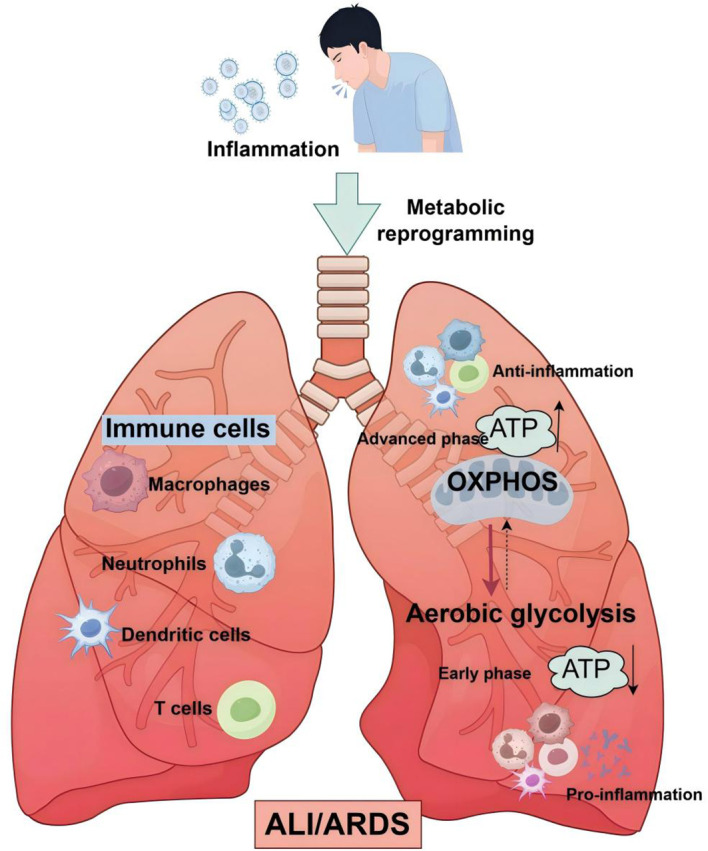
Acute lung injury (ALI) is a prevalent and critical complication of sepsis, marked by high incidence and mortality rates, with its pathogenesis still not being fully elucidated. Recent research has revealed a significant correlation between the metabolic reprogramming of glucose and sepsis-associated ALI (S-ALI). Throughout the course of S-ALI, immune cells, including macrophages and dendritic cells, undergo metabolic shifts to accommodate the intricate demands of immune function that emerge as sepsis advances. Indeed, glucose metabolic reprogramming in S-ALI serves as a double-edged sword, fueling inflammatory immune responses in the initial stages and subsequently initiating anti-inflammatory responses as the disease evolves. In this review, we delineate the current research progress concerning the pathogenic mechanisms linked to glucose metabolic reprogramming in S-ALI, with a focus on the pertinent immune cells implicated. We encapsulate the impact of glucose metabolic reprogramming on the onset, progression, and prognosis of S-ALI. Ultimately, by examining key regulatory factors within metabolic intermediates and enzymes, We have identified potential therapeutic targets linked to metabolic reprogramming, striving to tackle the inherent challenges in diagnosing and treating Severe Acute Lung Injury (S-ALI) with greater efficacy.
急性肺损伤(ALI)是脓毒症常见且严重的并发症,发病率和死亡率高,其发病机制仍未完全阐明。最近的研究表明,葡萄糖代谢重编程与脓毒症相关急性肺损伤(S-ALI)之间存在显著关联。在S-ALI病程中,包括巨噬细胞和树突状细胞在内的免疫细胞会发生代谢转变,以适应随着脓毒症进展而出现的复杂免疫功能需求。事实上,S-ALI中的葡萄糖代谢重编程是一把双刃剑,在疾病初期促进炎症免疫反应,随后随着疾病进展引发抗炎反应。在这篇综述中,我们阐述了当前关于S-ALI中与葡萄糖代谢重编程相关的致病机制的研究进展,重点关注相关免疫细胞。我们总结了葡萄糖代谢重编程对S-ALI的发生、发展和预后的影响。最终,通过研究代谢中间体和酶中的关键调节因子,我们确定了与代谢重编程相关的潜在治疗靶点,力求更有效地应对重症急性肺损伤(S-ALI)诊断和治疗中的固有挑战。