Jiang Li, Lin Zhiqiang
Department of Pharmacy, Quanzhou First Hospital Affiliated to Fujian Medical University, Quanzhou, Fujian Province, China.
Front Pharmacol. 2024 Dec 6;15:1439586. doi: 10.3389/fphar.2024.1439586. eCollection 2024.
Exploring adjustments to the voriconazole dosing program based on therapeutic drug monitoring results to implement individualized therapy.
PubMed and Embase were systematically searched to obtain study about voriconazole dose adjustment program guided by therapeutic drug monitoring. Quality evaluation and summarization of the obtained studies were performed to obtain program adjustments for voriconazole under therapeutic drug monitoring.
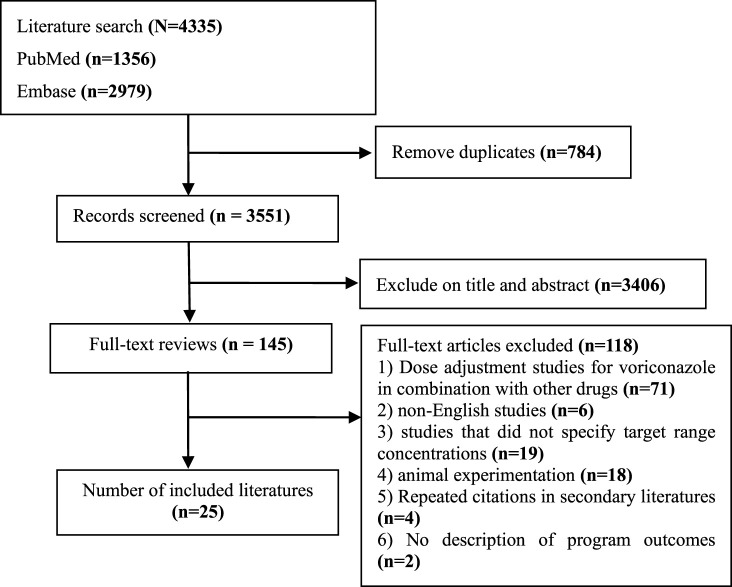
A total of 1,356 and 2,979 studies were searched on PubMed and Embase, respectively, and after removing irrelevant and duplicated studies, a total of 25 studies were included. A loading dose of 5 mg/kg q12 h or 200 mg q12 h and a maintenance dose of 50 mg q12 h or 100 mg q24 h is recommended for patients with Child-Pugh C. And in patients with Child-Pugh C, CYP2C19 genotype had no significant effect on voriconazole blood concentrations. Recommendations for presenting dosing programs based on different CYP2C19 genotypes are inconsistent, and genetic testing is not routinely recommended prior to dosing from a pharmacoeconomic perspective. Additionally, in adult patients, if the voriconazole trough concentration is subtherapeutic, the voriconazole dose should be increased by 25%∼50%. If the voriconazole trough concentration is supratherapeutic,the voriconazole dose should be decreased by 25%∼50%. If a drug-related adverse event occurs, hold 1 dose, decrease subsequent dose by 50%.In pediatric patients, if the voriconazole trough concentration is subtherapeutic, increase the voriconazole dose by 1∼2 mg/kg or increase the voriconazole dose by 50%. If the voriconazole trough concentration is supratherapeutic, reduce the voriconazole dose by 1 mg/kg or hold 1 dose, and decrease the subsequent dose by 25%.
It is recommended that all patients on voriconazole should have their initial dosing program selected on the basis of their hepatic function or other influencing factors (e.g., pathogens, infections, C-reactive protein, albumin, or obesity), and that therapeutic concentrations should be achieved through appropriate dosage adjustments guided by therapeutic drug monitoring. Routine genetic testing for voriconazole application in patients is not considered necessary at this time. However, there has been a great deal of research and partial consensus on individualized dosing of voriconazole, but there are still some critical issues that have not been resolved.
根据治疗药物监测结果探索伏立康唑给药方案的调整,以实施个体化治疗。
系统检索PubMed和Embase,以获取关于治疗药物监测指导下伏立康唑剂量调整方案的研究。对获取的研究进行质量评估和总结,以得出治疗药物监测下伏立康唑的方案调整。
在PubMed和Embase上分别检索到1356项和2979项研究,去除无关和重复研究后,共纳入25项研究。对于Child-Pugh C级患者,推荐负荷剂量为5mg/kg q12h或200mg q12h,维持剂量为50mg q12h或100mg q24h。在Child-Pugh C级患者中,CYP2C19基因型对伏立康唑血药浓度无显著影响。基于不同CYP2C19基因型给出给药方案的建议不一致,从药物经济学角度出发,不常规推荐给药前进行基因检测。此外,在成年患者中,如果伏立康唑谷浓度低于治疗水平,伏立康唑剂量应增加25%至50%。如果伏立康唑谷浓度高于治疗水平,伏立康唑剂量应减少25%至50%。如果发生药物相关不良事件,停用1剂,后续剂量减少50%。在儿科患者中,如果伏立康唑谷浓度低于治疗水平,将伏立康唑剂量增加1至2mg/kg或增加50%。如果伏立康唑谷浓度高于治疗水平,将伏立康唑剂量减少1mg/kg或停用1剂,后续剂量减少25%。
建议所有接受伏立康唑治疗的患者应根据其肝功能或其他影响因素(如病原体、感染、C反应蛋白、白蛋白或肥胖)选择初始给药方案,并通过治疗药物监测指导下的适当剂量调整达到治疗浓度。目前认为对患者进行伏立康唑应用的常规基因检测没有必要。然而,关于伏立康唑个体化给药已有大量研究并达成部分共识,但仍有一些关键问题尚未解决。