Guo Jiru, Yang Hong, Zhang Xiaoli
School of Economics and Management, Shanghai University of Sport, Shanghai, China.
School of Physical Education, Xi'an Physical Education University, Xi'an, China.
Front Psychol. 2024 Dec 6;15:1471658. doi: 10.3389/fpsyg.2024.1471658. eCollection 2024.
While engaging in sports is widely recognized for enhancing wellbeing, limited research has examined the effects of watching sports events on individuals' subjective wellbeing. The mechanisms and pathways underlying this relationship remain unclear.
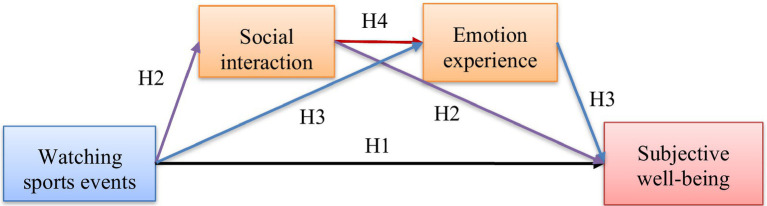
This study explores the correlation between watching sports events and the wellbeing of Chinese individuals, based on the theoretical framework of "spectator behavior → social interaction → emotional experience → happiness." The aim is to investigate the mediating effects of social interaction and emotional experience, providing insights for promoting greater participation in sports events and supporting the healthy development of the sports industry.
The study involved 885 participants from five representative provinces and cities in China. Assessment tools included the Physical Activity Rating Scale, Social Interaction Questionnaire, Emotional Experience Questionnaire, and Subjective Wellbeing Scale. Data were analyzed using Stata and the PROCESS plug-in of SPSS for comprehensive multivariate statistical analysis.
Watching sports events significantly and positively affects subjective wellbeing, social interaction, and emotional experience ( < 0.001). Three mediating pathways were identified: (1) watching sports events → social interaction → subjective wellbeing (effect size: 0.024), (2) watching sports events → emotional experience → subjective wellbeing (effect size: 0.011), and (3) watching sports events → social interaction → emotional experience → subjective wellbeing (effect size: 0.003).
The direct impact of watching sports events on subjective wellbeing was positive. Indirect effects were facilitated by the mediating roles of social interaction and emotional experience, with the effect of social interaction being more substantial than that of emotional experience.
These findings suggest that watching sports events can serve as a catalyst for enhancing wellbeing, primarily through fostering social connections and enriching emotional experiences. Practically, this indicates the potential value of encouraging viewership of sports events as a means of promoting community engagement and mental health, thus contributing to the holistic growth of the sports sector and public health initiatives.
虽然参与体育运动因能增进幸福感而广为人知,但关于观看体育赛事对个人主观幸福感影响的研究却很有限。这种关系背后的机制和途径仍不明确。
本研究基于“观众行为→社会互动→情感体验→幸福感”的理论框架,探讨观看体育赛事与中国个体幸福感之间的相关性。旨在研究社会互动和情感体验的中介作用,为促进更多人参与体育赛事以及支持体育产业的健康发展提供见解。
该研究涉及来自中国五个具有代表性的省市的885名参与者。评估工具包括体育活动评分量表、社会互动问卷、情感体验问卷和主观幸福感量表。使用Stata和SPSS的PROCESS插件进行数据分析,以进行全面的多变量统计分析。
观看体育赛事对主观幸福感、社会互动和情感体验有显著的正向影响(<0.001)。确定了三条中介途径:(1)观看体育赛事→社会互动→主观幸福感(效应量:0.024),(2)观看体育赛事→情感体验→主观幸福感(效应量:0.011),以及(3)观看体育赛事→社会互动→情感体验→主观幸福感(效应量:0.003)。
观看体育赛事对主观幸福感的直接影响是积极的。社会互动和情感体验的中介作用促进了间接影响,其中社会互动的作用比情感体验更为显著。
这些发现表明,观看体育赛事可以成为增进幸福感的催化剂,主要是通过促进社会联系和丰富情感体验。实际上,这表明鼓励观看体育赛事作为促进社区参与和心理健康的一种手段具有潜在价值,从而有助于体育部门和公共卫生倡议的整体发展。