Osako Miho, Yamaoka Yui, Mochizuki Yoko, Fujiwara Takeo
Department of Neurology, Tokyo Metropolitan Kita Medical and Rehabilitation Center for the Disabled, 1-2-3 Jujodai, Kita-ku, Tokyo 114-0033, Japan.
Department of Global Health Promotion, Tokyo Medical and Dental University, 1-5-45, Yushima, Bunkyo-ku, Tokyo 113-8519, Japan.
Health Care Transit. 2023 Dec 29;2:100037. doi: 10.1016/j.hctj.2023.100037. eCollection 2024.
Individuals with childhood-onset neurologic conditions often face challenges in the pediatric-to-adult health care transition (HCT). Furthermore, the importance of implementing primary care is unrecognized. We investigated the situation of adults with childhood-onset neurologic conditions from the perspective of health care professionals (HCPs) in community- and hospital-based primary care practice.
Overall, 1334 HCPs in medical facilities across Tokyo (mainly in Kita, Nerima, and Itabashi Cities) were surveyed regarding their experience caring for adults with childhood-onset neurologic conditions. Snowball sampling was also deployed to enhance the input from various health professions. The questionnaire included quick response codes linked to web-based questionnaires identical to paper-based ones, enabling additional HCPs to answer the questionnaire. The survey included questions about the care provided by HCPs, the perceived challenges and worthwhileness of the care, and their views on HCT.
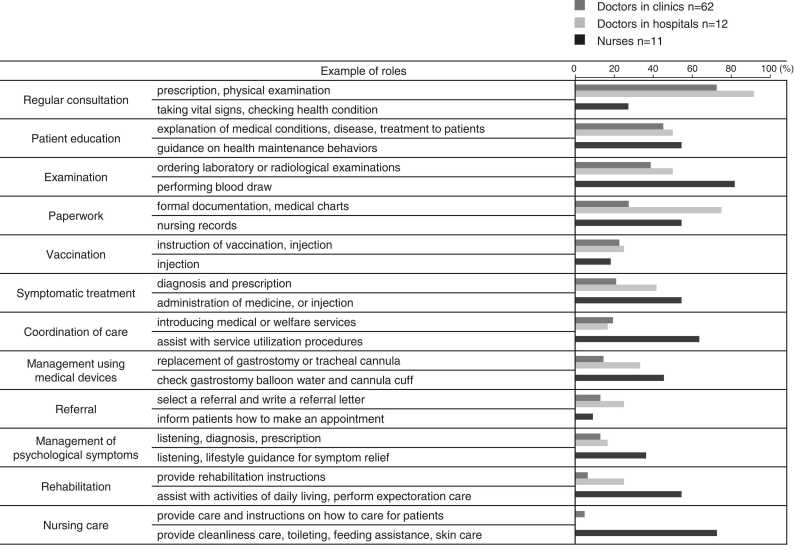
We collected 276 responses (response rate, 20.7%): 224 by mail and 52 online. In total, 94 HCPs of the respondents (75 doctors, 11 nurses, 5 therapists, 2 care workers, and 1 medical social worker) involved in caring for this population were analyzed. Doctors and nurses managed medical devices, educated patients, and provided consultation and care. Doctors cited the management of comorbidities outside of their expertise and difficulties securing hospitalization during emergencies as barriers to care. HCPs found the valuable opportunities to enrich their clinical experience and long-term relationships with patients worthwhile. HCPs expressed the need for systems that guarantee patient hospitalization and multidisciplinary conferences between HCPs and specialists.
We described the roles of HCPs in community- and hospital-based primary care, which are vital components of HCT for adults with childhood-onset neurologic conditions. Their practice includes multidisciplinary involvement, patient education, and care coordination. For better HCT in this population, efforts are required to enhance HCPs' capability to respond to patients with disabilities, patients' multiple comorbidities, and families' needs.
Further efforts to deepen community-based care are desired to improve HCT for people with childhood-onset neurologic conditions.
患有儿童期起病神经系统疾病的个体在从儿科向成人医疗保健过渡(HCT)过程中常常面临挑战。此外,实施初级保健的重要性尚未得到认可。我们从社区和医院初级保健机构的医护人员(HCPs)角度调查了患有儿童期起病神经系统疾病的成年人的情况。
总体而言,对东京各地(主要在北区、练马区和板桥区)医疗机构中的1334名医护人员进行了调查,询问他们照顾患有儿童期起病神经系统疾病成年人的经历。还采用了滚雪球抽样法以增加来自不同卫生专业的意见。问卷包含与基于网络的问卷相关联的快速响应码,这些问卷与纸质问卷相同,使更多医护人员能够回答问卷。调查问题包括医护人员提供的护理、护理中察觉到的挑战和价值,以及他们对医疗保健过渡的看法。
我们收集到276份回复(回复率为20.7%):224份通过邮寄,52份通过网络。总共对参与照顾这一人群的94名医护人员(75名医生、11名护士、5名治疗师、2名护理人员和1名医务社会工作者)进行了分析。医生和护士管理医疗设备、对患者进行教育,并提供咨询和护理。医生指出,处理其专业领域之外的合并症以及在紧急情况下确保住院治疗存在困难是护理的障碍。医护人员认为丰富临床经验以及与患者建立长期关系的宝贵机会是值得的。医护人员表示需要有保障患者住院治疗的系统以及医护人员与专科医生之间的多学科会议。
我们描述了医护人员在社区和医院初级保健中的作用,这是患有儿童期起病神经系统疾病成年人医疗保健过渡的重要组成部分。他们的工作包括多学科参与、患者教育和护理协调。为了在这一人群中实现更好的医疗保健过渡,需要努力提高医护人员应对残疾患者、患者多种合并症以及家庭需求的能力。
期望进一步努力深化基于社区的护理,以改善患有儿童期起病神经系统疾病人群的医疗保健过渡。