Morey Gabriella, Morey Valeria C, Gruman Taylor, Al-Khayat Thura
Department of Medical Education, Nova Southeastern University Dr. Kiran C. Patel College of Allopathic Medicine, Davie, USA.
Department of Biological Sciences, Florida International University, Miami, USA.
Cureus. 2024 Nov 19;16(11):e74034. doi: 10.7759/cureus.74034. eCollection 2024 Nov.
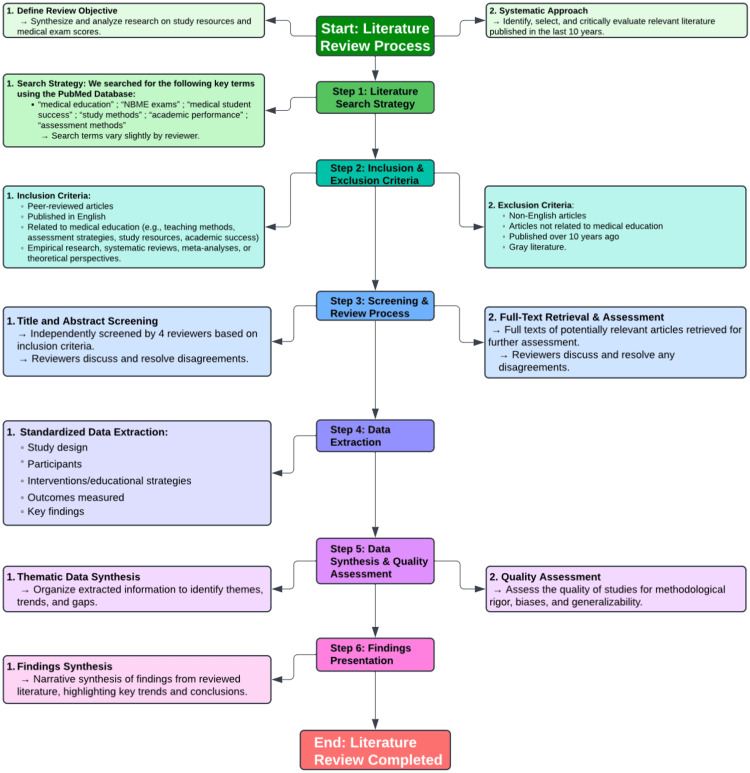
Medical school exams, like those by the National Board of Medical Examiners (NBME) and the United States Medical Licensing Examination (USMLE), assess essential knowledge and skills for safe patient care, essential for student advancement and securing competitive residencies. Understanding the correlation between exam scores and medical school performance, as well as identifying trends among high scorers, provides valuable insights for both medical students and educators. This review examines the link between study resources and NBME exam scores, as well as psychological factors influencing these outcomes. The focus is on identifying key factors, particularly study resources, that can improve medical student test scores. This literature review synthesizes research from the past 15 years on teaching methods, study resources, and academic success in medical education. While foundational knowledge and study techniques are widely agreed upon, there are gaps in evaluating specific approaches, alternative materials, and the integration of new educational technologies. Key findings from our review include the effectiveness of practice questions and spaced repetition for long-term retention, as well as the impact of prior academic performance and study strategies (e.g., question bank use) on Step 2 Clinical Knowledge (CK) scores. Factors like time management, self-testing skills, and structured preparation programs are crucial to success. Commercial resources like First Aid, UWorld, Boards and Beyond, and Pathoma are noted for their comprehensive support in exam preparation. Future research may offer insights to further optimize study strategies and improve performance.
医学院校考试,如美国国家医学考试委员会(NBME)和美国医师执照考试(USMLE)举办的考试,评估安全护理患者所需的基本知识和技能,这对学生的进步和获得有竞争力的住院医师培训资格至关重要。了解考试成绩与医学院校学业表现之间的关联,以及找出高分者的趋势,可为医学生和教育工作者提供宝贵的见解。本综述考察了学习资源与NBME考试成绩之间的联系,以及影响这些结果的心理因素。重点是找出能够提高医学生考试成绩的关键因素,尤其是学习资源。这篇文献综述综合了过去15年关于医学教育中的教学方法、学习资源和学业成就的研究。虽然基础知识和学习技巧已得到广泛认可,但在评估具体方法、替代材料以及新教育技术的整合方面仍存在差距。我们综述的主要发现包括练习题和间隔重复对长期记忆的有效性,以及先前学业表现和学习策略(如使用题库)对第二步临床知识(CK)分数的影响。时间管理、自我测试技能和结构化备考计划等因素对成功至关重要。像《急救》《优题库》《博傲医考》和《病理图谱》等商业资源在考试准备方面提供了全面支持而受到关注。未来的研究可能会提供进一步优化学习策略和提高成绩的见解。