Tarquino Jonathan, Rodríguez Jhonathan, Becerra David, Roa-Peña Lucia, Romero Eduardo
Computer Imaging and Medical Application Laboratory, Universidad Nacional de Colombia, Bogotá 111321, Colombia.
Department of Pathology, School of Medicine, Universidad Nacional de Colombia, Bogotá, Colombia.
J Pathol Inform. 2024 Jul 3;15:100390. doi: 10.1016/j.jpi.2024.100390. eCollection 2024 Dec.
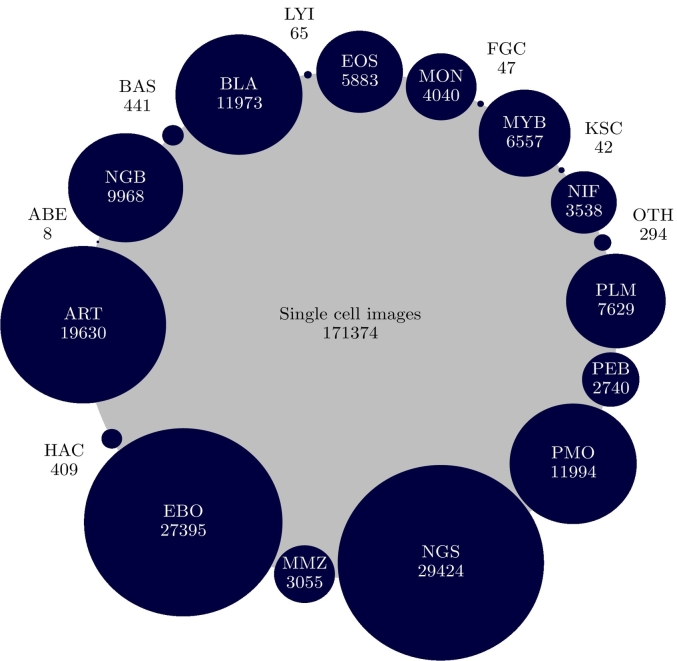
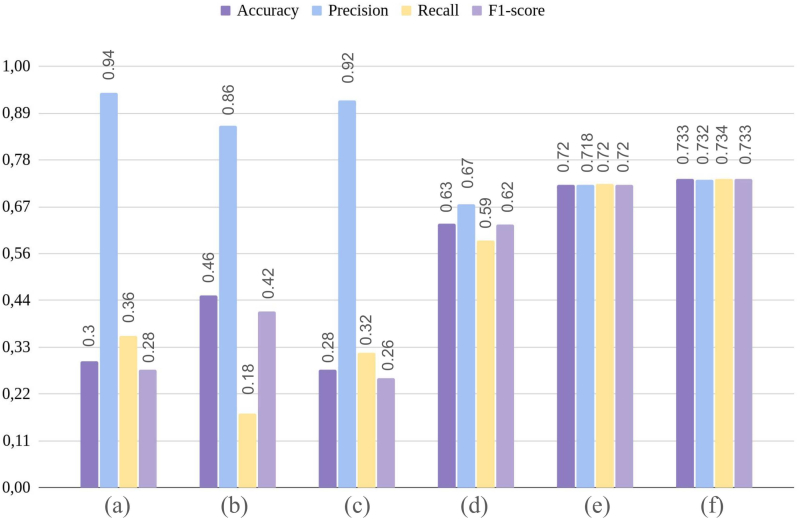
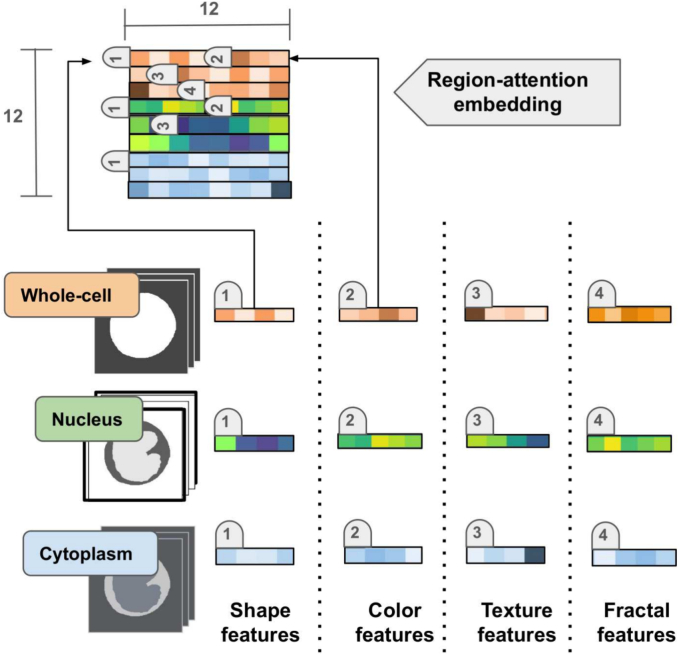
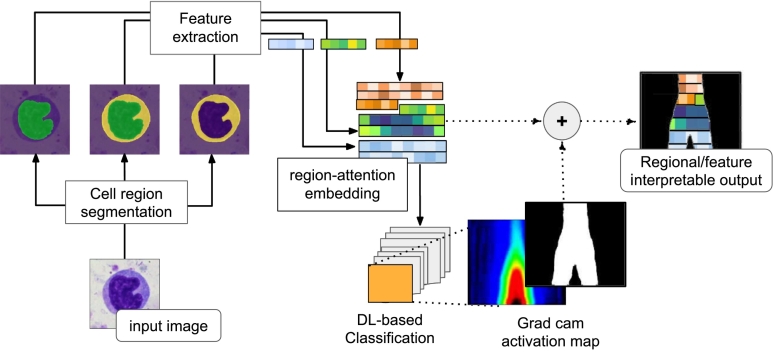
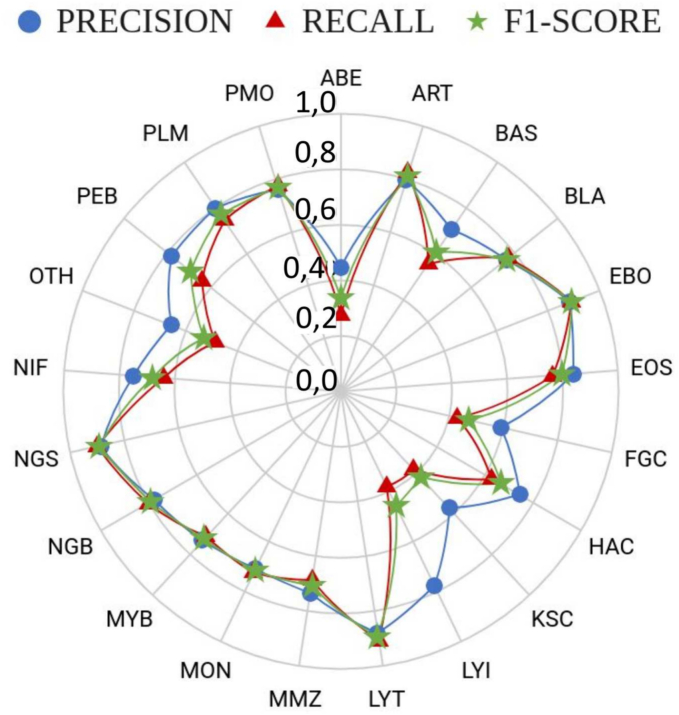
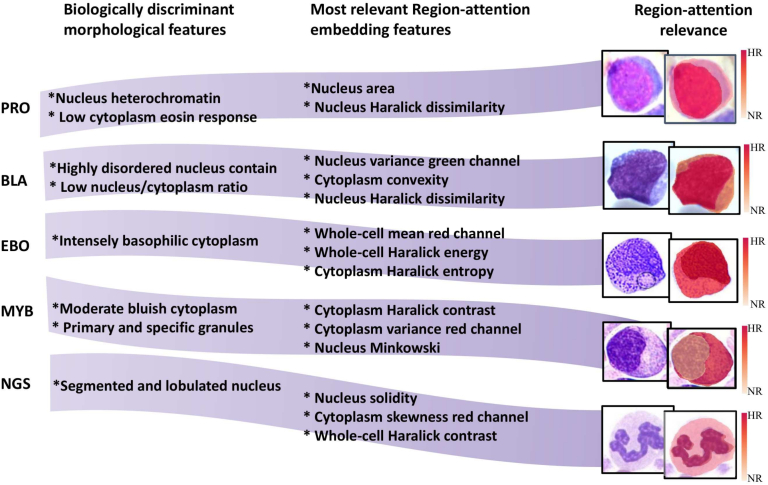
Cytomorphology evaluation of bone marrow cell is the initial step to diagnose different hematological diseases. This assessment is still manually performed by trained specialists, who may be a bottleneck within the clinical process. Deep learning algorithms are a promising approach to automate this bone marrow cell evaluation. These artificial intelligence models have focused on limited cell subtypes, mainly associated to a particular disease, and are frequently presented as black boxes. The herein introduced strategy presents an engineered feature representation, the region-attention embedding, which improves the deep learning classification performance of a cytomorphology with 21 bone marrow cell subtypes. This embedding is built upon a specific organization of cytology features within a squared matrix by distributing them after pre-segmented cell regions, i.e., cytoplasm, nucleus, and whole-cell. This novel cell image representation, aimed to preserve spatial/regional relations, is used as input of the network. Combination of region-attention embedding and deep learning networks (Xception and ResNet50) provides local relevance associated to image regions, adding up interpretable information to the prediction. Additionally, this approach is evaluated in a public database with the largest number of cell subtypes (21) by a thorough evaluation scheme with three iterations of a 3-fold cross-validation, performed in 80% of the images ( = 89,484), and a testing process in an unseen set of images composed by the remaining 20% of the images ( = 22,371). This evaluation process demonstrates the introduced strategy outperforms previously published approaches in an equivalent validation set, with a f1-score of 0.82, and presented competitive results on the unseen data partition with a f1-score of 0.56.
骨髓细胞的细胞形态学评估是诊断不同血液系统疾病的第一步。这项评估目前仍由训练有素的专家手动进行,这可能成为临床过程中的一个瓶颈。深度学习算法是实现骨髓细胞评估自动化的一种很有前景的方法。这些人工智能模型主要关注有限的细胞亚型,且主要与特定疾病相关,并且常常被视为黑箱。本文介绍的策略提出了一种经过设计的特征表示方法,即区域注意力嵌入,它提高了对21种骨髓细胞亚型进行细胞形态学深度学习分类的性能。这种嵌入是基于细胞学特征在方形矩阵中的特定组织构建的,通过在预先分割的细胞区域(即细胞质、细胞核和全细胞)之后分布这些特征来实现。这种旨在保留空间/区域关系的新型细胞图像表示方法被用作网络的输入。区域注意力嵌入与深度学习网络(Xception和ResNet50)的结合提供了与图像区域相关的局部相关性,为预测增加了可解释的信息。此外,该方法在一个拥有最大数量细胞亚型(21种)的公共数据库中进行评估,采用了一种全面的评估方案,即进行三次3折交叉验证迭代,其中80%的图像(=89484张)用于验证,其余20%的图像(=22371张)用于在一个未见图像集上进行测试。该评估过程表明,在等效验证集中,所介绍的策略优于先前发表的方法,f1分数为0.82,并且在未见数据分区上也呈现出具有竞争力的结果,f1分数为0.56。