Ahmad Riaz, Awais Muhammad, Kausar Nabeela, Akram Tallha
Department of Computer Science, Iqra University, Islamabad 44800, Pakistan.
Department of Computer Science, COMSATS University Islamabad, Wah Campus, Wah Cantt 47010, Pakistan.
Diagnostics (Basel). 2023 Jan 18;13(3):352. doi: 10.3390/diagnostics13030352.
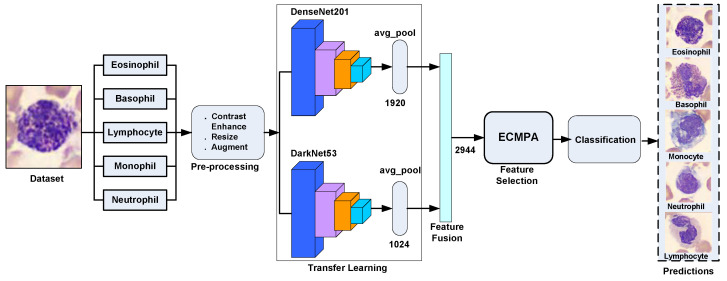
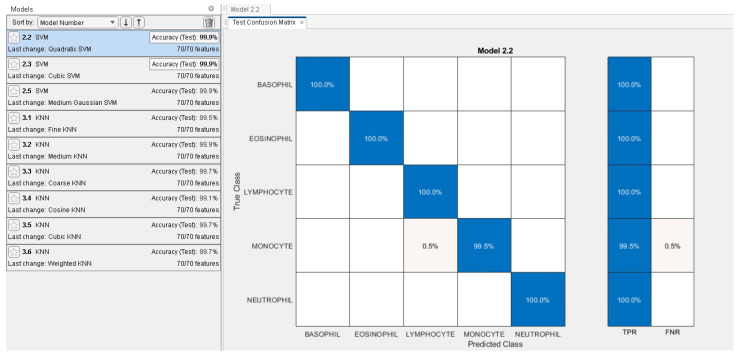
White blood cells (WBCs) constitute an essential part of the human immune system. The correct identification of WBC subtypes is critical in the diagnosis of leukemia, a kind of blood cancer defined by the aberrant proliferation of malignant leukocytes in the bone marrow. The traditional approach of classifying WBCs, which involves the visual analysis of blood smear images, is labor-intensive and error-prone. Modern approaches based on deep convolutional neural networks provide significant results for this type of image categorization, but have high processing and implementation costs owing to very large feature sets. This paper presents an improved hybrid approach for efficient WBC subtype classification. First, optimum deep features are extracted from enhanced and segmented WBC images using transfer learning on pre-trained deep neural networks, i.e., DenseNet201 and Darknet53. The serially fused feature vector is then filtered using an entropy-controlled marine predator algorithm (ECMPA). This nature-inspired meta-heuristic optimization algorithm selects the most dominant features while discarding the weak ones. The reduced feature vector is classified with multiple baseline classifiers with various kernel settings. The proposed methodology is validated on a public dataset of 5000 synthetic images that correspond to five different subtypes of WBCs. The system achieves an overall average accuracy of 99.9% with more than 95% reduction in the size of the feature vector. The feature selection algorithm also demonstrates better convergence performance as compared to classical meta-heuristic algorithms. The proposed method also demonstrates a comparable performance with several existing works on WBC classification.
白细胞(WBCs)是人体免疫系统的重要组成部分。白细胞亚型的正确识别对于白血病的诊断至关重要,白血病是一种由骨髓中恶性白细胞异常增殖所定义的血癌。传统的白细胞分类方法涉及对血液涂片图像进行视觉分析,这种方法劳动强度大且容易出错。基于深度卷积神经网络的现代方法在这类图像分类方面取得了显著成果,但由于特征集非常大,处理和实现成本很高。本文提出了一种改进的混合方法,用于高效的白细胞亚型分类。首先,使用预训练深度神经网络(即DenseNet201和Darknet53)上的迁移学习,从增强和分割后的白细胞图像中提取最优深度特征。然后,使用熵控制的海洋捕食者算法(ECMPA)对串联融合的特征向量进行滤波。这种受自然启发的元启发式优化算法选择最主要的特征,同时舍弃较弱的特征。对缩减后的特征向量使用具有各种核设置的多个基线分类器进行分类。所提出的方法在一个包含5000张合成图像的公共数据集上进行了验证,这些图像对应于白细胞的五种不同亚型。该系统实现了99.9%的总体平均准确率,特征向量大小减少了95%以上。与经典元启发式算法相比,特征选择算法还表现出更好的收敛性能。所提出的方法在白细胞分类方面也与几项现有工作表现出相当的性能。