Schuler Sebastian, Einsiedler Manuel, Evers Julia K, Malay Mert, Uka Valdet, Schneider Sabine, Gulder Tobias A M
Chair of Technical Biochemistry, Technische Universität Dresden, Bergstraße 66, 01069, Dresden, Germany.
Department of Natural Product Biotechnology, Helmholtz Institute for Pharmaceutical Research Saarland (HIPS), Helmholtz Centre for Infection Research (HZI) and Department of Pharmacy at Saarland University, PharmaScienceHub (PSH), Campus E8.1, 66123, Saarbrücken, Germany.
Angew Chem Int Ed Engl. 2025 Mar 24;64(13):e202420335. doi: 10.1002/anie.202420335. Epub 2025 Feb 27.
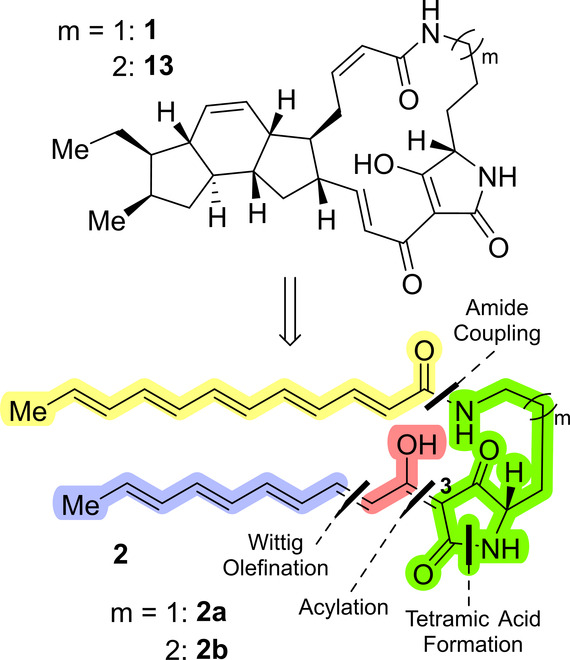
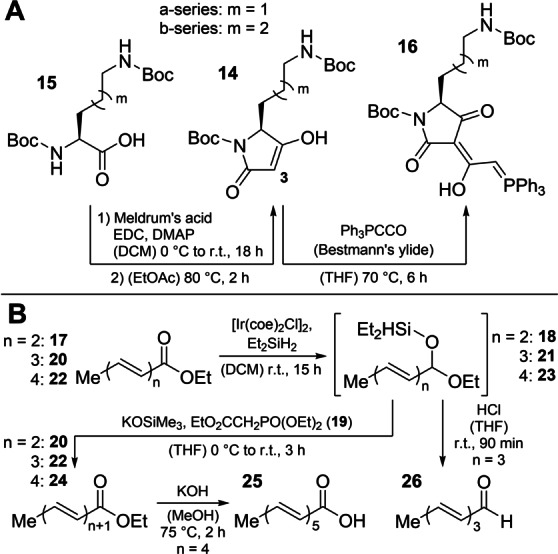
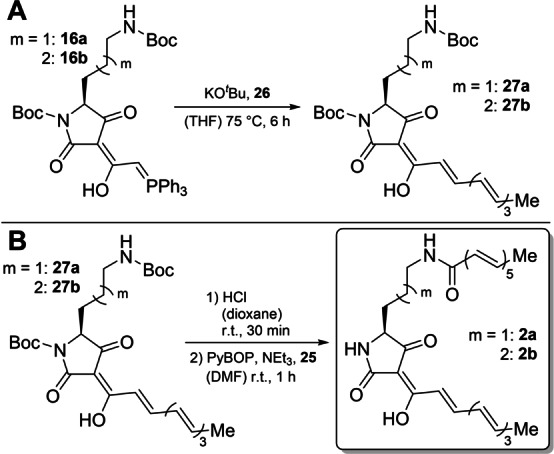
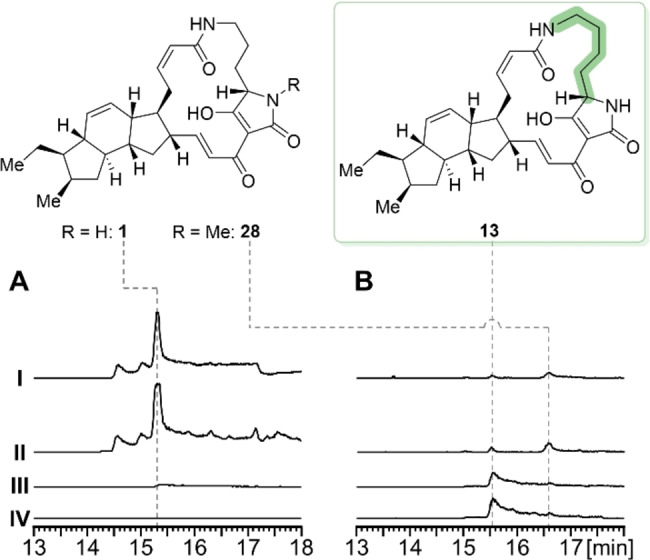
Polycyclic tetramate macrolactams (PoTeMs) represent a growing class of bioactive natural products that are derived from a common tetramate polyene precursor, lysobacterene A, produced by an unusual bacterial iterative polyketide synthase (PKS)/non-ribosomal peptide synthetase (NRPS). The structural and functional diversity of PoTeMs is biosynthetically elaborated from lysobacterene A by pathway-specific cyclizing and modifying enzymes. This results in diverse core structure decoration and cyclization patterns. However, approaches to directly edit the PoTeM carbon skeleton do currently not exist. We thus set out to modify the PoTeM core structure by exchanging the natural l-ornithine-derived building block by l-lysine, hence extending macrocycle size by an additional CH group. We developed streamlined synthetic access to lysobacterene A and the corresponding extended analog and achieved cyclization of both precursors by the cognate PoTeM cyclases IkaBC in vitro. This chemo-enzymatic approach corroborated the catalytic competence of IkaBC to produce a larger macrolactam yielding homo-ikarugamycin. We thus engineered the adenylation domain active site of IkaA to directly accept l-lysine, which upon co-expression with IkaBC delivered a recombinant bacterial homo-ikarugamycin producer. Our work establishes an entirely new PoTeM structural framework and sets the stage for the biotechnological diversification of the PoTeM natural product class in general.
多环四酰胺大环内酯类化合物(PoTeMs)是一类不断增加的生物活性天然产物,它们源自一种常见的四酰胺多烯前体——溶杆菌烯A,由一种不寻常的细菌迭代聚酮合酶(PKS)/非核糖体肽合成酶(NRPS)产生。PoTeMs的结构和功能多样性是通过途径特异性环化和修饰酶从溶杆菌烯A进行生物合成修饰而来的。这导致了不同的核心结构修饰和环化模式。然而,目前还不存在直接编辑PoTeM碳骨架的方法。因此,我们着手通过用L-赖氨酸取代天然的L-鸟氨酸衍生构建块来修饰PoTeM核心结构,从而使大环尺寸增加一个额外的CH基团。我们开发了一种简化的合成方法来制备溶杆菌烯A和相应的扩展类似物,并在体外通过同源的PoTeM环化酶IkaBC实现了两种前体的环化。这种化学酶法证实了IkaBC催化生成更大的大环内酯从而产生高伊卡鲁霉素的能力。因此,我们对IkaA的腺苷化结构域活性位点进行了工程改造,使其能够直接接受L-赖氨酸,与IkaBC共表达时可产生重组细菌高伊卡鲁霉素生产者。我们的工作建立了一个全新的PoTeM结构框架,并为PoTeM天然产物类别的生物技术多样化奠定了基础。