Kosciessa Julian Q, Mayr Ulrich, Lindenberger Ulman, Garrett Douglas D
Max Planck UCL Centre for Computational Psychiatry and Ageing Research, Berlin, Germany.
Center for Lifespan Psychology, Max Planck Institute for Human Development, Berlin, Germany.
Nat Commun. 2024 Dec 23;15(1):10717. doi: 10.1038/s41467-024-55416-2.
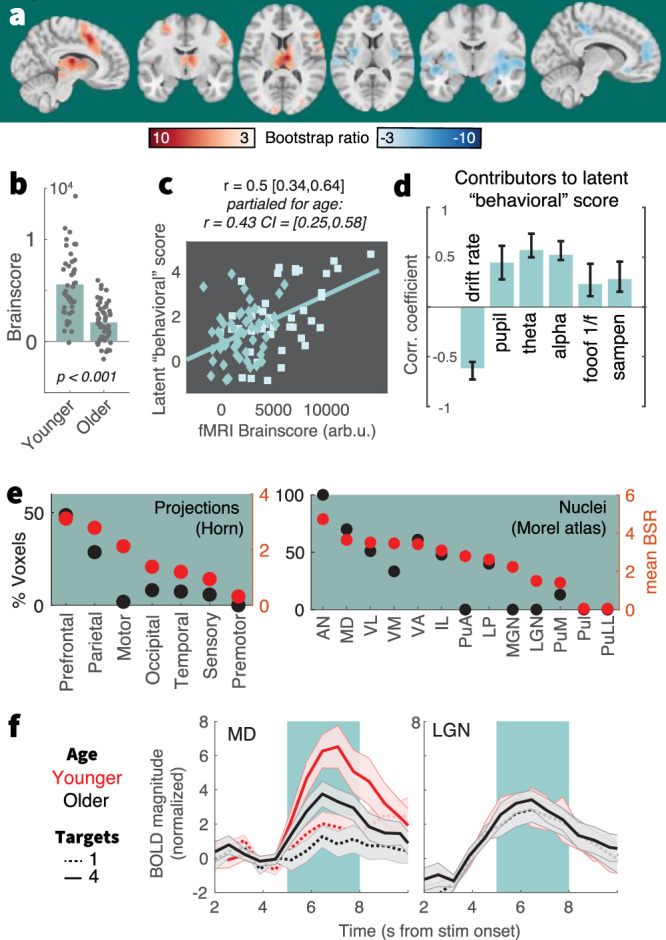
The ability to prioritize among input features according to relevance enables adaptive behaviors across the human lifespan. However, relevance often remains ambiguous, and such uncertainty increases demands for dynamic control. While both cognitive stability and flexibility decline during healthy ageing, it is unknown whether aging alters how uncertainty impacts perception and decision-making, and if so, via which neural mechanisms. Here, we assess uncertainty adjustment across the adult lifespan (N = 100; cross-sectional) via behavioral modeling and a theoretically informed set of EEG-, fMRI-, and pupil-based signatures. On the group level, older adults show a broad dampening of uncertainty adjustment relative to younger adults. At the individual level, older individuals whose modulation more closely resembled that of younger adults also exhibit better maintenance of cognitive control. Our results highlight neural mechanisms whose maintenance plausibly enables flexible task-set, perception, and decision computations across the adult lifespan.
根据相关性对输入特征进行优先级排序的能力使人在整个生命周期中都能表现出适应性行为。然而,相关性往往仍然不明确,这种不确定性增加了动态控制的需求。虽然在健康衰老过程中认知稳定性和灵活性都会下降,但目前尚不清楚衰老是否会改变不确定性对感知和决策的影响,如果是,又是通过何种神经机制。在这里,我们通过行为建模以及一组基于脑电图、功能磁共振成像和瞳孔的理论特征,评估了整个成年期(N = 100;横断面研究)的不确定性调整情况。在群体层面上,与年轻人相比,老年人的不确定性调整普遍受到抑制。在个体层面上,那些调节方式更类似于年轻人的老年人,其认知控制的维持能力也更好。我们的研究结果突出了一些神经机制,这些神经机制的维持可能有助于在整个成年期灵活地进行任务集、感知和决策计算。