Meyer Henrike, Hinz Andreas, Weisgerber Christiane, Pilny Adrian, Dornhöfer Nadja, Mehnert-Theuerkauf Anja, Aktas Bahriye, Wolf Benjamin
Department of Gynecology, University Hospital Leipzig, Liebigstraße 20a, 04103, Leipzig, Germany.
Department of Medical Psychology and Medical Sociology, Comprehensive Cancer Center Central Germany (CCCG), University Medical Center Leipzig, Leipzig, Germany.
Arch Gynecol Obstet. 2025 Apr;311(4):1151-1162. doi: 10.1007/s00404-024-07886-4. Epub 2024 Dec 23.
The Gynecologic Cancer Lymphedema Questionnaire (GCLQ) is an established patient-reported outcome measure for lower extremity lymphedema (LEL) in gynecologic oncology. We aimed to validate the GCLQ in German language (GCLQ-GER) for lymphedema detection in German-speaking patients and also investigated real-world patterns of lymphedema treatment.
The GCLQ was translated from English into German in accordance with the standards of a professional translation process. Subsequently, the questionnaire was administered in a prospective observational study including 102 patients who had undergone lymph node dissection (LND) within gynecologic cancer surgery. Various test quality criteria were calculated for the GCLQ-GER. As gold standard of testing methods, patients were clinically evaluated for LEL, and limb volume measurements were taken. Further data for lymphedema treatment were collected in patients with lymphedema diagnosis.
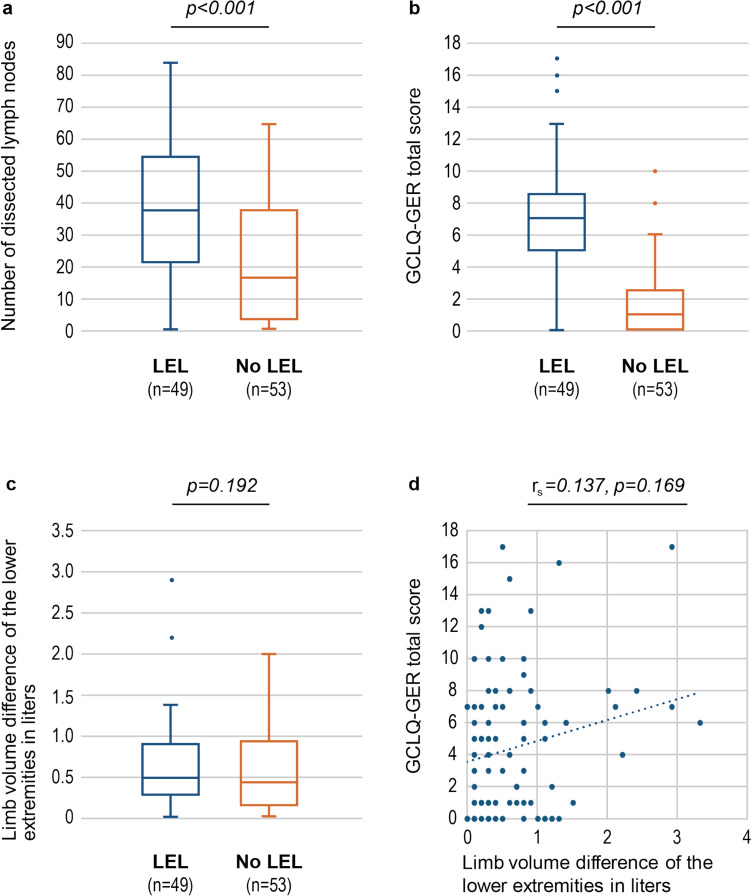
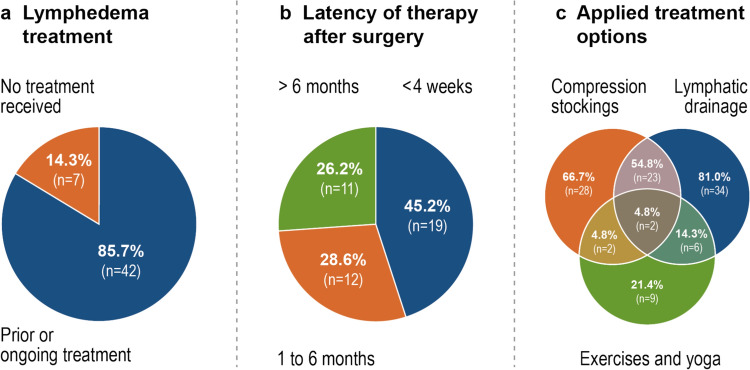
Patients with LEL had increased GCLQ-GER total scores (mean 7.27) compared to patients without LEL (mean 1.81), p < 0.001. High diagnostic accuracy was indicated by the large area under the receiver operating characteristics curve (AUC) of 0.874 (95% CI 0.802-0.946). Based on sensitivity and specificity values ≥ 79.0%, the GCLQ total score ≥ 4 was determined as the optimal cut-off value to identify LEL. Excellent internal consistency was demonstrated by Cronbach's alpha of 0.876. The clinical examination revealed a LEL prevalence of 48.0% (n = 49), and 85.7% (n = 42) of these patients received treatment.
The GCLQ-GER is a valid and feasible patient-reported outcome measure for lymphedema detection in German-speaking gynecologic cancer survivors. Its clinical introduction could improve secondary prevention of lymphedema and real-world treatment.
妇科癌症淋巴水肿问卷(GCLQ)是一种既定的患者报告结局指标,用于评估妇科肿瘤患者的下肢淋巴水肿(LEL)。我们旨在验证德语版的GCLQ(GCLQ-GER)在德语患者中检测淋巴水肿的有效性,并调查淋巴水肿治疗的实际模式。
按照专业翻译流程的标准将GCLQ从英语翻译成德语。随后,在一项前瞻性观察性研究中对该问卷进行应用,该研究纳入了102例在妇科癌症手术中接受了淋巴结清扫术(LND)的患者。计算了GCLQ-GER的各种测试质量标准。作为测试方法的金标准,对患者进行了LEL的临床评估,并测量了肢体体积。对诊断为淋巴水肿的患者收集了有关淋巴水肿治疗的进一步数据。
与无LEL的患者(平均1.81)相比,LEL患者的GCLQ-GER总分更高(平均7.27),p <0.001。受试者工作特征曲线(AUC)下的大面积为0.874(95% CI 0.802-0.946),表明诊断准确性高。基于敏感性和特异性值≥79.0%,将GCLQ总分≥4确定为识别LEL的最佳临界值。Cronbach's alpha为0.876,表明具有出色的内部一致性。临床检查显示LEL患病率为48.0%(n = 49),其中85.7%(n = 42)的患者接受了治疗。
GCLQ-GER是一种有效且可行的患者报告结局指标,用于在说德语的妇科癌症幸存者中检测淋巴水肿。其临床应用可改善淋巴水肿的二级预防和实际治疗。