Department of Psychosomatic Medicine, Center of Internal Medicine and Dermatology, Charité - Universitätsmedizin Berlin, Charitéplatz 1, 10117, Berlin, Germany.
Department of Gynecology With Breast Center, Charité University Hospital Berlin, Berlin, Germany.
Qual Life Res. 2023 Mar;32(3):749-758. doi: 10.1007/s11136-022-03324-7. Epub 2023 Jan 9.
The assessment of health-related quality of life (HRQOL) measured via patient-reported outcomes (PROs) is a key component in clinical trials and increasingly used in clinical routine worldwide. Two PRO measures (PROMs) that share the same definition of health and report outcomes on a comparable T-metric anchored to general population samples are the PROMIS-29 and the EORTC QLQ-C30. In this study, we investigate the empirical agreement of these underlying concepts.
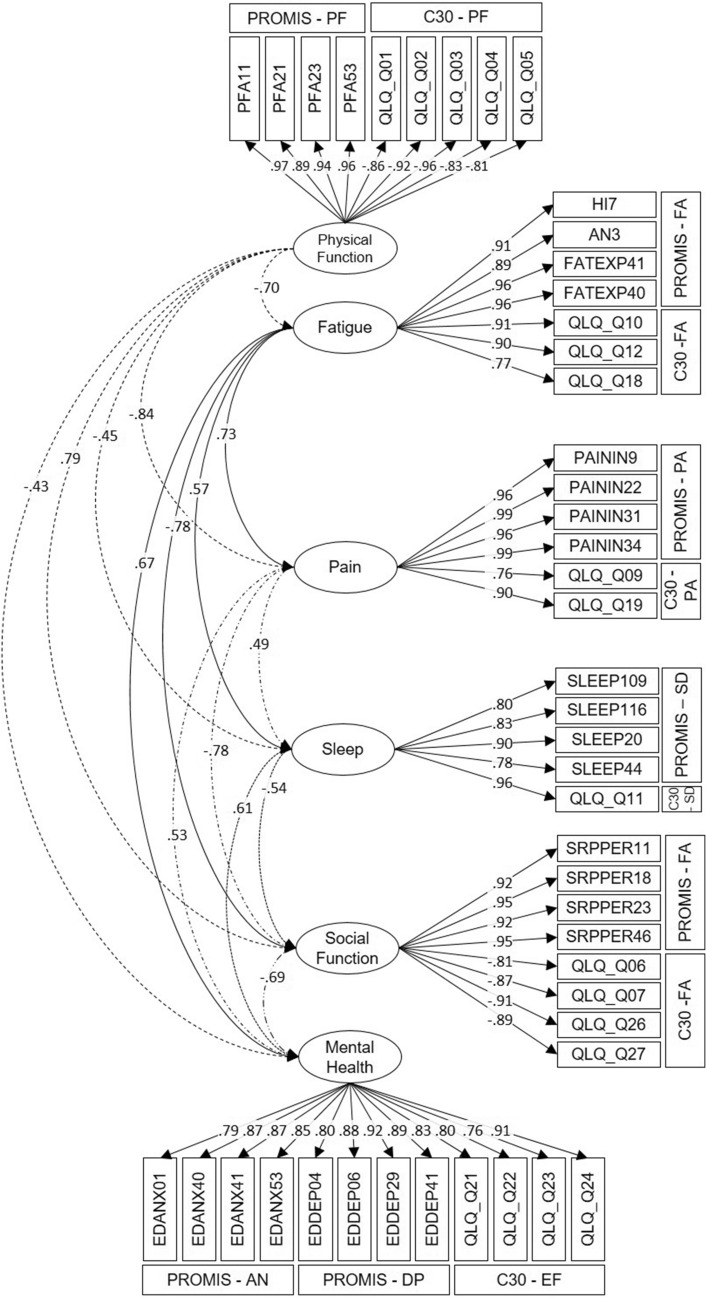
We collected PROMIS-29 and EORTC QLQ-C30 data from 1,478 female patients at a breast cancer outpatient centre. We calculated descriptive statistics and correlations between the subscales of both instruments. We performed exploratory (EFA) and confirmatory factor analysis (CFA) in randomly split subsamples in order to assess the underlying psychometric structure of both instruments.
The cohort (mean age = 47.4, ± 14.49) reported comparable mean HRQOL scores between the corresponding subscales of both instruments similar to general population reference values. Correlation between the corresponding subscales of both instruments ranged between 0.59 (Social Role) and 0.78 (Physical Functioning). Both an exploratory and a theoretically driven confirmatory factor analysis provided further support for conceptual agreement of the scales.
EORTC QLQ-C30 and PROMIS-29 showed similar scores and satisfactory agreement in conceptional and statistical analysis. This suggests that the underlying conceptualization of health is reasonably close. Hence, the development of score transformation algorithms or calibration of both instruments on common scales could prospectively increase the comparability of clinical and research PRO data collected with either instrument.
通过患者报告的结果(PROs)评估健康相关生活质量(HRQOL)是临床试验的关键组成部分,并且在全球范围内越来越多地用于临床常规。两种具有相同健康定义并在可比的 T 度量上报告结果的 PRO 测量工具(PROMs),即 PROMIS-29 和 EORTC QLQ-C30。在这项研究中,我们研究了这些基本概念的经验一致性。
我们从一家乳腺癌门诊中心收集了 1478 名女性患者的 PROMIS-29 和 EORTC QLQ-C30 数据。我们计算了两个工具的子量表之间的描述性统计和相关性。我们在随机分割的子样本中进行了探索性(EFA)和验证性因素分析(CFA),以评估两个工具的潜在心理计量结构。
该队列(平均年龄 47.4±14.49)报告了两个工具的相应子量表之间的可比平均 HRQOL 评分,类似于一般人群的参考值。两个工具的相应子量表之间的相关性在 0.59(社会角色)和 0.78(身体功能)之间。探索性和理论驱动的验证性因素分析都为量表的概念一致性提供了进一步的支持。
EORTC QLQ-C30 和 PROMIS-29 在概念和统计学分析方面表现出相似的评分和令人满意的一致性。这表明健康的基本概念是相当接近的。因此,开发评分转换算法或在共同量表上校准两个工具,有望提高使用任一工具收集的临床和研究 PRO 数据的可比性。