Amiel Thomas, Srinivasan Shyam, Turrina Chiara, Ebel Florian, Straub Michael, Schwaminger Sebastian P
Department of Urology, University Hospital Klinikum Rechts der Isar, Technical University of Munich, Ismaninger Str. 22, 81675, Munich, Germany.
Chair of Bioseparation Engineering, School of Engineering and Design, Technical University of Munich (TUM), Boltzmannstr. 15, 85748, Garching, Germany.
Urolithiasis. 2024 Dec 24;53(1):12. doi: 10.1007/s00240-024-01684-y.
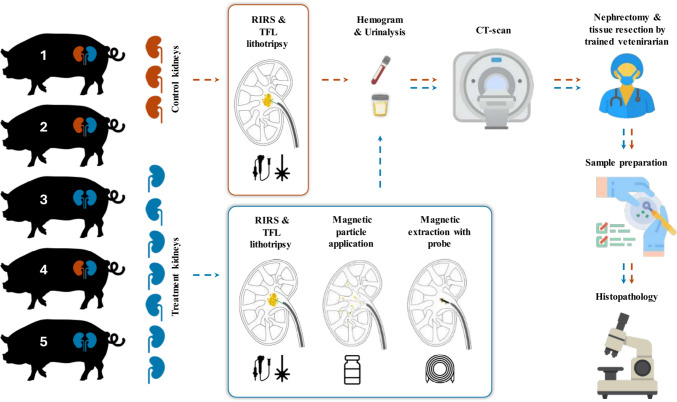
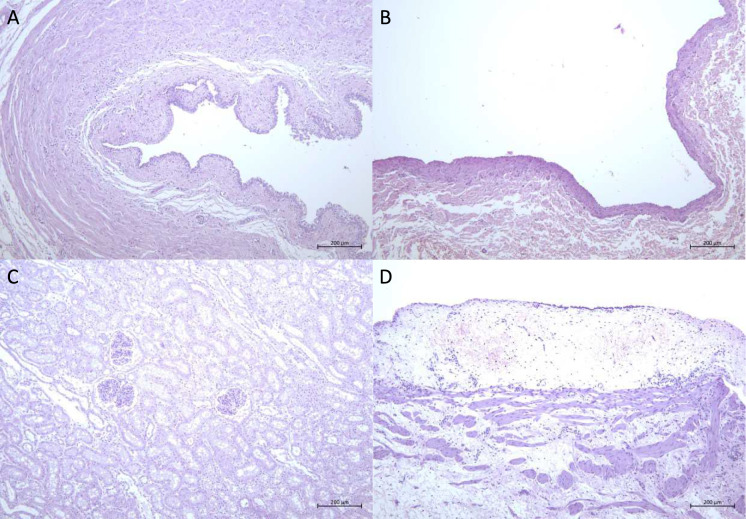
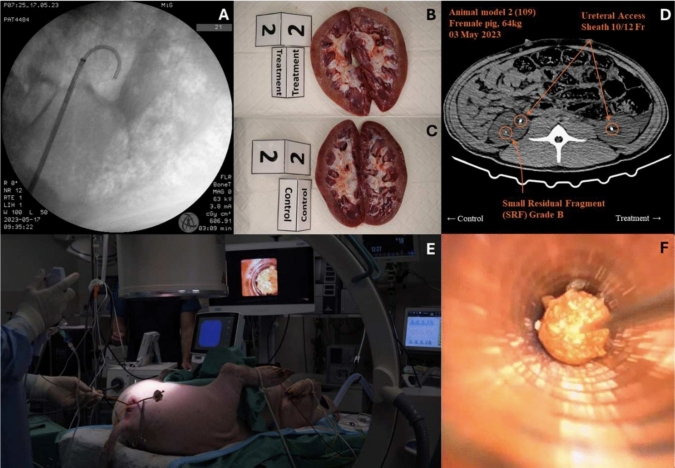
The primary objective of urolithiasis therapy is complete stone removal and highest stone-clearance rates possible to minimize recurrence. A novel approach that employs a magnetic suspension and a magnetic probe for the passive collection and removal of small residual fragments was developed. This study assessed the feasibility of this system in porcine models. Five female domestic pigs underwent retrograde intrarenal surgery under general anaesthesia to assess the new magnetic system. Pre-analysed human calculi were endoscopically inserted and comminuted using lithotripsy. The magnetic suspension was applied, and the magnetic-stone fragment complex was extracted. After nephrectomy, independent blinded pathologists evaluated all the kidneys. Safety and tolerance assessments revealed no adverse events (i.e. no complications on the Clavien-Dindo scale > 1) or complications associated with treatment. This study revealed superficial urothelial damage in all animals, characterized by desquamation and inflammation, caused primarily by the insertion of access sheaths and laser lithotripsy. Residual magnetic particles were observed in the renal pelvis but did not show signs of toxicity even though this study is limited to the acute treatment. No pathological indicators were observed in the hemogram and urinalysis. Overall, the treatment did not cause any significant pathological changes. Preclinical in vivo evaluation of magnetic extraction of small rest fragments in porcine kidneys presents a promising, atraumatic approach for fragments removal. It demonstrated safety, tolerance, and feasibility that warrants clinical investigation. This method has the potential to increase stone-clearance rates with shorter extraction times, offering a possibility for addressing the challenge of urolithiasis in clinical practice.
尿石症治疗的主要目标是完全清除结石,并尽可能提高结石清除率,以减少复发。一种采用磁悬浮和磁探针被动收集和清除小残留碎片的新方法被开发出来。本研究评估了该系统在猪模型中的可行性。五只雌性家猪在全身麻醉下接受逆行肾内手术,以评估新的磁系统。预先分析的人体结石经内镜插入并使用碎石术粉碎。应用磁悬浮技术,提取磁石碎片复合物。肾切除术后,独立的盲法病理学家对所有肾脏进行评估。安全性和耐受性评估显示无不良事件(即Clavien-Dindo分级>1级无并发症)或与治疗相关的并发症。本研究发现所有动物均存在浅表性尿路上皮损伤,其特征为脱屑和炎症,主要由穿刺鞘插入和激光碎石术引起。尽管本研究仅限于急性治疗,但在肾盂中观察到残留的磁性颗粒,且未显示出毒性迹象。血常规和尿液分析未观察到病理指标。总体而言,该治疗未引起任何显著的病理变化。猪肾中小残留碎片磁提取的临床前体内评估为碎片清除提供了一种有前景的、无创的方法。它证明了安全性、耐受性和可行性,值得进行临床研究。该方法有可能在更短的提取时间内提高结石清除率,为临床实践中应对尿石症挑战提供了一种可能。