Harimochi So, Godai Kohei, Nakahara Mayumi, Matsunaga Akira
Department of Anesthesiology and Critical Care Medicine, Graduate School of Medical and Dental Sciences, Kagoshima University, Kagoshima, Japan.
Operating Room, Kagoshima University Hospital, Kagoshima, Japan.
Can J Anaesth. 2025 Mar;72(3):397-408. doi: 10.1007/s12630-024-02900-4. Epub 2024 Dec 23.
Safe perioperative management of patients undergoing transcatheter aortic valve implantation (TAVI) is crucial. Remimazolam is a newly developed short-acting benzodiazepine. We hypothesized that combining remimazolam and flumazenil would reduce emergence time compared with sevoflurane in patients undergoing general anesthesia for TAVI.
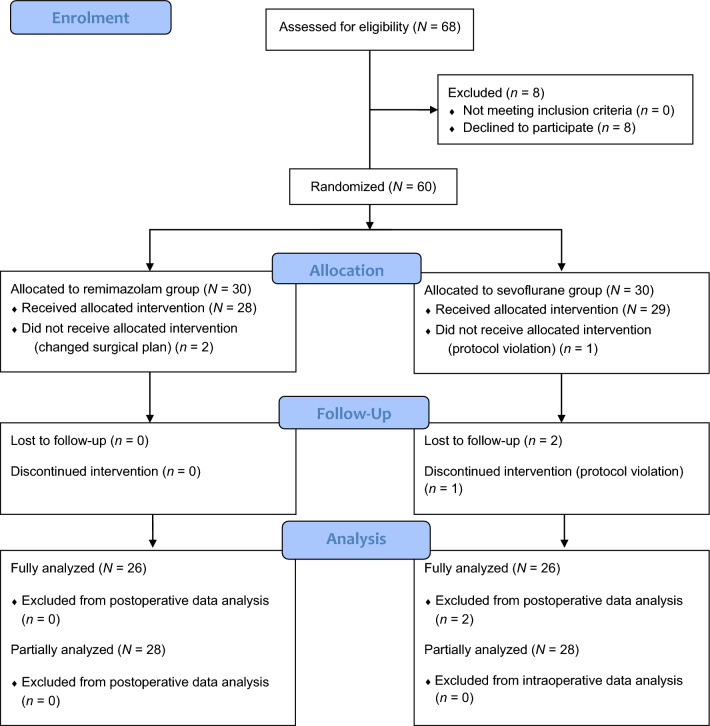
We conducted a prospective, randomized, parallel-design, open-label, single-centre clinical trial between June 2022 and August 2023 at Kagoshima University Hospital. We allocated patients randomly to either the remimazolam/flumazenil group or the sevoflurane group. Patients in the remimazolam group received iv remimazolam whereas patients in the sevoflurane group received sevoflurane for general anesthesia maintenance. Patients in both groups received a remifentanil infusion throughout the TAVI procedure (0.2 μg·kg·min iv). Remimazolam and sevoflurane were adjusted to maintain a Bispectral Index™ (Covidien/Medtronic, Minneapolis, MN, USA) of 40-60. In the remimazolam group, flumazenil (0.2 mg iv) was administered immediately after remimazolam discontinuation. The primary outcome was time to extubation. Secondary outcomes included intraoperative variables (hemodynamic variables and vasopressor dose), rate of intra- and postoperative complications, and recovery of muscle strength.
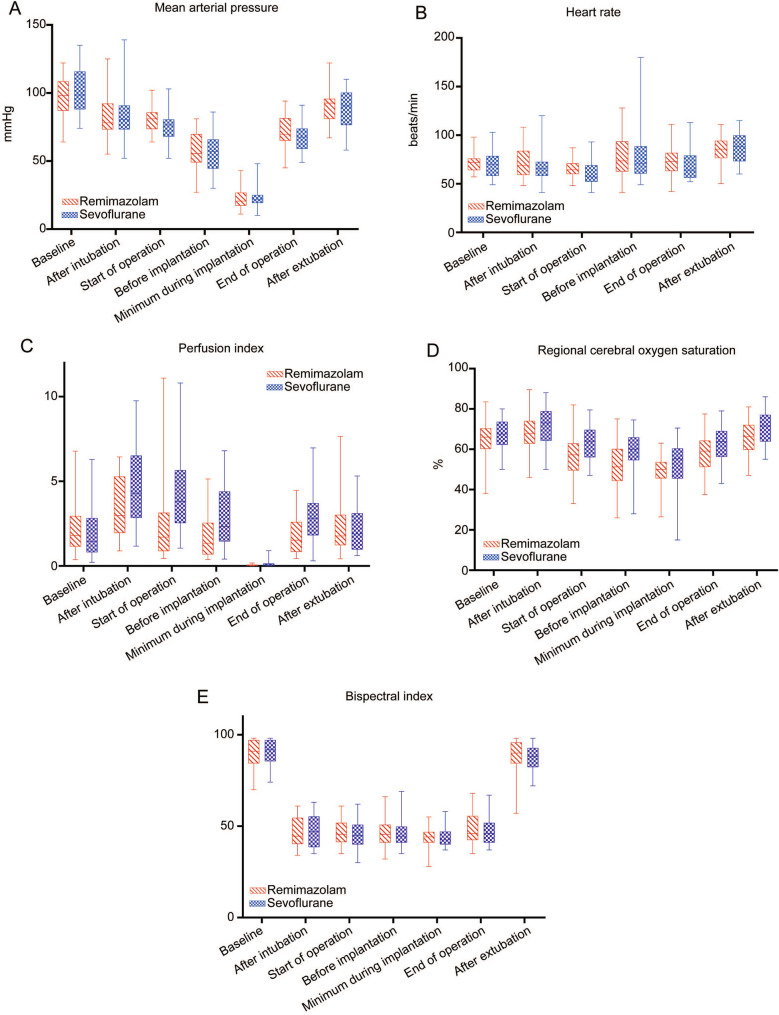
Overall, 60 patients were enrolled, and data from 56 were included. The median [interquartile range] time to extubation was significantly shorter in the remimazolam group than in the sevoflurane group (6.5 [5.1-8.1] min vs 14.2 [10.9-15.9] min; difference in medians, -6.9 min; 95% confidence interval, -8.7 to -5.0; P < 0.001). Statistically significant differences were observed in the perfusion index (P = 0.03) and regional cerebral oxygen saturation (P = 0.03) between the groups. No significant differences between the two groups were seen in other secondary outcomes.
Compared with sevoflurane, a combination of remimazolam and flumazenil significantly reduced the time to extubation in patients undergoing general anesthesia for TAVI. Therefore, remimazolam may be a suitable choice for general anesthesia in patients undergoing TAVI.
UMIN.ac.jp ( UMIN000047892 ); first posted 30 May 2022.
经导管主动脉瓣植入术(TAVI)患者的围手术期安全管理至关重要。瑞马唑仑是一种新开发的短效苯二氮䓬类药物。我们假设,在接受TAVI全身麻醉的患者中,与七氟醚相比,瑞马唑仑与氟马西尼联合使用可缩短苏醒时间。
2022年6月至2023年8月,我们在鹿儿岛大学医院进行了一项前瞻性、随机、平行设计、开放标签的单中心临床试验。我们将患者随机分配至瑞马唑仑/氟马西尼组或七氟醚组。瑞马唑仑组患者静脉注射瑞马唑仑,而七氟醚组患者接受七氟醚用于全身麻醉维持。两组患者在整个TAVI手术过程中均输注瑞芬太尼(静脉注射0.2μg·kg·min)。调整瑞马唑仑和七氟醚剂量以维持脑电双频指数(美国明尼阿波利斯市Covidien/Medtronic公司)在40 - 60之间。在瑞马唑仑组,瑞马唑仑停药后立即静脉注射氟马西尼(0.2mg)。主要结局为拔管时间。次要结局包括术中变量(血流动力学变量和血管升压药剂量)、术中和术后并发症发生率以及肌肉力量恢复情况。
总体而言,共纳入60例患者,其中56例患者的数据被纳入分析。瑞马唑仑组的拔管中位[四分位间距]时间显著短于七氟醚组(6.5[小值5.1 - 大值8.1]分钟 vs 14.2[小值10.9 - 大值15.9]分钟;中位数差异为 - 6.9分钟;95%置信区间为 - 8.7至 - 5.0;P < 0.001)。两组之间在灌注指数(P = 0.03)和局部脑氧饱和度(P = 0.03)方面观察到具有统计学意义的差异。两组在其他次要结局方面未观察到显著差异。
与七氟醚相比,瑞马唑仑与氟马西尼联合使用可显著缩短接受TAVI全身麻醉患者的拔管时间。因此,瑞马唑仑可能是TAVI患者全身麻醉的合适选择。
UMIN.ac.jp(UMIN000047892);首次发布于2022年5月30日。