Hwang Young Hoon, Yoon Doran, Go Suryeong, Yeom Joon-Sup, Oh Hong Sang
The 75th Infantry Division, Republic of Korea Army, Namyangju, Korea.
Department of Internal Medicine, Armed Forces Capital Hospital, Seongnam, Korea.
J Korean Med Sci. 2024 Dec 23;39(49):e314. doi: 10.3346/jkms.2024.39.e314.
We aimed to analyze the epidemiology, clinical characteristics, and outcomes of malaria caused by among military members of the Republic of Korea (ROK).
We reviewed the medical records of patients diagnosed with malaria in 16 military hospitals in the ROK between 2012-2021, excluding other types of malaria, as well as imported cases and those treated in civilian hospitals.
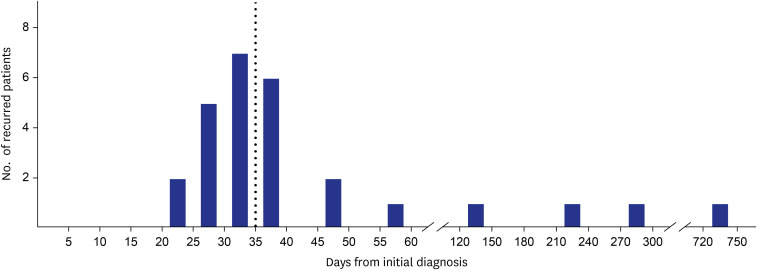
In total, 653 patients were treated for malaria. Their mean age was 22.0 ± 3.8 years, and their mean body weight was 73.4 ± 10.8 kg. Hospitalization occurred in 92.0% (n = 601) of the cases, with 4.4% (n = 29) recurring. The mean administered dose was 20.7 ± 3.4 mg/kg for the chloroquine (CQ) base and 3.5 ± 1.2 mg/kg for the primaquine (PQ) base. Between 2012-2016 and 2017-2021, the mean patient body weight increased (72.9 ± 11.1 vs. 74.3 ± 10.3 kg, = 0.044). Correspondingly, the total administered doses of CQ (1,476.0 ± 144.0 vs. 1,515.1 ± 155.1 mg, = 0.010) and PQ (242.6 ± 79.7 vs. 265.7 ± 92.3 mg, < 0.001) were increased. However, there was no difference in the weight-based dosage of CQ (20.7 ± 3.6 vs. 20.7 ± 3.2 mg/kg, = 0.580) or PQ (3.33 ± 1.1 vs. 3.64 ± 1.3 mg/kg, = 0.256), nor in the percentage of patients who received sub-recommended doses. Among the 27 patients who experienced recurrence and had available initial treatment data, the proportion of those prescribed PQ (24 [88.9%] vs. 623 [99.5%], = 0.001) and the mean PQ dose (2.75 ± 0.7 vs. 3.50 ± 1.2 mg/kg, = 0.003) were significantly lower in the recurrence group.
Over time, as the body weight of patients with malaria in the ROK military has increased, the administered dosages of CQ and PQ have correspondingly risen. However, these dosages often remain suboptimal when compared to the body weight-based recommendations by the World Health Organization. Of particular concern is the continued administration of antimalarial drugs at suboptimal doses, which may contribute to an elevated risk of recurrence. Further education may therefore be beneficial to ensuring appropriate dosing for more effective malaria treatment.
我们旨在分析大韩民国(韩国)军人中由[某种疟疾类型未明确]引起的疟疾的流行病学、临床特征及转归。
我们回顾了2012年至2021年期间韩国16家军医院中诊断为[某种疟疾类型未明确]疟疾的患者的病历,排除其他类型的疟疾、输入性病例以及在民营医院接受治疗的病例。
共有653例患者接受了[某种疟疾类型未明确]疟疾的治疗。他们的平均年龄为22.0±3.8岁,平均体重为73.4±10.8千克。92.0%(n = 601)的病例需要住院治疗,其中4.4%(n = 29)复发。氯喹(CQ)碱的平均给药剂量为20.7±3.4毫克/千克,伯氨喹(PQ)碱的平均给药剂量为3.5±1.2毫克/千克。在2012 - 2016年和2017 - 2021年期间,患者的平均体重增加了(72.9±11.1千克对74.3±10.3千克,P = 0.044)。相应地,CQ(1476.0±144.0毫克对1515.1±155.1毫克,P = 0.010)和PQ(242.6±79.7毫克对265.7±92.3毫克,P < 0.001)的总给药剂量增加。然而,基于体重的CQ给药剂量(20.7±3.6毫克/千克对20.7±3.2毫克/千克,P = 0.580)或PQ给药剂量(3.33±1.1毫克/千克对3.64±1.3毫克/千克,P = 0.256)没有差异,接受低于推荐剂量的患者百分比也没有差异。在27例经历复发且有可用初始治疗数据的患者中,复发组中开具PQ的比例(24例[88.9%]对623例[99.5%],P = 0.001)和PQ平均剂量(2.75±0.7毫克/千克对3.50±1.2毫克/千克,P = 0.003)显著较低。
随着时间推移,韩国军队中[某种疟疾类型未明确]疟疾患者的体重增加,CQ和PQ的给药剂量相应上升。然而,与世界卫生组织基于体重的建议相比,这些剂量往往仍未达到最佳水平。特别值得关注的是抗疟药物持续以未达最佳剂量给药,这可能导致复发风险升高。因此,进一步的教育可能有助于确保适当给药以更有效地治疗疟疾。