Jiang Min, Kang Li, Wang Ya-Li, Zhou Bin, Li Hong-Yi, Yan Qiang, Liu Zhi-Gang
Department of Clinical Laboratory, Neijiang Central District People's Hospital, Neijiang, Sichuan, China.
Department of Anesthesiology, The First People's Hospital of Neijiang, Neijiang, Sichuan, China.
Front Neurosci. 2024 Dec 9;18:1501134. doi: 10.3389/fnins.2024.1501134. eCollection 2024.
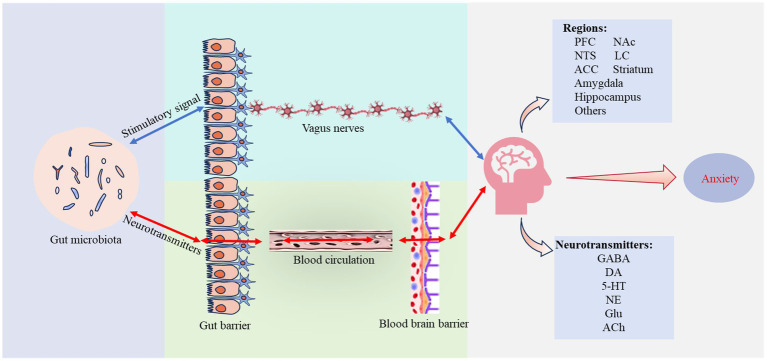
Anxiety disorders, prevalent mental health conditions, receive significant attention globally due to their intricate etiology and the suboptimal effectiveness of existing therapies. Research is increasingly recognizing that the genesis of anxiety involves not only neurochemical brain alterations but also changes in gut microbiota. The microbiota-gut-brain axis (MGBA), serving as a bidirectional communication pathway between the gut microbiota and the central nervous system (CNS), is at the forefront of novel approaches to deciphering the complex pathophysiology of anxiety disorders. This review scrutinizes the role and recent advancements in the MGBA concerning anxiety disorders through a review of the literature, emphasizing mechanisms via neural signals, endocrine pathways, and immune responses. The evidence robustly supports the critical influence of MGBA in both the development and progression of these disorders. Furthermore, this discussion explores potential therapeutic avenues stemming from these insights, alongside the challenges and issues present in this realm. Collectively, our findings aim to enhance understanding of the pathological mechanisms and foster improved preventative and therapeutic strategies for anxiety disorders.
焦虑症是常见的心理健康状况,由于其病因复杂且现有治疗方法效果欠佳,在全球范围内受到了广泛关注。越来越多的研究认识到,焦虑的发生不仅涉及神经化学层面的大脑改变,还包括肠道微生物群的变化。微生物-肠道-大脑轴(MGBA)作为肠道微生物群与中枢神经系统(CNS)之间的双向通信途径,处于解读焦虑症复杂病理生理学新方法的前沿。本综述通过文献回顾,审视了MGBA在焦虑症中的作用和最新进展,重点强调了通过神经信号、内分泌途径和免疫反应的机制。证据有力地支持了MGBA在这些疾病的发生和发展中的关键影响。此外,本讨论探讨了基于这些见解的潜在治疗途径,以及该领域存在的挑战和问题。总体而言,我们的研究结果旨在增进对病理机制的理解,并促进改进焦虑症的预防和治疗策略。