Foffano L, Cucciniello L, Nicolò E, Migliaccio I, Noto C, Reduzzi C, Malorni L, Cristofanilli M, Gerratana L, Puglisi F
Department of Medical Oncology. CRO Aviano, National Cancer Institute, IRCCS, Aviano, Italy; Department of Medicine, University of Udine, Udine, Italy.
Division of Hematology-Oncology, Weill Cornell Medicine, New York, NY, USA; Department of Oncology and Hemato-Oncology, University of Milan, Milan, Italy; Division of New Drugs and Early Drug Development, European Institute of Oncology IRCCS, Milan, Italy.
Breast. 2025 Feb;79:103863. doi: 10.1016/j.breast.2024.103863. Epub 2024 Dec 16.
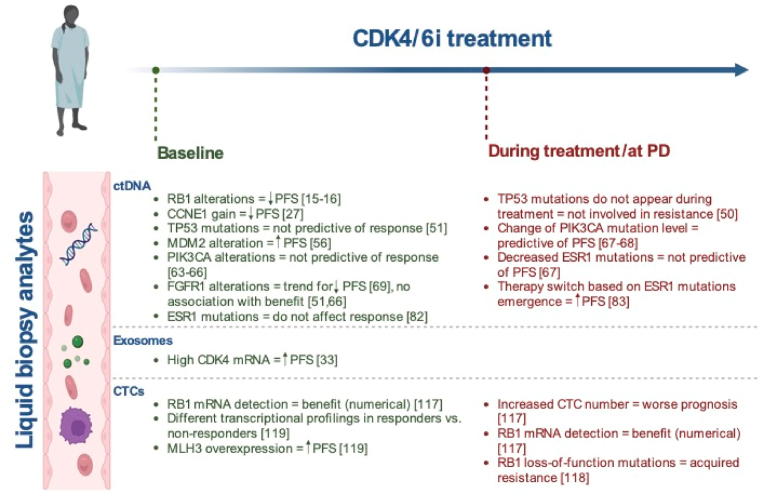
CDK4/6 inhibitors (CDK4/6i) have significantly impacted on the treatment of HR + HER2 negative (HER2-) metastatic breast cancer (BC) when combined with endocrine therapy. Nonetheless, despite significant research efforts, the mechanisms of de novo and acquired resistance to CDK4/6i have not yet been fully elucidated, highlighting the need for a deeper understanding of these process. Additionally, the importance of dissecting CDK4/6i resistance from endocrine resistance for personalized treatment is increasingly recognized. Liquid biopsy has emerged as a minimally invasive tool for identifying circulating biomarkers of resistance through the integration of multiparametric and dynamic assessments that encompass ctDNA, CTCs, exosomes, and epigenetic ctDNA alterations, representing a promising perspective for the clinical characterization of treatment resistance and guiding post-progression strategies to improve patient outcomes. Aim of this review is summarize potential mechanisms of CDK4/6i resistance, along with the advantages of using liquid biopsy to identify resistance biomarkers in HR+/HER2- MBC patients treated with CDK 4/6 inhibitors.
CDK4/6抑制剂(CDK4/6i)与内分泌治疗联合使用时,对激素受体阳性(HR+)人表皮生长因子受体2阴性(HER2-)转移性乳腺癌(BC)的治疗产生了重大影响。尽管如此,尽管进行了大量研究,但对CDK4/6i的原发性和获得性耐药机制尚未完全阐明,这凸显了深入了解这些过程的必要性。此外,将CDK4/6i耐药与内分泌耐药区分开来以进行个性化治疗的重要性也日益得到认可。液体活检已成为一种微创工具,通过整合包括循环肿瘤DNA(ctDNA)、循环肿瘤细胞(CTCs)、外泌体和表观遗传ctDNA改变在内的多参数和动态评估来识别耐药的循环生物标志物,这为治疗耐药的临床特征分析和指导进展后策略以改善患者预后提供了一个有前景的视角。本综述的目的是总结CDK4/6i耐药的潜在机制,以及使用液体活检在接受CDK4/6抑制剂治疗的HR+/HER2-MBC患者中识别耐药生物标志物的优势。