Rivero-Moreno Yeisson, Goyal Aman, Redden-Chirinos Samantha, Bulut Halil, Dominguez-Profeta Rebeca, Munnangi Pujita, Shenoi Jason, Ganguly Paulamy, Blanc Pierre, Alkadam Khalid, Pouwels Sjaak, Taha Safwan, Pascotto Beniamino, Azagra Juan Santiago, Yang Wah, Garcia Andrea, Morfin-Meza Kathia Dayana, Fuentes-Orozco Clotilde, González-Ojeda Alejandro, Suárez-Carreón Luis Osvaldo, Marano Luigi, Abou-Mrad Adel, Oviedo Rodolfo J
Department of Surgery, Montefiore Medical Center, New York, USA.
Universidad de Oriente, Núcleo Anzoátegui, Venezuela.
Aging Clin Exp Res. 2024 Dec 24;37(1):3. doi: 10.1007/s40520-024-02890-9.
This study aimed to assess and compare outcomes of robotic inguinal hernia repair (RIHR) in patients under and over 70 years old, performed by a fellowship-trained robotic surgeon at a single institution.
A retrospective analysis of patients undergoing robotic primary transabdominal preperitoneal inguinal hernia repair between 2020 and 2022 was conducted. Patients were categorized into two age groups: those under 70 years and 70 years and older. Data were collected through chart reviews with a mean follow-up of 30 days. Concurrently, a systematic review (SR) of relevant high-level literature was carried out.
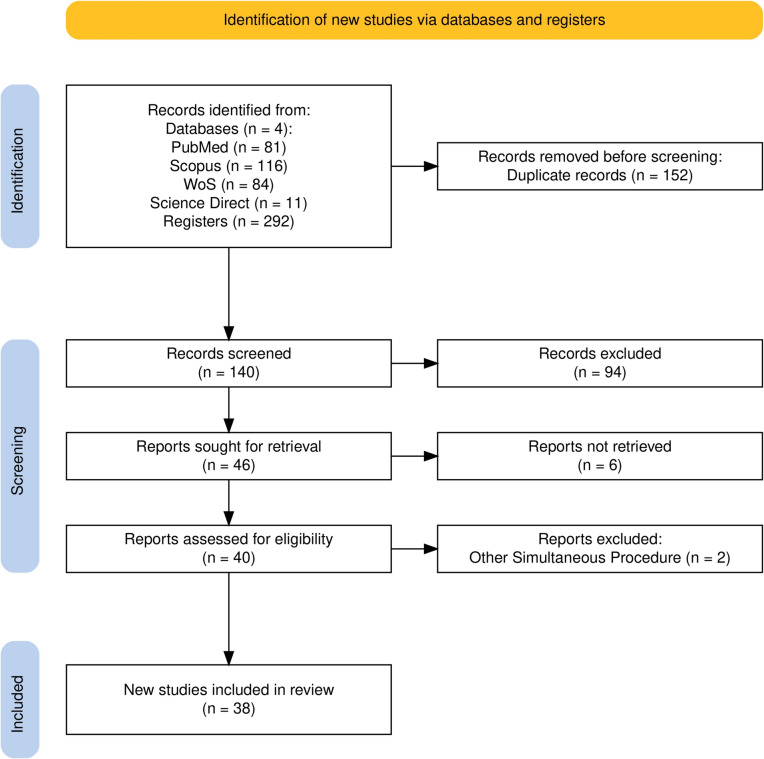
Among the 37 patients studied, 75.7% (n = 28) were male, with a mean age of 64.8 years. Demographic features did not significantly differ based on age groups. Patients > 70 years had a higher incidence of reported complications (52.3% vs. 87.5%, p < 0.461). There were no differences in operative time or length of stay between the groups. In the SR, only 23.7% (n = 9) of studies provided age-related conclusions. Three studies identified age over 70 as a risk factor for postoperative complications, while two studies suggested that RIHR is feasible and safe in patients aged 80 years and older.
Patients over 70 years old demonstrated a higher incidence of complications compared to younger patients. However, current literature indicates that the robotic approach may offer a safe and minimally invasive option for inguinal hernia repair in both younger and older adults.
本研究旨在评估和比较由一名在单一机构接受过专项培训的机器人外科医生为70岁及以下和70岁以上患者实施的机器人腹股沟疝修补术(RIHR)的效果。
对2020年至2022年间接受机器人经腹腹膜前腹股沟疝修补术的患者进行回顾性分析。患者被分为两个年龄组:70岁以下和70岁及以上。通过病历审查收集数据,平均随访30天。同时,对相关高水平文献进行系统评价(SR)。
在研究的37例患者中,75.7%(n = 28)为男性,平均年龄64.8岁。不同年龄组的人口统计学特征无显著差异。70岁以上患者报告的并发症发生率更高(52.3%对87.5%,p < 0.461)。两组之间的手术时间和住院时间无差异。在系统评价中,只有23.7%(n = 9)的研究提供了与年龄相关的结论。三项研究确定70岁以上为术后并发症的危险因素,而两项研究表明RIHR在80岁及以上患者中是可行且安全的。
与年轻患者相比,70岁以上患者的并发症发生率更高。然而,目前的文献表明,机器人手术方法可能为年轻和老年成人腹股沟疝修补提供一种安全且微创的选择。