Zhao Yazhou, Yin Zhou, Zhang Xin, Kuang Yue, Zhao Yishu, Liu Jing, Zhang Qingling, Li Yanping
Center for Pollution and Carbon Reduction, Chinese Research Academy of Environmental Sciences, Beijing, 100012, China.
Heliyon. 2024 Nov 28;10(23):e40695. doi: 10.1016/j.heliyon.2024.e40695. eCollection 2024 Dec 15.
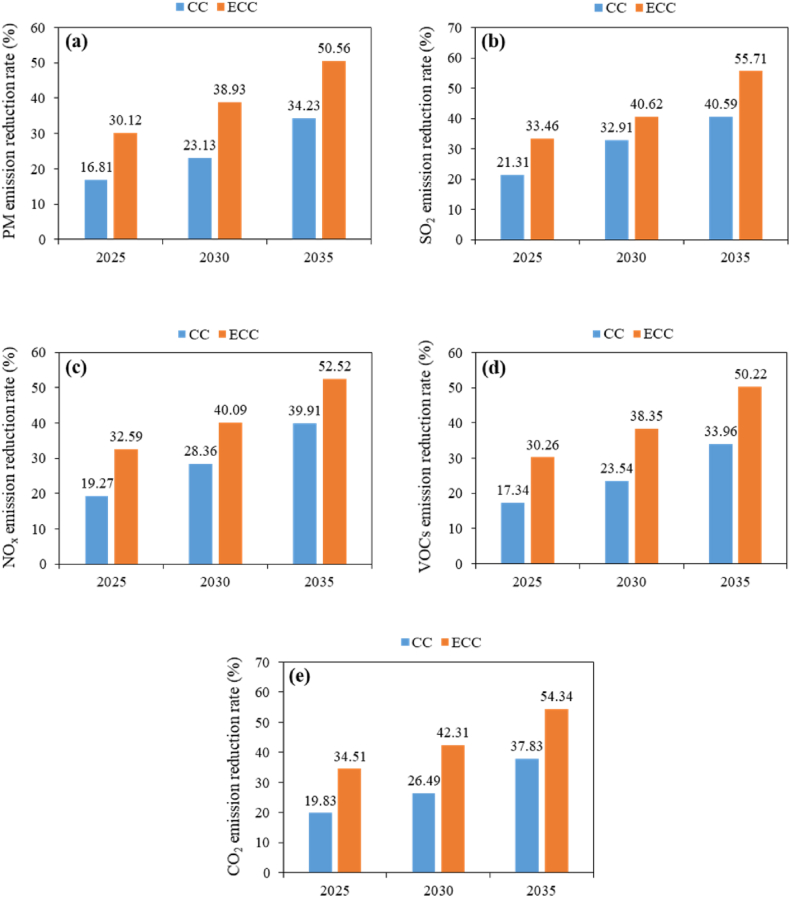
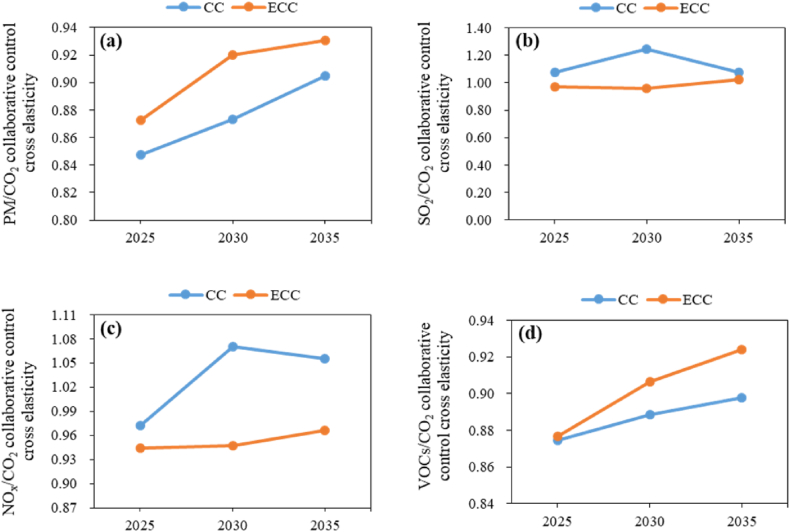
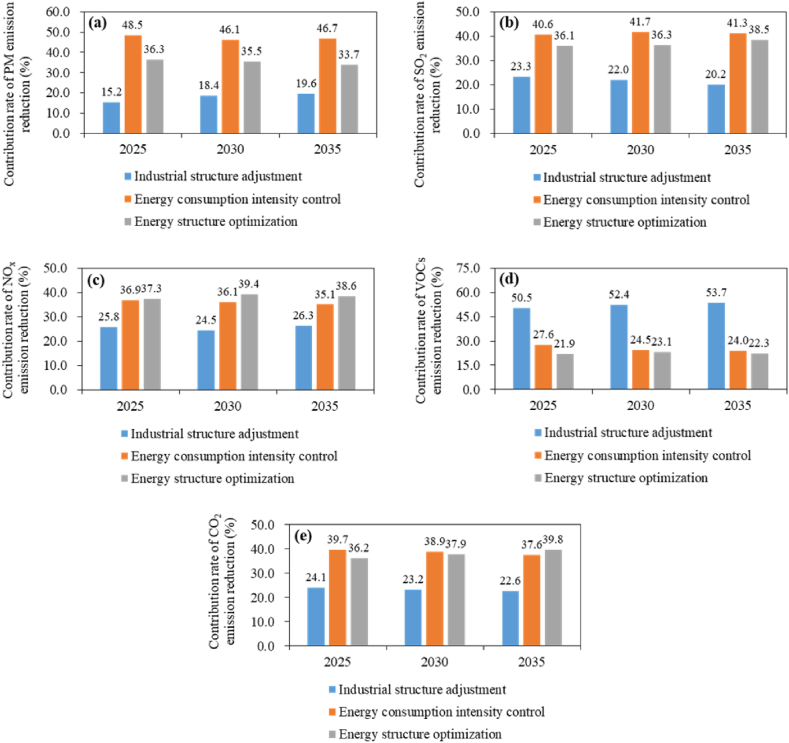
The collaborative control of pollution and carbon emission reduction in industrial fields is crucial for improving regional air quality and mitigating climate change. However, to our knowledge, there is limited research regarding the collaborative control paths for reducing industrial pollution and carbon emissions. The present study assesses the potential for reducing emissions of air pollutants and carbon dioxide (CO) in the industries operating in the Hohhot-Baotou-Ordos (HBO) region of Inner Mongolia. The collaborative control cross elasticity analytical method is employed to examine the synergistic effects of controlling air pollutants and CO emissions. The changes in fine particulate matter (PM) concentrations are simulated under various scenarios. Ultimately, a collaborative control path for pollution and carbon emission reduction is proposed. The results indicate that adjusting the industrial structure, controlling energy consumption intensity, and optimizing the energy structure in collaborative control (CC) and enhanced collaborative control (ECC) scenarios effectively facilitate the coordinated reduction of air pollution and CO emissions. The synergistic control effects on the four evaluated air pollutants and CO in the ECC scenarios surpass those in the CC scenarios. The reductions in PM concentrations from 2020 to 2025 in the CC and ECC scenarios correspond to 10.81 % and 25.36 %, respectively, with even greater reductions projected for 2030 and 2035 (for all scenarios). Under CC and ECC scenarios in 2025, CO emissions per unit of industrial added value would be reduced by 20.12 % and 38.36 %, respectively, compared with the 2020 levels. The CC scheme is highlighted as an effective approach for collaborative pollution control and carbon emission reduction because it meets the continuous improvement requirements for air quality in the HBO region and the industrial CO emission reduction targets. Additionally, the results support the recommendation to prioritize the implementation of measures for controlling energy consumption intensity and adjusting industrial structures, followed by deploying measures to optimize energy structures.
工业领域污染与碳排放协同控制对于改善区域空气质量和缓解气候变化至关重要。然而,据我们所知,关于减少工业污染和碳排放的协同控制路径的研究有限。本研究评估了内蒙古呼和浩特-包头-鄂尔多斯(HBO)地区各行业减少空气污染物和二氧化碳(CO)排放的潜力。采用协同控制交叉弹性分析方法来检验控制空气污染物和CO排放的协同效应。在不同情景下模拟细颗粒物(PM)浓度的变化。最终,提出了污染与碳排放协同控制路径。结果表明,在协同控制(CC)和强化协同控制(ECC)情景下,调整产业结构、控制能源消耗强度和优化能源结构有效地促进了空气污染和CO排放的协同减少。ECC情景下对四种评估空气污染物和CO的协同控制效果超过CC情景。CC和ECC情景下2020年至2025年PM浓度的降低分别对应10.81%和25.36%,预计2030年和2035年(所有情景)降幅更大。2025年在CC和ECC情景下,单位工业增加值CO排放量与2020年水平相比将分别降低20.12%和38.36%。CC方案被视为污染协同控制和碳排放减少的有效方法,因为它满足了HBO地区空气质量持续改善的要求和工业CO减排目标。此外,结果支持优先实施控制能源消耗强度和调整产业结构措施的建议,其次是部署优化能源结构的措施。