School of Biochemistry, University of Bristol, Bristol, UK.
School of Chemistry, University of Bristol, Bristol, UK.
Nat Chem Biol. 2024 Jul;20(7):916-923. doi: 10.1038/s41589-024-01640-2. Epub 2024 Jun 7.
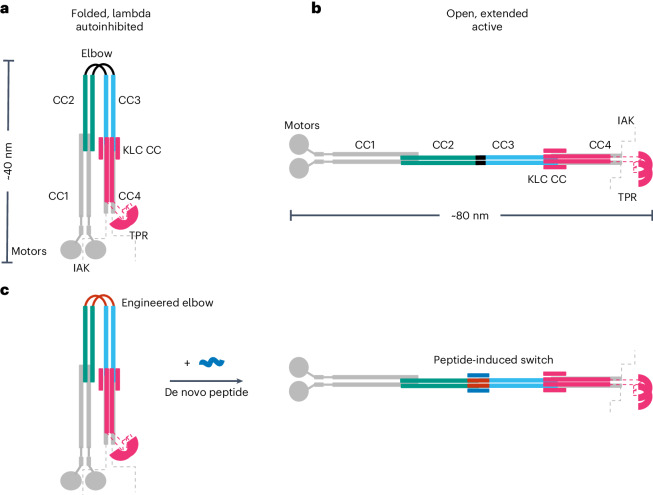
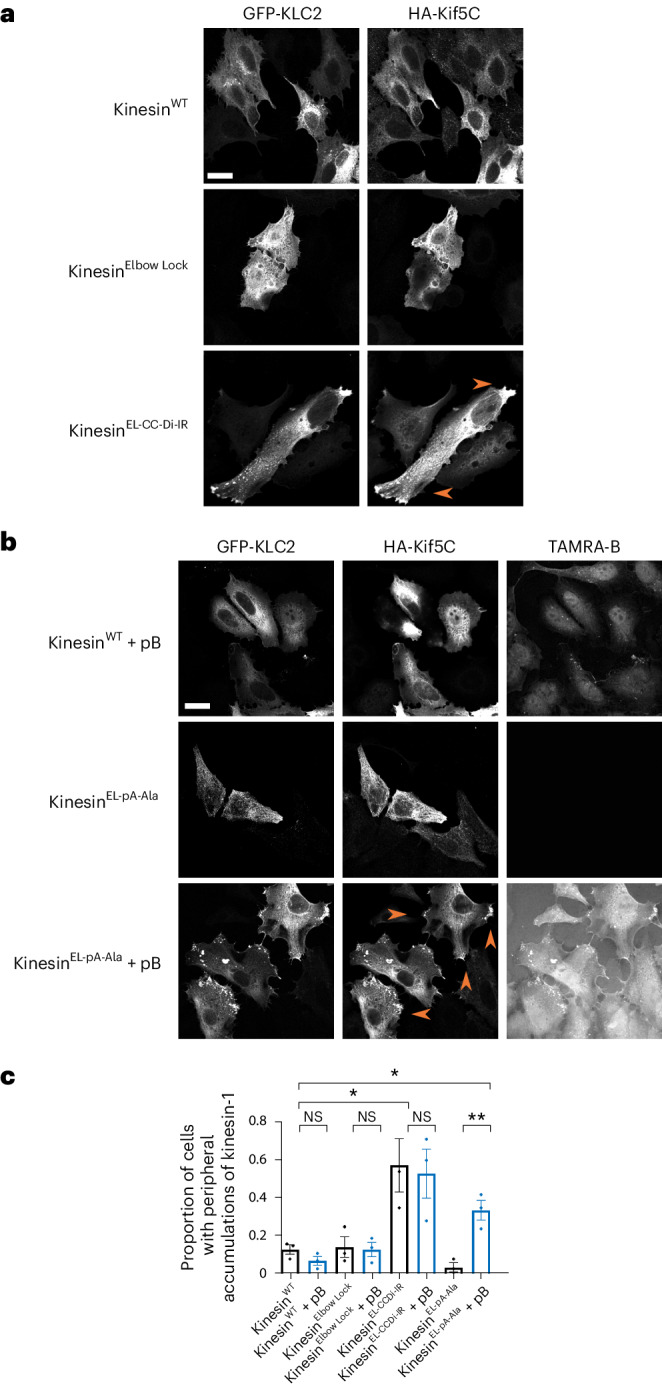
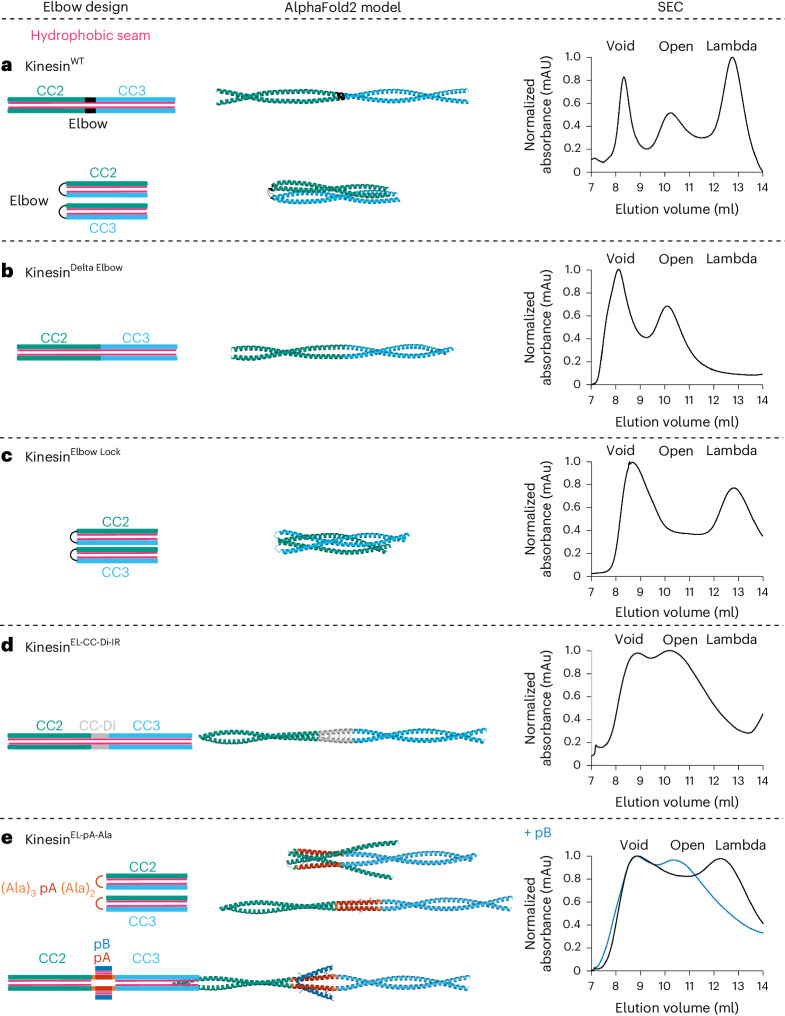
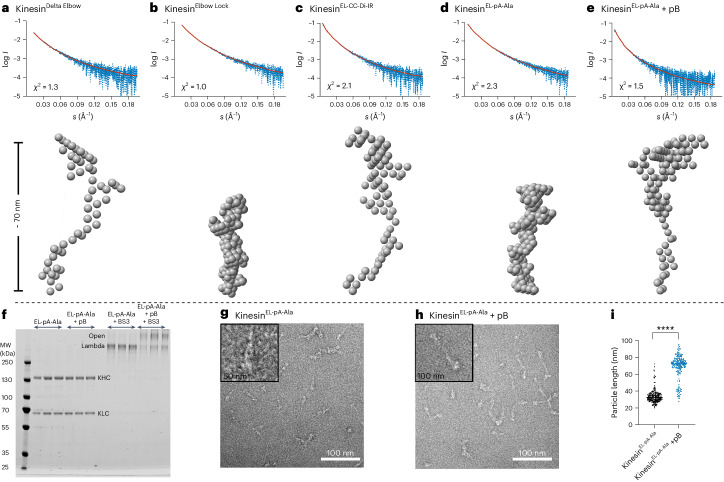
Many enzymes are allosterically regulated via conformational change; however, our ability to manipulate these structural changes and control function is limited. Here we install a conformational switch for allosteric activation into the kinesin-1 microtubule motor in vitro and in cells. Kinesin-1 is a heterotetramer that accesses open active and closed autoinhibited states. The equilibrium between these states centers on a flexible elbow within a complex coiled-coil architecture. We target the elbow to engineer a closed state that can be opened with a de novo designed peptide. The alternative states are modeled computationally and confirmed by biophysical measurements and electron microscopy. In cells, peptide-driven activation increases kinesin transport, demonstrating a primary role for conformational switching in regulating motor activity. The designs are enabled by our understanding of ubiquitous coiled-coil structures, opening possibilities for controlling other protein activities.
许多酶通过构象变化进行别构调节;然而,我们操纵这些结构变化和控制功能的能力是有限的。在这里,我们在体外和细胞中为驱动蛋白-1微管马达安装了一个别构激活的构象开关。驱动蛋白-1是一种异四聚体,可进入开放的活性和封闭的自动抑制状态。这些状态之间的平衡集中在一个复杂的卷曲螺旋结构中的灵活肘上。我们将肘作为目标,设计一个可以用新设计的肽打开的封闭状态。替代状态通过计算建模,并通过生物物理测量和电子显微镜确认。在细胞中,肽驱动的激活增加了驱动蛋白的运输,这表明构象转换在调节马达活性方面起着主要作用。这些设计是基于我们对普遍存在的卷曲螺旋结构的理解,为控制其他蛋白质活性开辟了可能性。