Comolet Gabriel, Bose Neeloy, Winchell Jeff, Duren-Lubanski Alyssa, Rusielewicz Tom, Goldberg Jordan, Horn Grayson, Paull Daniel, Migliori Bianca
The New York Stem Cell Foundation Research Institute, New York, NY 10019, USA.
iScience. 2024 Dec 6;27(12):111434. doi: 10.1016/j.isci.2024.111434. eCollection 2024 Dec 20.
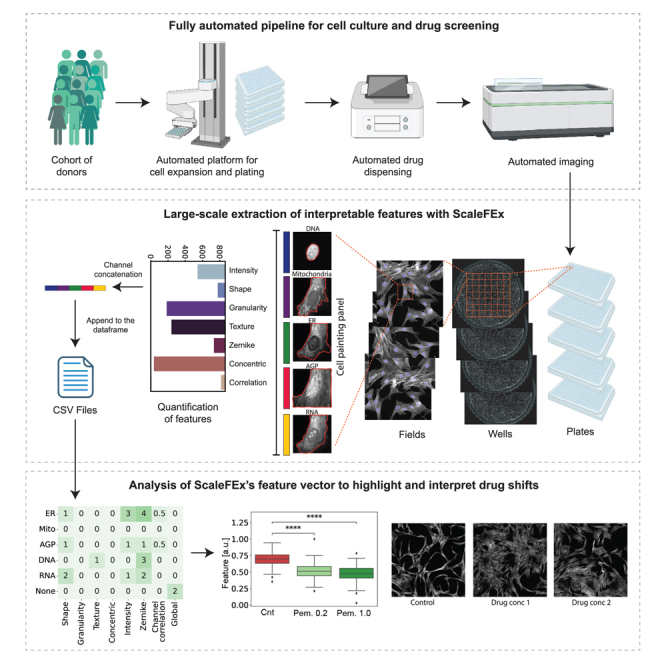
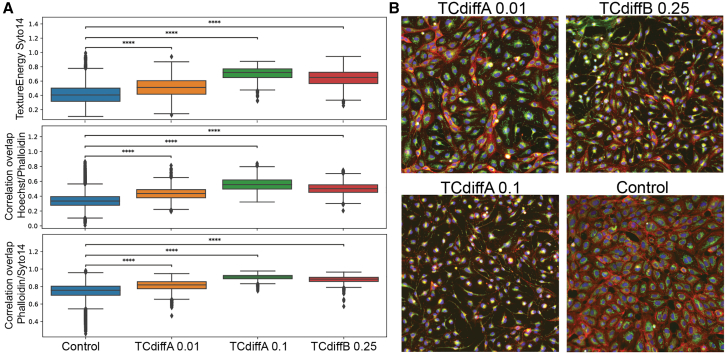
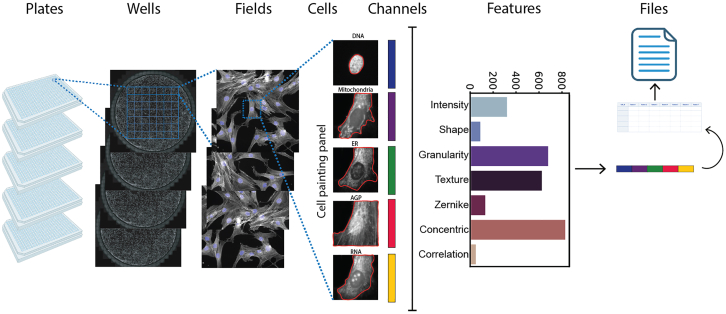
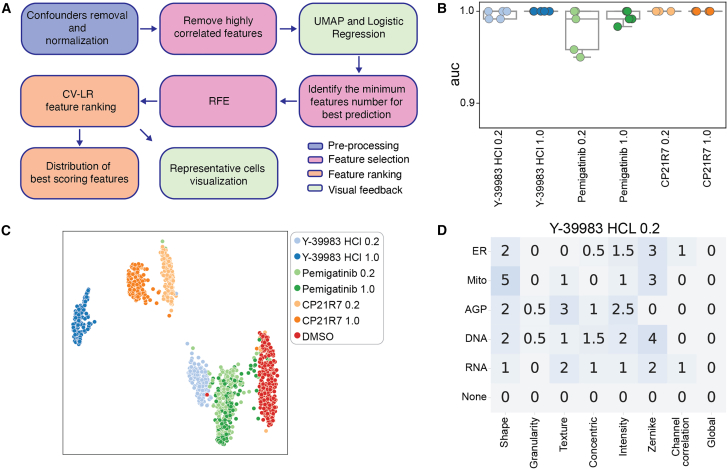
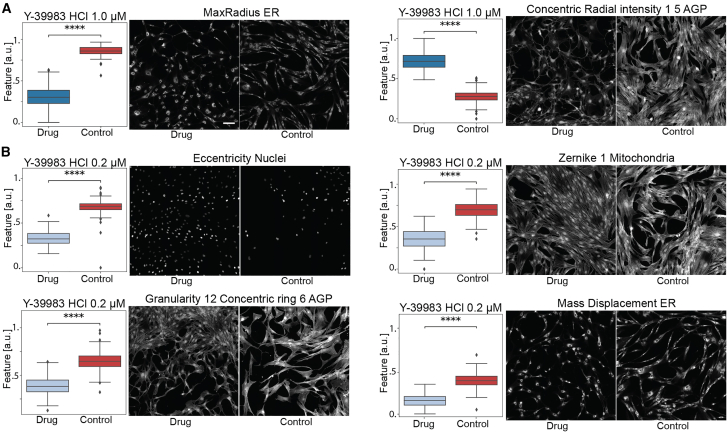
Applying artificial intelligence (AI) to image-based morphological profiling cells offers significant potential for identifying disease states and drug responses in high-content imaging (HCI) screens. When differences between populations (e.g., healthy vs. diseased) are unknown or imperceptible to the human eye, large-scale HCI screens are essential, providing numerous replicates to build reliable models and accounting for confounding factors like donor and intra-experimental variations. As screen sizes grow, so does the challenge of analyzing high-dimensional datasets in an efficient way while preserving interpretable features and predictive power. Here, we introduce ScaleFEx℠, a memory-efficient, open-source Python pipeline that extracts biologically meaningful features from HCI datasets using minimal computational resources or scalable cloud infrastructure. ScaleFEx can be used together with AI models to successfully identify phenotypic shifts in drug-treated cells and rank interpretable features, and is applicable to public datasets, highlighting its potential to accelerate the discovery of disease-associated phenotypes and new therapeutics.
将人工智能(AI)应用于基于图像的细胞形态学分析,在高内涵成像(HCI)筛选中识别疾病状态和药物反应方面具有巨大潜力。当人群之间的差异(例如,健康与患病)未知或肉眼难以察觉时,大规模HCI筛选至关重要,它提供大量重复样本以建立可靠模型,并考虑诸如供体和实验内变异等混杂因素。随着筛选规模的扩大,以高效方式分析高维数据集同时保留可解释特征和预测能力的挑战也随之增加。在此,我们引入ScaleFEx℠,这是一个内存高效的开源Python管道,它使用最少的计算资源或可扩展的云基础设施从HCI数据集中提取具有生物学意义的特征。ScaleFEx可与AI模型一起使用,以成功识别药物处理细胞中的表型变化并对可解释特征进行排名,并且适用于公共数据集,突出了其加速发现疾病相关表型和新疗法的潜力。