Li Xiaoguang, Chu Yaqi, Wu Xuejian
Huzhou Key Laboratory of Green Energy Materials and Battery Cascade Utilization, School of Intelligent Manufacturing, Huzhou College, Huzhou, China.
State Key Laboratory of Robotics, Shenyang Institute of Automation, Chinese Academy of Sciences, Shenyang, China.
Front Neurorobot. 2024 Dec 10;18:1485640. doi: 10.3389/fnbot.2024.1485640. eCollection 2024.
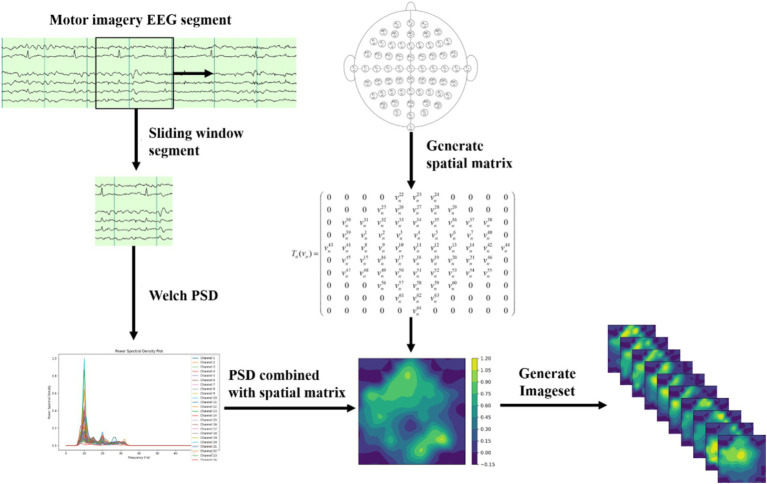
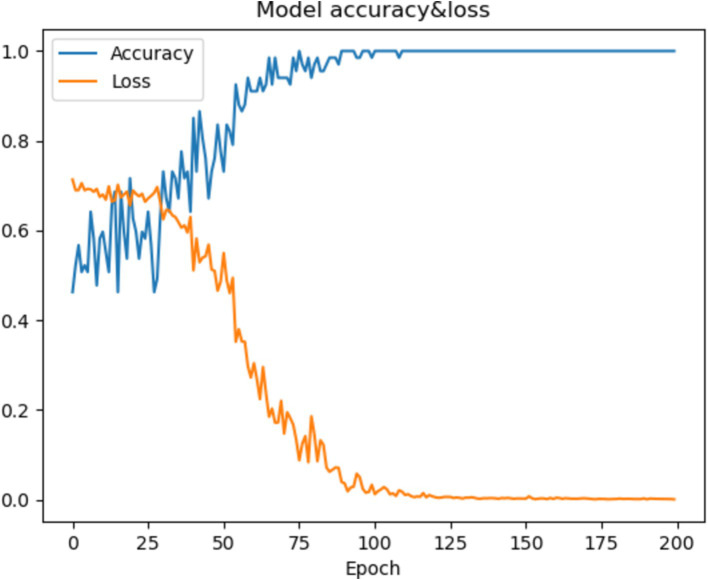
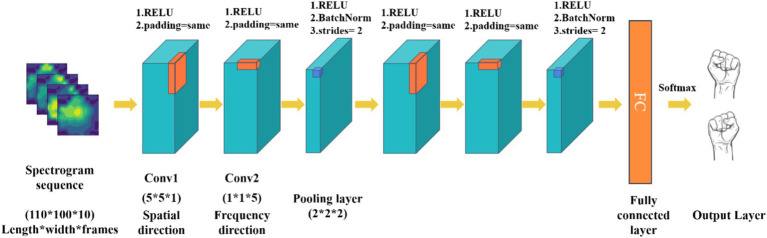
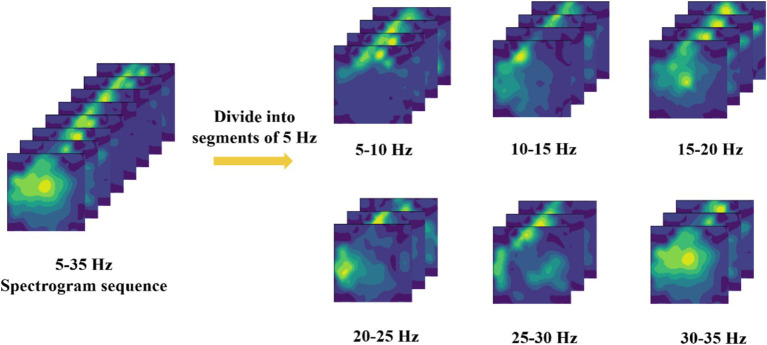
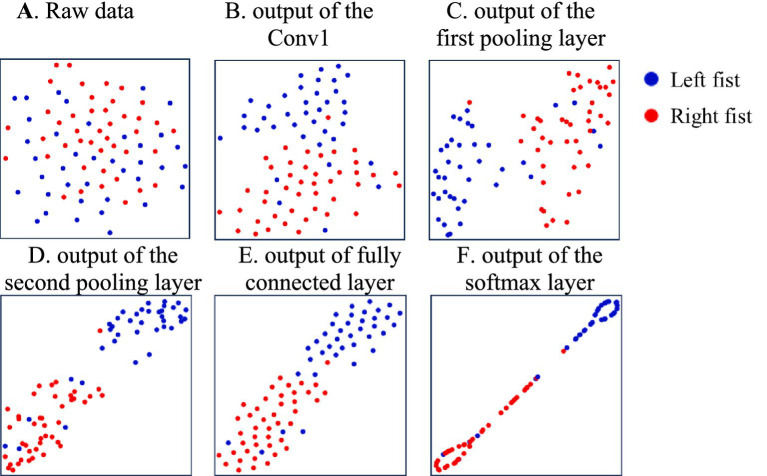
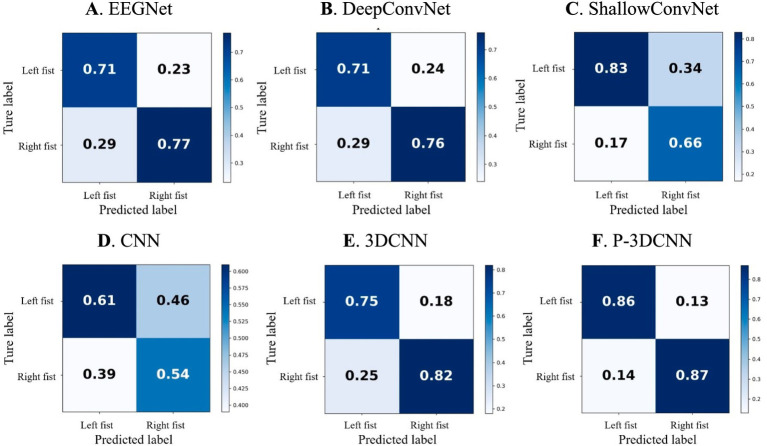
Non-invasive brain-computer interfaces (BCI) hold great promise in the field of neurorehabilitation. They are easy to use and do not require surgery, particularly in the area of motor imagery electroencephalography (EEG). However, motor imagery EEG signals often have a low signal-to-noise ratio and limited spatial and temporal resolution. Traditional deep neural networks typically only focus on the spatial and temporal features of EEG, resulting in relatively low decoding and accuracy rates for motor imagery tasks. To address these challenges, this paper proposes a 3D Convolutional Neural Network (P-3DCNN) decoding method that jointly learns spatial-frequency feature maps from the frequency and spatial domains of the EEG signals. First, the Welch method is used to calculate the frequency band power spectrum of the EEG, and a 2D matrix representing the spatial topology distribution of the electrodes is constructed. These spatial-frequency representations are then generated through cubic interpolation of the temporal EEG data. Next, the paper designs a 3DCNN network with 1D and 2D convolutional layers in series to optimize the convolutional kernel parameters and effectively learn the spatial-frequency features of the EEG. Batch normalization and dropout are also applied to improve the training speed and classification performance of the network. Finally, through experiments, the proposed method is compared to various classic machine learning and deep learning techniques. The results show an average decoding accuracy rate of 86.69%, surpassing other advanced networks. This demonstrates the effectiveness of our approach in decoding motor imagery EEG and offers valuable insights for the development of BCI.
非侵入式脑机接口(BCI)在神经康复领域具有巨大潜力。它们易于使用且无需手术,特别是在运动想象脑电图(EEG)领域。然而,运动想象EEG信号通常具有低信噪比以及有限的空间和时间分辨率。传统的深度神经网络通常只关注EEG的空间和时间特征,导致运动想象任务的解码率和准确率相对较低。为应对这些挑战,本文提出一种三维卷积神经网络(P-3DCNN)解码方法,该方法从EEG信号的频率和空间域联合学习空间频率特征图。首先,使用韦尔奇方法计算EEG的频段功率谱,并构建表示电极空间拓扑分布的二维矩阵。然后通过对时间EEG数据进行三次插值生成这些空间频率表示。接下来,本文设计一个具有一维和二维卷积层串联的3DCNN网络,以优化卷积核参数并有效学习EEG的空间频率特征。还应用批量归一化和随机失活来提高网络的训练速度和分类性能。最后,通过实验将所提出的方法与各种经典机器学习和深度学习技术进行比较。结果显示平均解码准确率为86.69%,超过其他先进网络。这证明了我们的方法在解码运动想象EEG方面的有效性,并为BCI的发展提供了有价值的见解。