Ong Shun Seng, Tang Ting, Xu Lianjie, Xu Canwei, Li Qi, Deng Xiaoyue, Shen Peihua, Chen Yi, Song Yang, Lu Hai, Fang Ling
Department of Traditional Chinese Medicine, Nanjing Drum Tower Hospital, Clinical College of Nanjing University of Chinese Medicine, Nanjing, China.
Department of Chinese Medicine, The Affiliated Taizhou's People Hospital of Nanjing Medical University, Taizhou, China.
Front Med (Lausanne). 2024 Dec 11;11:1482066. doi: 10.3389/fmed.2024.1482066. eCollection 2024.
Functional Constipation (FC) is a common gastrointestinal disorder that imposes a considerable strain on global health. It negatively impacts the quality of life and results in significant healthcare expenditures. Current treatments, such as lifestyle changes and medications, fail to meet patient satisfaction due to efficacy and safety issues. Electroacupuncture (EA), with its precise stimulation control and standardized protocols, shows promise in FC management. However, optimal EA parameters for FC treatment are yet to be established. Our study reviews EA applications in FC to inform a standardized treatment approach and explore EA's therapeutic mechanisms.
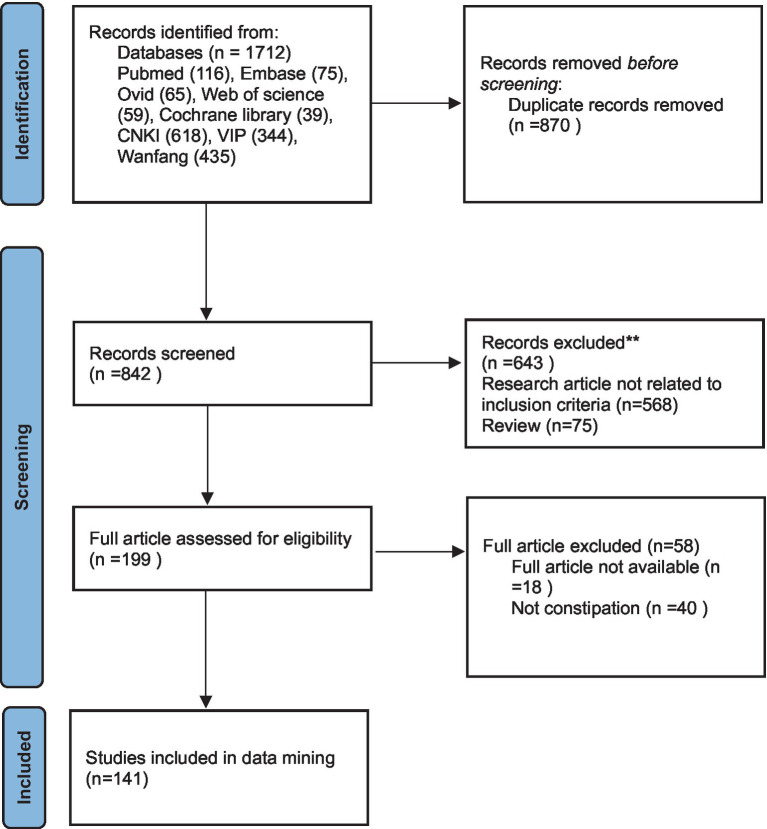
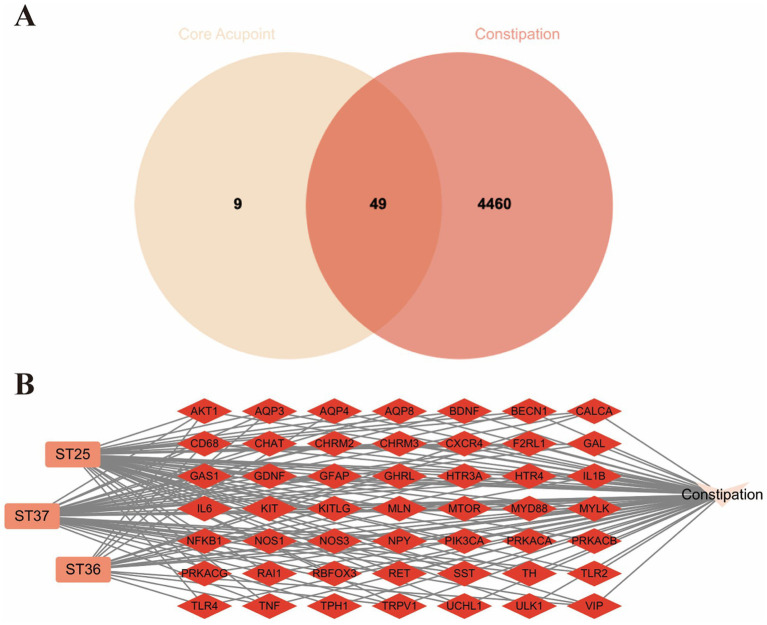
This comprehensive study utilized research literature from databases including PubMed, Embase, OVID, Web of Science, the Cochrane Library, CNKI, VIP, and Wanfang to perform a descriptive analysis of acupoint selection and EA parameters. It proceeded to analyze high-frequency acupoint groupings and stimulus parameters, followed by the excavation and analysis of core acupoint prescriptions. Subsequent steps integrated potential target identification for these core formulas, the assembly of a "core acupoint-prescription-target-constipation" network, and the construction of a protein-protein interaction (PPI) network to extract central targets. Additionally, Gene Ontology (GO) and KEGG enrichment analyses were conducted to prognosticate the underlying mechanisms by which EA may exert its therapeutic effects on FC.
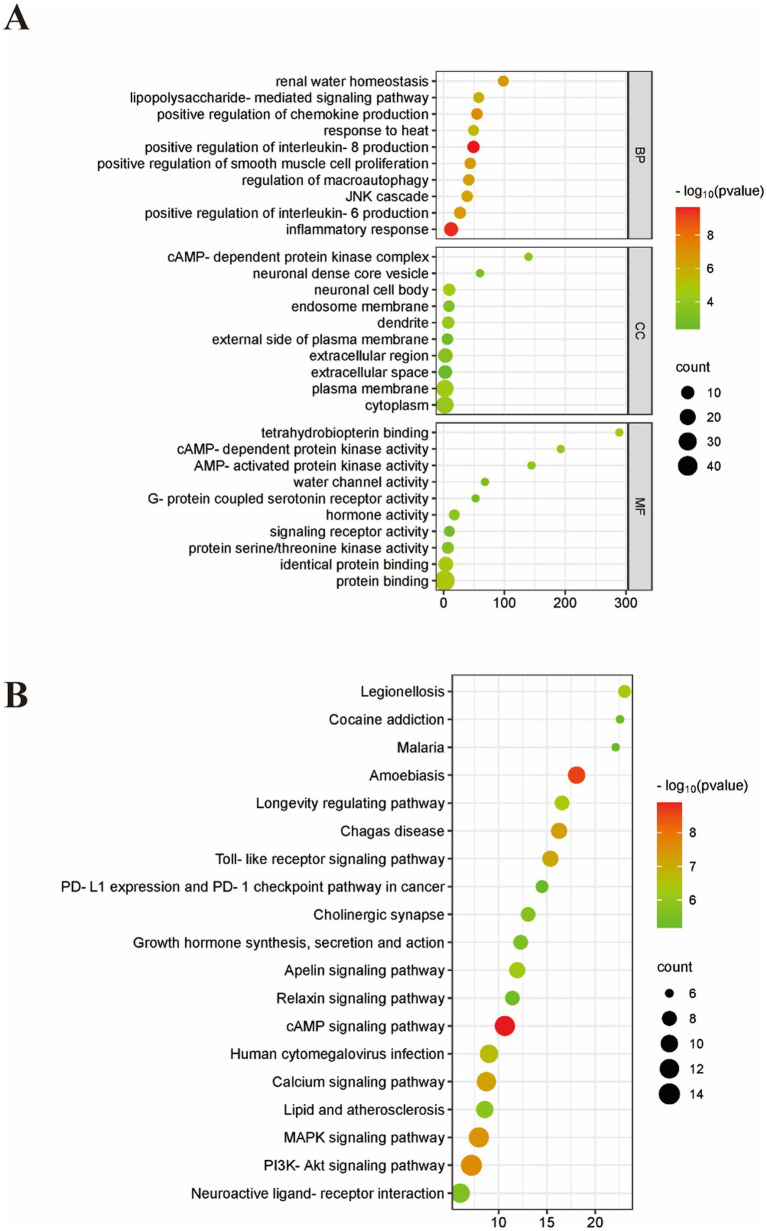
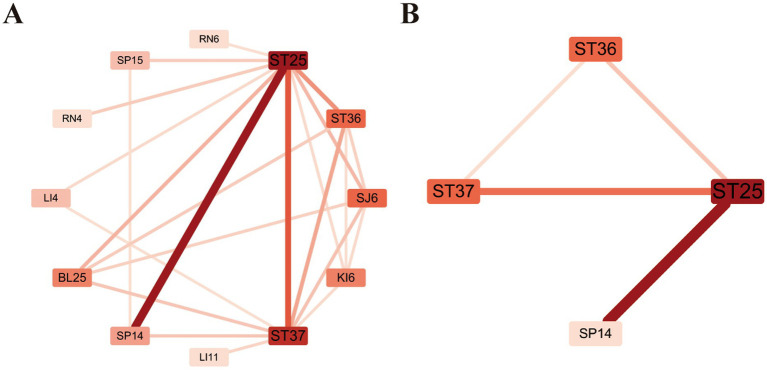
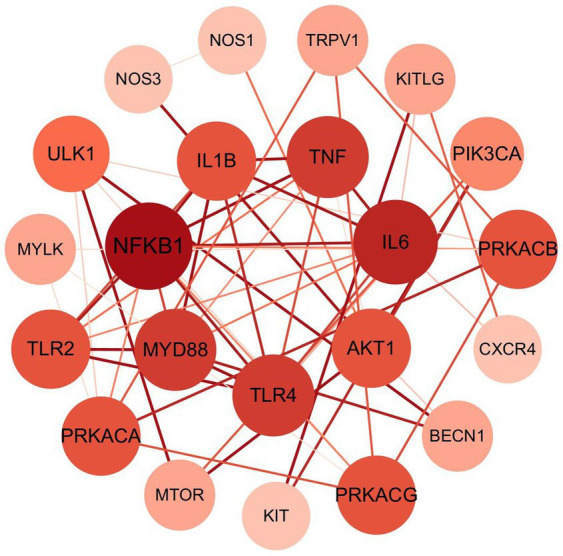
In our study, we analyzed 141EA prescriptions for FC and identified a core set of acupoints including Tianshu (ST25), Fujie (SP14), Shangjuxu (ST37), and Zusanli (ST36) through data mining. The frequency of use was highest for Tianshu (ST25) with 119 occurrences, followed by Fujie (SP14) with 59, Shangjuxu (ST37) with 42, and Zusanli (ST36) with 23. PPI network analysis revealed key targets such as NFKB1, IL6, MyD88, TLR4, TNF, TLR2, and IL1B. GO and KEGG analyses of 49 constipation-associated targets identified 257 BP, 37 CC, and 41 MF terms, and 154 significant pathways, with the top 20 visualized for further analysis.
The core acupoint prescription of EA for FC can exert its therapeutic effects by acting on multiple targets and pathways synergistically especially on NFKB1, IL6, MyD88, TLR4, TNF, TLR2, and IL1B. The research findings have preliminarily validated the fundamental effects and related mechanisms of EA parameters and core prescriptions, providing direction for further in-depth exploration of the mechanisms of action.
功能性便秘(FC)是一种常见的胃肠道疾病,给全球健康带来了相当大的负担。它对生活质量产生负面影响,并导致大量医疗支出。由于疗效和安全性问题,目前的治疗方法,如生活方式改变和药物治疗,未能达到患者满意度。电针(EA)凭借其精确的刺激控制和标准化方案,在FC管理中显示出前景。然而,FC治疗的最佳EA参数尚未确定。我们的研究回顾了EA在FC中的应用,以提供标准化的治疗方法,并探索EA的治疗机制。
这项综合性研究利用了来自PubMed、Embase、OVID、Web of Science、Cochrane图书馆、CNKI、VIP和万方等数据库的研究文献,对穴位选择和EA参数进行描述性分析。接着分析高频穴位组合和刺激参数,随后挖掘和分析核心穴位处方。后续步骤整合了这些核心配方的潜在靶点识别、“核心穴位 - 处方 - 靶点 - 便秘”网络的构建以及蛋白质 - 蛋白质相互作用(PPI)网络的构建,以提取核心靶点。此外,进行了基因本体(GO)和KEGG富集分析,以预测EA可能对FC发挥治疗作用的潜在机制。
在我们的研究中,我们分析了141个FC的EA处方,并通过数据挖掘确定了一组核心穴位,包括天枢(ST25)、腹结(SP14)、上巨虚(ST37)和足三里(ST36)。天枢(ST25)的使用频率最高,出现119次,其次是腹结(SP14)59次、上巨虚(ST37)42次、足三里(ST36)23次。PPI网络分析揭示了关键靶点,如NFKB1、IL6、MyD88、TLR4、TNF、TLR2和IL1B。对49个便秘相关靶点的GO和KEGG分析确定了257个生物学过程(BP)、37个细胞组分(CC)和41个分子功能(MF)术语,以及154条显著通路,可视化了前20条通路以进行进一步分析。
FC的EA核心穴位处方可通过协同作用于多个靶点和通路发挥治疗作用,尤其是作用于NFKB1、IL6、MyD88、TLR4、TNF、TLR2和IL1B。研究结果初步验证了EA参数和核心处方的基本作用及相关机制,为进一步深入探索作用机制提供了方向。