Cho Heejung, Park Ji Yeon, Kim Duck Hyun, Han JiWon, Natesan Karthi, Choi Min-Seon, Lee Seon-Kyeong, Kim Jiseon, Cho Kun, Ahn Byoung Ohg
Genomics Division, National Institute of Agricultural Sciences, Rural Development Administration, Jeonju, Republic of Korea.
Digital Omics Research Center, Korea Basic Science Institute (KBSI), Cheongju, Republic of Korea.
Front Plant Sci. 2024 Dec 11;15:1488553. doi: 10.3389/fpls.2024.1488553. eCollection 2024.
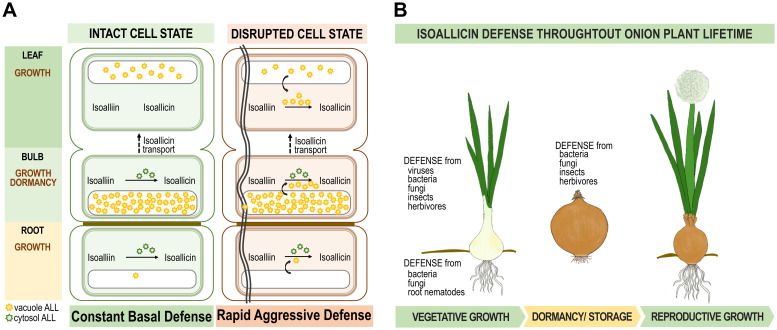
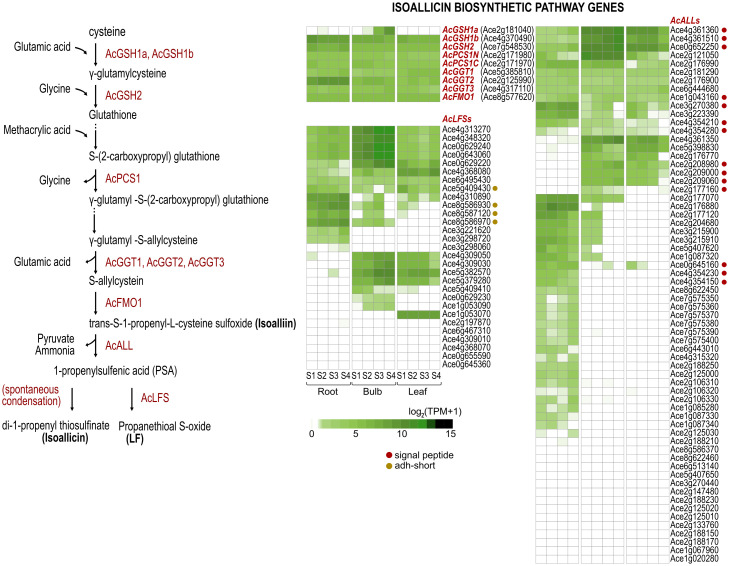
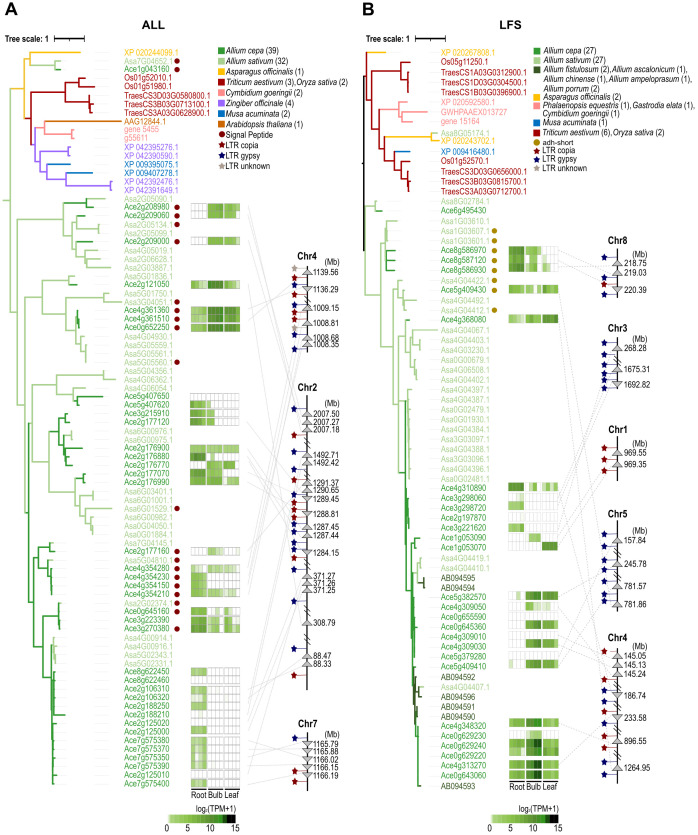
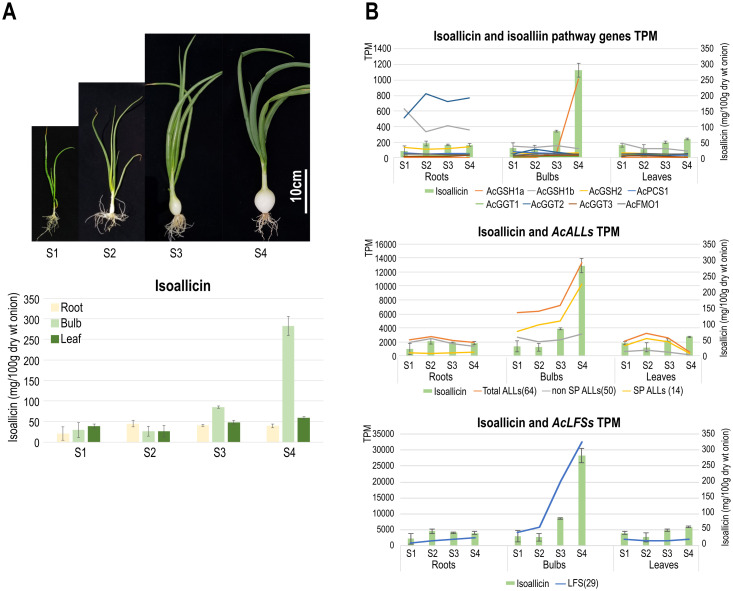
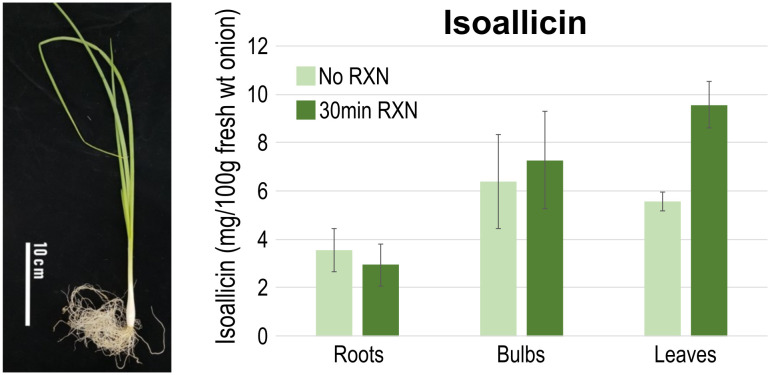
Onion ( L.) is an important seasoning vegetable worldwide. It belongs to the Allium genus, which produces distinctive flavor compounds, allicin/isoallicin. It has been known that allicin/isoallicin is produced upon cell damage by vacuole-localized alliinase releasing. Pungent isoallicin and lachrymaroty factor (LF) are unique features of onions. To understand the isoallicin system of onions, we identified and characterized the biosynthesis-related genes by displaying transcriptional profiles and analyzing the isoallicin contents of onion plants. The DHW30006 onion genome encoded 64 alliinase (ALL) and 29 LF synthase (LFS) proteins, which are the key enzymes for producing of isoallicin and LF. Interestingly, when we analyzed the N-terminal signal peptide sequences (SP) necessary for transport to the vacuole, we found that 14 ALLs contained the SP (SP-ALL) and 50 ALLs did not (non-SP-ALL). We hypothesized that non-SP-ALLs stayed in the cytosol of onion cells, reacted with isoalliin, and generated isoallicin without cell damage. Our transcriptome and LC-MS/MS analyses reveal that isoallicin levels vary significantly across onion tissues and growth stages, with substantial production occurring in intact cells through cytosolic alliinases and an increase through vacuolar alliinases upon tissue disruption. This novel observation suggests that the isoallicin system in onions functions as a dual-defense mechanism: cytosolic alliinases maintain a constant level of defense against biotic stress in undamaged tissues, while vacuolar alliinases enhance isoallicin production in response to tissue damage by herbivory and insects. Together, these coordinated mechanisms demonstrate an adaptable and dynamic defense strategy against biotic stresses in Allium plants.
洋葱(L.)是全球重要的调味蔬菜。它属于葱属,能产生独特的风味化合物,即蒜素/异蒜素。已知蒜素/异蒜素是在液泡定位的蒜氨酸酶释放导致细胞损伤时产生的。辛辣的异蒜素和催泪因子(LF)是洋葱的独特特征。为了解洋葱的异蒜素系统,我们通过展示转录谱和分析洋葱植株的异蒜素含量,鉴定并表征了生物合成相关基因。DHW30006洋葱基因组编码64种蒜氨酸酶(ALL)和29种LF合成酶(LFS)蛋白,它们是产生异蒜素和LF的关键酶。有趣的是,当我们分析转运至液泡所需的N端信号肽序列(SP)时,发现14种ALL含有SP(SP-ALL),50种ALL不含SP(非SP-ALL)。我们推测非SP-ALL留在洋葱细胞的细胞质中,与异蒜氨酸反应,在无细胞损伤的情况下产生异蒜素。我们的转录组和液相色谱-串联质谱分析表明,异蒜素水平在洋葱组织和生长阶段间差异显著,完整细胞通过细胞质蒜氨酸酶大量产生异蒜素,组织破坏时液泡蒜氨酸酶使其增加。这一新颖的观察结果表明,洋葱中的异蒜素系统起到双重防御机制作用:细胞质蒜氨酸酶在未受损组织中维持对生物胁迫的恒定防御水平,而液泡蒜氨酸酶则在食草动物和昆虫造成组织损伤时增强异蒜素的产生。总之,这些协调机制展示了葱属植物针对生物胁迫的一种适应性动态防御策略。