Gill Harmeet, Patel Neel, Naik Nishthaben, Vala Lovekumar, Rana Rishabh K, Jain Sakshi, Sirekulam Vaishnavi, Jain Shika M, Khan Tanzina, Kinthada Sudharani, Patel Rashi B, Nanjundappa Athmananda, Siripuram Chandu, Patel Urvish
Department of Medicine, HopeHealth, Florence, SC, USA.
Department of Medicine, MBBS Medical Student, GMERS Medical College Gotri, Vadodara, Gujarat, India.
J Family Med Prim Care. 2024 Nov;13(11):4783-4796. doi: 10.4103/jfmpc.jfmpc_654_24. Epub 2024 Nov 18.
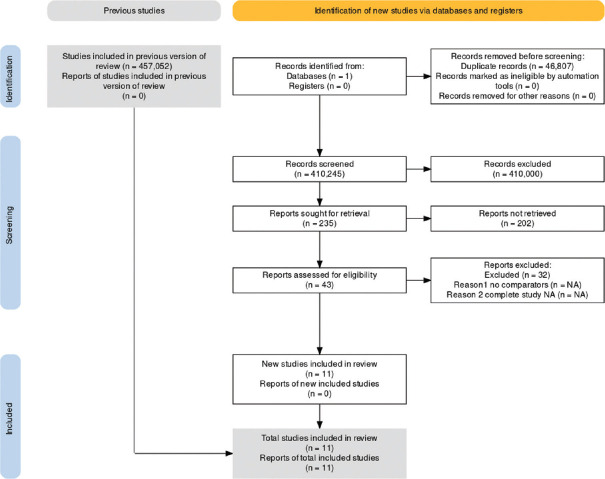
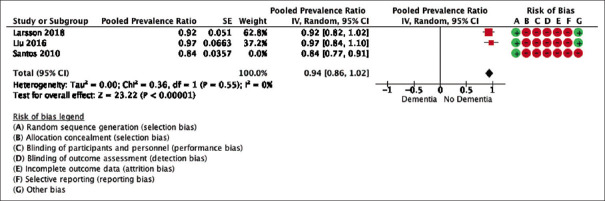
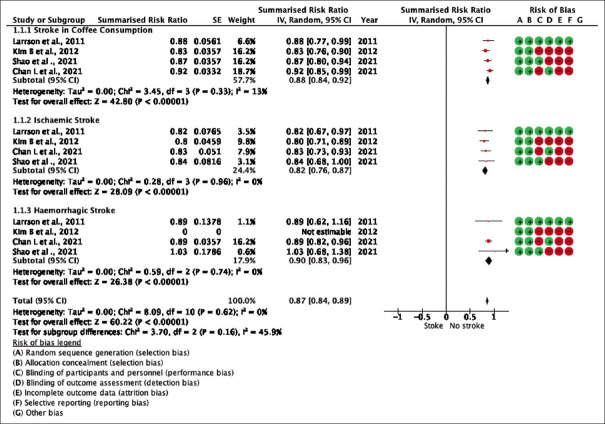
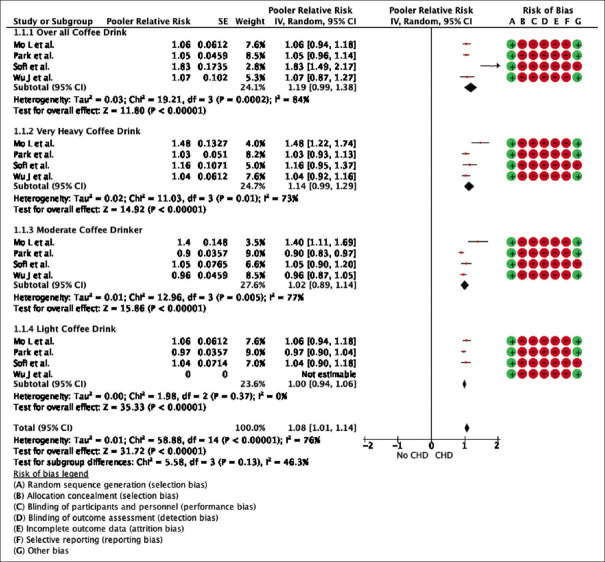
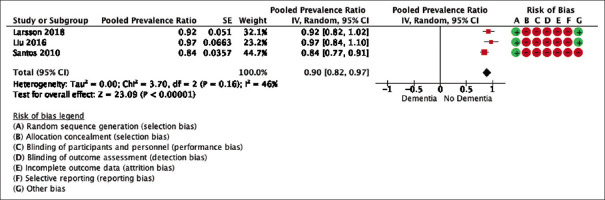
Coffee has long been popular worldwide. The rise in lifestyle-related diseases such as cardiovascular disease, diabetes, stroke, dementia, and others has motivated coffee usage and illness prevalence studies. Some studies show coffee consumers are at risk for such diseases, whereas others show its active components protect them. Policymakers and the public need a comprehensive umbrella review to make healthy choices and enjoy coffee. Coffee consumption and stroke, CHD, and dementia outcomes have been distinguished using the PICO search strategy in PubMed with a filter for meta-analysis. We included 10 years of investigations until October 2023. MeSH terms "coffee intake," "stroke, dementia," and "transient ischemic attack," comparing stroke risk with coffee consumption were used. The study excluded case reports and non-human, non-English observational research. The stroke risk of coffee was examined using RevMan software. Coffee consumption's stroke risk ratio (RR), 95% CI, and I2 were estimated. Forest plots with values ≤ 0.05 are significant. The umbrella review includes 11 meta-analyses from 457052 papers, totalling 11.96 million individuals. Drinking up to 4 cups of coffee daily reduced stroke risk by 12% compared with not drinking any coffee (0.88 (CI of 0.84-0.92, I2 of 13%, < 0.00001)). Coffee drinkers had a 1.19 risk ratio for cardiovascular diseases compared to non-coffee drinkers (CI: 0.99-1.38, I2 = 84%, < 0.00001). The dementia risk ratio for caffeine users was 0.90 (95% CI: 0.82-0.97, I2 = 46%, < 0.00001) compared with non-consumers. Our analysis covering 5.42 million individuals found that 4 cups of coffee consumed a day reduced stroke risk by 12%. Coffee may reduce ischemic and haemorrhagic strokes by preserving endothelium and antioxidants. Coffee may lessen dementia risk, according to our study's 0.94 pooled risk ratio after sensitivity analysis. Heavy coffee drinkers had a greater CHD risk, as per our findings. Heavy coffee drinkers were more at risk.
咖啡长期以来在全球都很受欢迎。心血管疾病、糖尿病、中风、痴呆症等与生活方式相关疾病的增多,促使人们开展了关于咖啡饮用与疾病患病率的研究。一些研究表明,喝咖啡的人有患此类疾病的风险,而另一些研究则表明咖啡中的活性成分能保护他们。政策制定者和公众需要一份全面的综述来做出健康的选择并享用咖啡。在PubMed中使用PICO检索策略并设置荟萃分析过滤器,对咖啡消费与中风、冠心病和痴呆症结果进行了区分。我们纳入了截至2023年10月的10年调查。使用了医学主题词“咖啡摄入量”“中风、痴呆症”和“短暂性脑缺血发作”,比较咖啡消费与中风风险。该研究排除了病例报告以及非人类、非英文的观察性研究。使用RevMan软件检查了咖啡的中风风险。估计了咖啡消费的中风风险比(RR)、95%置信区间(CI)和I²。I²值≤0.05的森林图具有显著性。该综述包括来自457052篇论文的11项荟萃分析,共计1196万人。与不喝咖啡相比,每天饮用多达4杯咖啡可使中风风险降低12%(0.88(CI为0.84 - 0.92,I²为13%,P < 0.00001))。与不喝咖啡的人相比,喝咖啡的人心血管疾病的风险比为1.19(CI:0.99 - 1.38,I² = 84%,P < 0.00001)。与不喝咖啡的人相比,咖啡因饮用者患痴呆症的风险比为0.90(95% CI:0.82 - 0.97,I² = 46%,P < 0.00001)。我们涵盖542万人的分析发现,每天饮用4杯咖啡可使中风风险降低12%。咖啡可能通过保护内皮和抗氧化剂来降低缺血性和出血性中风的风险。根据我们研究在敏感性分析后得出的0.94合并风险比,咖啡可能会降低患痴呆症的风险。根据我们的研究结果,大量饮用咖啡的人患冠心病的风险更高。大量饮用咖啡的人风险更大。