Kızıltepe Melih, Oguz Kokoglu Emel, Kaplan Huseyin, Sas Senem, Kahraman Denizhan Tugba, Cengiz Celil B, Senel Abdurrahman S
Division of Rheumatology, Department of Internal Medicine, Erciyes University Faculty of Medicine, Kayseri, TUR.
Division of Rheumatology, Department of Physical Medicine and Rehabilitation, Erciyes University Faculty of Medicine, Kayseri, TUR.
Cureus. 2024 Nov 25;16(11):e74390. doi: 10.7759/cureus.74390. eCollection 2024 Nov.
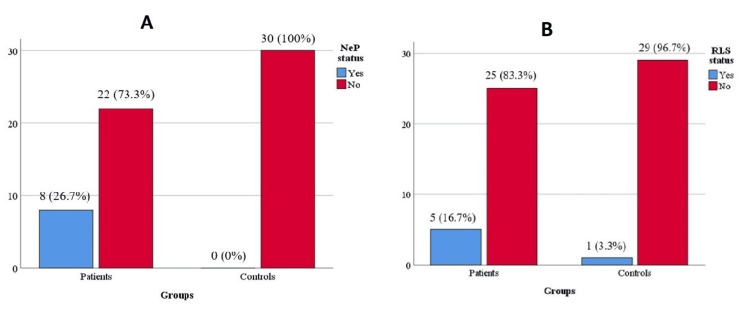
Objective This study aims to investigate the frequency of restless leg syndrome (RLS) and neuropathic pain (NeP) and their effects on the quality of life (QoL) of patients with anti-neutrophil cytoplasmic antibody-associated vasculitis (AAV). Methods The study included 30 patients with AAV and 30 healthy volunteers. Demographic and clinical parameters and laboratory data were recorded. International criteria were used for the diagnosis of RLS, the Douleur-Neuropathique-4 questionnaire for NeP, and the Short Form-36 (SF-36) questionnaire to assess the QoL. AAV patients were subdivided according to NeP (with and without NeP) and RLS (with and without RLS) status. The recorded data were compared between patients and controls and between subgroups of patients. Results Although there was a proportional difference in RLS incidence between patients with AAV and healthy controls, this difference was not statistically significant (16.7% vs. 3.3%; p=0.195). Data regarding the comparison of demographic, clinical, and laboratory findings and Birmingham vasculitis activity score did not exhibit significant differences between the RLS and control groups, respectively. The prevalence of NeP was significantly higher in the AAV group than in the control group (26.7% vs. 0%, p=0.005). Furthermore, when QoL analysis was done in both groups, general health (p=0.001) and SF-36-MCS (p=0.021) scores were significantly lower in the AAV with NeP than without NeP. Conclusion This study showed that NeP was more common in the AAV group than in healthy controls. In addition, some sub-components of QoL were worse in those with NeP than in those without NeP. However, the AAV was negatively associated with NeP and QoL rather than RLS. Caution should be exercised with regard to NeP in AAV, especially in patients with permanent organ damage.
目的 本研究旨在调查抗中性粒细胞胞浆抗体相关性血管炎(AAV)患者中不宁腿综合征(RLS)和神经性疼痛(NeP)的发生率及其对生活质量(QoL)的影响。方法 本研究纳入30例AAV患者和30名健康志愿者。记录人口统计学和临床参数以及实验室数据。采用国际标准诊断RLS,使用神经病理性疼痛-4问卷评估NeP,并使用简明健康调查问卷(SF-36)评估QoL。AAV患者根据NeP(有和无NeP)和RLS(有和无RLS)状态进行细分。比较患者与对照组以及患者亚组之间记录的数据。结果 虽然AAV患者与健康对照组之间RLS发生率存在比例差异,但该差异无统计学意义(16.7%对3.3%;p=0.195)。RLS组与对照组在人口统计学、临床和实验室检查结果以及伯明翰血管炎活动评分的比较数据中,分别未显示出显著差异。AAV组中NeP的患病率显著高于对照组(26.7%对0%,p=0.005)。此外,对两组进行QoL分析时,伴有NeP的AAV患者的总体健康(p=0.001)和SF-36-精神健康分量表(MCS)评分(p=0.021)显著低于无NeP的患者。结论 本研究表明,NeP在AAV组中比在健康对照组中更常见。此外,伴有NeP的患者的QoL的一些子成分比无NeP的患者更差。然而,AAV与NeP和QoL呈负相关,而非与RLS。对于AAV中的NeP应予以关注,尤其是在有永久性器官损伤的患者中。