Sohrabi Masoudreza, Gholami Ali, Hassanzadeh Parvin, Hatami Sara, Ajdarkosh Hosein, Zamani Farhad, Doustmohammadian Azam
Gastrointestinal and Liver Diseases Research Center, Iran University of Medical Sciences, Tehran, Iran.
Noncommunicable Diseases Research Center, Neyshabur University of Medical Sciences, Neyshabur, Iran.
BMC Cancer. 2024 Dec 26;24(1):1577. doi: 10.1186/s12885-024-13347-7.
Poor sleep quality is one of the prevalent manifestations experienced by cancer patients. There is a lack of research focusing specifically on sleep quality and affecting factors in Gastrointestinal (GI) cancer patients. This study aimed to assess the potential interaction between dietary, comorbid conditions, demographic, and socioeconomic determinants of sleep quality in GI cancer patients.
In a cross-sectional study, the Pittsburg Sleep Quality Index (PSQI) was completed for 875 adult patients suffering from GI cancer in a referral hospital. We conducted structural equation modeling analyses to evaluate the potential interaction between dietary and socioeconomic determinants of sleep quality in GI cancer patients.
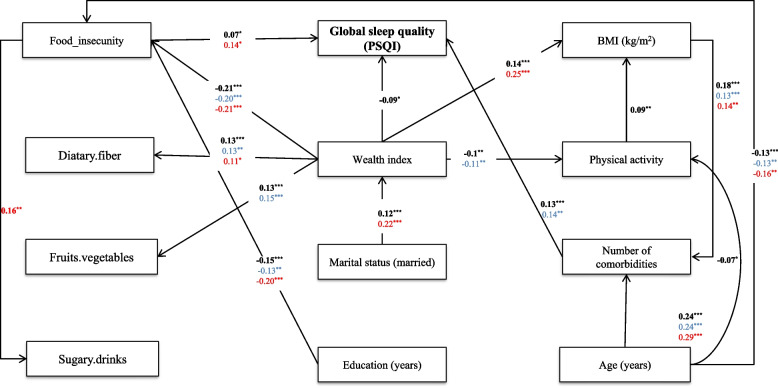
This study demonstrated that the PSQI encompasses two factors (perceived sleep quality and sleep disturbances) in GI cancer patients in Iran. Based on the standardized coefficients for the structural paths, the wealth index (WI) partially mediated the effect of food insecurity (FI) on the sleep quality index. There was a direct predictive effect of the WI on the PSQI (β = 0.10, P = 0.01). In addition, WI indirectly through FI (effect of WI on FI: β = -0.21, P = 0.01 & effect of FI on PSQI: β = 0.07, P = 0.03) had a negative effect on PSQI. Our finding suggested the full mediation effect of age on PSQI through the number of comorbidities (effect of age on number of comorbidities: β = 0.25, P < 0.001 & the effect of number of comorbidities on PSQI: β = 0.13, P < 0.001). Structural path outputs for gender-model indicated the full mediation effect of age on PSQI through the number of comorbidities among males and through the FI among females.
These findings highlight the importance of considering the bi-dimensional construct of the PSQI for assessing sleep quality among GI cancer patients. The current study demonstrated that food insecurity and comorbidity prevalence mediated the relationship between socio-demographic determinants of sleep quality in patients with GI cancer.
睡眠质量差是癌症患者常见的表现之一。目前缺乏专门针对胃肠道(GI)癌症患者睡眠质量及其影响因素的研究。本研究旨在评估饮食、合并症、人口统计学和社会经济因素对GI癌症患者睡眠质量的潜在交互作用。
在一项横断面研究中,对一家转诊医院的875名成年GI癌症患者完成了匹兹堡睡眠质量指数(PSQI)评估。我们进行了结构方程模型分析,以评估饮食和社会经济因素对GI癌症患者睡眠质量的潜在交互作用。
本研究表明,在伊朗的GI癌症患者中,PSQI包含两个因素(感知睡眠质量和睡眠障碍)。根据结构路径的标准化系数,财富指数(WI)部分介导了粮食不安全(FI)对睡眠质量指数的影响。WI对PSQI有直接预测作用(β = 0.10,P = 0.01)。此外,WI通过FI间接影响PSQI(WI对FI的影响:β = -0.21,P = 0.01;FI对PSQI的影响:β = 0.07,P = 0.03)。我们的研究结果表明,年龄通过合并症数量对PSQI有完全中介作用(年龄对合并症数量的影响:β = 0.25,P < 0.001;合并症数量对PSQI的影响:β = 0.13,P < 0.001)。性别模型的结构路径输出表明,年龄在男性中通过合并症数量、在女性中通过FI对PSQI有完全中介作用。
这些发现凸显了考虑PSQI的二维结构对评估GI癌症患者睡眠质量的重要性。当前研究表明,粮食不安全和合并症患病率介导了GI癌症患者睡眠质量的社会人口统计学决定因素之间的关系。